Cathead

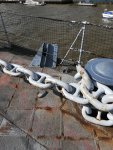
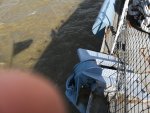
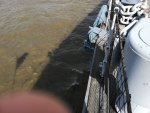
Could this be a modern 'take' on the requirement for a Clump Cathead ...?


48557056626_2806ba0132_b.jpg

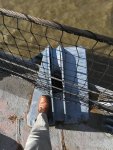
Normal modern arrangement to seat the anchor firmly home. To ride to a buoy, the cable will be broken and the anchor will be hung off as per the much smaller ship in post 13.
 
close up cruiser.jpg

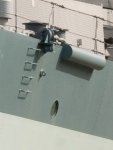
Here's a pic of an anchor suspended from a clump cathead, while the ship id secured to a mooring buoy. Most warships now have a hawsepipe on the centreline for use when secured to a buoy, so that the anchor remains in its normal position.
 
On drilling rigs the drawworks, a very large horizontal drum windlass, has two catheads, break-out and make-up, one on each side. They are basically small horizontal capstans used to raise and then haul tubulars into the well centre on the drill floor, about 45 above ground level as well as pull chains that torque up (make up) or torque out (break out) drill pipe tool joints. I can imagine that a marine design of anchor winch assembly was used in the development of drilling rig drawworks.

Interesting thread.
 
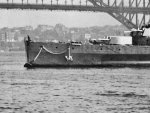
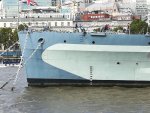
She's the Belfast, pictured in Sydney in '45. Found a closer one of her taken recently, where the fittings are more clearly visible:
View attachment 79830

Pity the poor matelot who has to climb down the side to shackle it on!

Which part was considered the clump cathead, the eye beside the ladder, the fairlead at the deck edge, or its support structure ?? My guess would be the first, probably.

Plomong
 
Please enlighten us, as some of us were only members of non-military "branches" of anything. Yours truly was a member of a telecommunications "branch" of a larger department of a larger ....


Plomong

Well it goes back to the olden days when there was no such thing as sandpaper, and woodwork would be rubbed down by junior ratings of the seamen branch with a piece of wet canvas and sand before painting, hence " sand scratchers".
 
Top