Captive pin shackles vs snap shackles

I had exactly this a few years ago with not enough line to get a good flick going. Persistence and very foul language won in the end. What's the trick?
Extract from an article with pictures I wrote for PBO a few years ago. I do not think that they will object to me posting here after all this time
Since I suggested it I know that a number of Hanse owners have fitted a line to stop the halyard catching.

Halyard Stopper

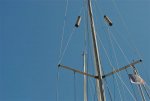
In the first picture one can see that the orange line is hooked around the steaming light on the front of the mast.-Picture 1

Now this is not a problem a one only has to give it a flick & it will disengage itself.

However, If one is about to hoist the mainsail in a rolling sea as one exits Ostend harbour & the bight of the mainsail halyard (the blue line in picture 1 ) goes between the 2 spreaders from aft & hooks around the light it can be a different matter. Worse still if the item is a radar dome or a passive radar reflector. No amount of flicking will release it because the spreaders get in the way. Looking upwards at the sky whilst holding the mast with one hand & flicking the halyard with the other can result in a dangerous dizzy spell for some. Not to mention some rather bad language as a friend of mine recently related.

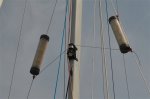
My solution is to fit a line between the 2 shrouds fitted tightly just above my steaming light. This is convenient for me as it also stops my passive reflectors sliding down the shroud. (I have an Echomax on the stern)

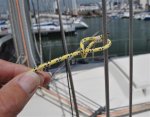
To fit it meant a trip up the mast in a bosuns chair. This does not worry me personally, but -some might not like swinging away from the mast out to the spreader ends. To make this easier I whipped a loop in one end, so I could just loop it over the shroud – picture2. The other end was tied with a couple of rolling hitches & a light seizing added for luck. Now the halyard bight will hit the line but cannot go in front of the mast.-Picture3- Of course one could fit it whilst the mast was lowered. It is just a matter of forward planning!!.
Picture 1 (600 x 393).jpg
Picture 2 (600 x 466).jpg
Picture 3 (600 x 402).jpg
 
My short bit of Dyneema idea works up to a point.

Our main halyard shackle is one with a bar across it so the bit of dyneema is bowlined through that, and comes down the luff for the length of two track slugs.

When the sail is lowered there is enough slack to take the shackle off. This means that the shackle isn’t going anywhere if you do drop it, but you still have to stand on the mast steps to open it.
 
My short bit of Dyneema idea works up to a point.

Our main halyard shackle is one with a bar across it so the bit of dyneema is bowlined through that, and comes down the luff for the length of two track slugs.

When the sail is lowered there is enough slack to take the shackle off. This means that the shackle isn’t going anywhere if you do drop it, but you still have to stand on the mast steps to open it.
I got slightly bothered about this idea. Having once had a burgee stick halyard get caught up in luff slides, jamming them temporarily, I would be cautious about introducing a light line in their vicinity. Not necessarily a problem though.
 
But surely it is so simple just to flick it back. Or do you mean that it goes between 2 spreaders & hooks to something in front of the mast, Such as the steaming light, or radar etc? If you do I can post a very simple solution
It’s not that simple. For a start, I will probably be in the cockpit without a harness but it will be bumpy enough to create a problem going on deck unattached with my wife watching nervously. With my double spreaders it can be quite tricky to flip the halyard (wire) back. It is necessary to give it some extra slack and make it fast in the cockpit, and then I will need to be fairly well outboard when doing the flipping.

Getting the halyard caught round the steaming light is not really a risk, and I have no blipper or radar on the mast. I did get the halyard caught round the blipper inside the cap shrouds on my last boat, and that is much harder to deal with. My method was to attach a heavy bucket and a light control line to the halyard shackle, raise it to the cross-tree, then lower it ahead of the mast, flip it round the blipper, and raise it again before recovering it with the help of the control line. This happened a couple of times and I was able to recover it while on the move.
 
I got slightly bothered about this idea. Having once had a burgee stick halyard get caught up in luff slides, jamming them temporarily, I would be cautious about introducing a light line in their vicinity. Not necessarily a problem though.

Yes, you have a point. I used a bit of small and very hard Dyneema hoping that it would not start a love affair with the track slugs (we have a Strongtrack, which is wonderful) but yes, there is a risk.

I wish I could think of a way of not climbing onto those mast steps to get to the shackle.
 
Yes, you have a point. I used a bit of small and very hard Dyneema hoping that it would not start a love affair with the track slugs (we have a Strongtrack, which is wonderful) but yes, there is a risk.

I wish I could think of a way of not climbing onto those mast steps to get to the shackle.
Buy a smaller boat?
Surely any boat over 45 feet (and most over 40 feet) will need mast steps for anybody less than 6’6” tall to comfortably reach the head of a sail on sliders - whether to remove a halyard or put on the front piece of the sail cover. But going up on a few fold out mast steps is a dawdle, easier than climbing the companionway on many boats, and often stop to take a photo of the anchorage at the same time.
Bit different on a J Class - where I noticed they kept 2 bosuns chairs permanently rigged at the mast, and needed one of these to reach the head of the sail (but again a dawdle for these guys, who often put a wind spotter high up in the rig).
 
Buy a smaller boat?
Surely any boat over 45 feet (and most over 40 feet) will need mast steps for anybody less than 6’6” tall to comfortably reach the head of a sail on sliders - whether to remove a halyard or put on the front piece of the sail cover. But going up on a few fold out mast steps is a dawdle, easier than climbing the companionway on many boats, and often stop to take a photo of the anchorage at the same time.
Bit different on a J Class - where I noticed they kept 2 bosuns chairs permanently rigged at the mast, and needed one of these to reach the head of the sail (but again a dawdle for these guys, who often put a wind spotter high up in the rig).

All true. Another benefit of the gaff rig. I may need to add another fold out step.

I suspect that the previous careful lady owner had crews who were generally younger and fitter than I am. I don’t have a problem as long as I have at least one son on board. ?
 
Top