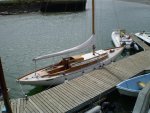
Canoe stern in a following sea.... good..... or bad?

dylanwinter

Well-Known Member
Joined
28 Mar 2005
Messages
12,954
Location
Buckingham
www.keepturningleft.co.uk
I came across some-one suggesting that canoe sterns are a liability in a following sea...

can this be true?


43-launch-day-using-the-break-back-trailer.jpg


http://www.keepturningleft.co.uk/galleries/katie-l-images-for-pbo/
 
Not necessarily bad, nor good. Bit less reserve buoyancy in the stern - theoretically more reluctant to rise to following seas, but it would be a marginal difference I suspect. Less cockpit seating and no stern locker would be a bigger bother.

I'm not convinced by the 'parts the waves' argument, all boats have canoe sterns under the waterline.
 
Its that big gaping hole that the outboard fits in that would worry me.

it is a big hole and you do lose quite a bit of lift I assume

although the way I see it Katie L is really a 21 footer with an extension on the end

strangely enough I bought the boat because I like the hole - although it does look a bit like a cloaca when it is out of the water

http://courses.washington.edu/vertebra/452/photos/amphib/newt_cloaca.jpg

http://www.keepturningleft.co.uk/wp...own-into-clean-flow-and-can-be-vectored-l.jpg
 
Hope it isnt a problem

I haven't tested this in anything really horrid, but in 'normal' bad weather it all seems ok so far.... I usd to sail on Tayana 37, a heavy Robert Perry designed double ender, whose shape was closer to the Hunter, though bigger of course. She was fine in quite big following seas, but again nothing very terrible, thank you very much

Graham
 

Attachments

  • 001.jpg
    001.jpg
    97.3 KB · Views: 0
All traditional Norwegian,Shetland and Viking yachts/ships are, were double enders ie canoe type sterns. Seaworthy and fast in the most hostile sea environment I M H O
 
I came across some-one suggesting that canoe sterns are a liability in a following sea...

Did this person explain their reasoning? The parting of the waves theory that says they are better with breaking waves - they discourage waves to break just astern. Peronally I have never been pooped (also a double ender), but know of a similar boat who has. With less volume in the cockpit perhaps the seriousness of being pooped could be less as well?

Canoe sterns may well be better balanced, and thus easier to steer and more sea kindly, though like the long keel debate, there are many factors at work.
 
When I was young and daft(er) we used to beach launch and recover on shallow North Sea beaches and the canoe stern boat we had was far better returning through any surf than other boats I used.
 
Bit less reserve buoyancy in the stern - theoretically more reluctant to rise to following seas...
That's the point (of being pointed...) - will not be lifted up so fast, or "suddenly" by overtaking breaker as with broad counter, so less prone to be then broached or pitch-poled; not surfing down wave also, feels like being 'sucked down' instead. But it's still form of a counter, as such, overhang, providing some reserve buoyancy aft of hull proper.

The one here looks rather as double ender, not 'canoe' - well, English term may be for both, but here such double-ender is called "spitzgat" (spetsgattad , rudder on sternpost), as something else than "canoe stern". With different behaviour on wave as well.
 
Last edited:
Colin Archers and the old Watson type lifeboats have canoe sterns and they seem to cope with following seas ok.

that is what I figured

good enough for life-boats good enough for me

and boat seems plenty slipery enough compared to the slug

the outboard inside the boat also helps as it stops it coming out of the water yet I can blast the prop wash at the rudder

However, I hope I never have to frighten myself
 
As mentioned the Colin archer lifeboats didn't suffer from being double enders.

I believe Ron holland is at least partly to blame for this myth about them being more vulnerable to seas from astern.
 
I strongly suspect this is *******s.

Canoe sterns have been use on everything from canoes to viking ships, life boats, fishing boats, for hundreds and thousands of years.
the only problems with canoe stern are less space, the boat is longer, more difficult and expensive to build.
Canoes sterns evolved to cope with following seas.
if canoe sterns were a problem in following seas we would be building boats with square bows because canoe bows are a problem in head seas.

You have a realy nice wee boat wich can probably handle seas better than almost any crew.

I have sailed a small boat (Cal 20) with an outboard well. not a problem ocasionaly needed wellies. Its just the same as a self draining cockpit just drains faster.
 
I came across some-one suggesting that canoe sterns are a liability in a following sea...

can this be true?

I love posts like this, has you friend/some-one ever sailed?

He also obviously knows nothing about boats or their design, when I have been offshore with a real heavy following sea give me my Colvic Watson anyday or any other canoe stern design boat for that matter!

Mind that said most do not have a bloody great chunk missing out the stern like the one in the photo !

Mike
 
Many ship's lifeboats were double ended and my old man told me it was because transom sterned boats are more liable to broach due to the flat rear offering a bigger area for a wve to push on, whereas the pointed stern splits the wave.
 
But a canoes stern may be a liability in following sea. Depends on hull shape, buoyancy distribution etc. It's the boat that counts, not the fact that it comes to the point :)
The boat shown is not looking "canoe stern", real example of this term is shown couple posts down, so may be compared.
Canoe stern was often used for slim, fast boats to give them longer easier lines; not necessarily these had good buoyancy aft - some really lacked buoyancy there so could be washed over with wave from astern, 'pooped' I guess is the term?

Pointed construction is a construction idea, stemming from Phoenicians millenia ago, when they built ships as shell of joined planks so they had to join them both ends. So did Normans. Quite different concept from western way of making a stiff framework to give strength and covering with some skin (sometimes skin as such, Celts should know the difference). This is stronger, usually indeed better in taking a breaker from behind, but rest depends on other things.

Speaking of Colin Archers once again I'd add they are not 'canoe'; the name, should anybody want it, is "Spissgatter". Nor were all of them so buoyant at stern, as not every Colin Archer is a lifeboat ;)
Colin Archer's yachts were slimmer and not necessarily pointed, some around UK should know it well: http://upload.wikimedia.org/wikipedia/commons/5/5a/Asgard_Childers_DublinDocks.jpg
 
Last edited:
Top