
Can you help out with advice for my solar regulator installation?

Ravi

Well-Known Member
Joined
18 Jun 2013
Messages
780
Location
NorthEast England ... Greece (Kalamata)
Visit site
Hi. I am afraid that I am on the mooch for help and advice, again.

I am fitting an 80W solar panel to the boat this winter and I am just about to fit the regulator and I have a few questions that I hope someone can answer. If these questions seem very basic (dumb), my apologies. I have picked up bits and pieces of information from the forum and the web and would really appreciate it if someone can tell me if I am on the right track.

On the recommendation of a fellow forum member, I have bought a dual power solar regulator. (10A dual battery solar charge controller / regulator with a remote LCD display and cable for 12/24V batteries). It has one input for the solar and two separate battery 'outputs'. The charger will charge the battery connected to output 1 first and, when it is fully charged, switch to battery #2.

My battery setup is the traditional - 1 x Engine start battery + 1 x Leisure battery with a Battery switch can select either, both or neither battery.

Question 1 - The regulator manual says, in Bold, .... "Note: independent charging assumes that batteries should be electrically isolated from each other, i.e. they should not be connected to the same system." Will this be a problem on the very rare motoring occasions when I have my battery switch set to "Both"?

Question 2 - The regulator has connection points to allow two wires for each battery. These are similar to the brass screw down connections in a domestic plug. Can I use standard domestic or automotive wire? (Heavy duty wire could be a bit of a squeeze to get it into the terminals on the regulator.)

Question 3 - (This is where my lack of knowledge and experience gets really embarrassing.) My batteries are currently connected (only) to the switch. as shown in the photograph. To add the connections to the regulator, is it as simple as popping another ring crimp connector on top of the existing (switch) ring connector and screwing the plastic tap thingie back on?
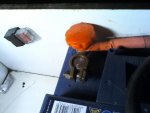
picture of battery connection.jpg

Question 4 - My Googling and reading of forum posts have made me aware that it is advisable to have a fuse between each battery and the regulator. The regulator has a rated load / charge current of 10A, so I was going use a separate 10A fuse between each battery and the regulator. Is that correct?

Question 5 - (Another question of ignorance ).... I am uncertain about what to buy for the inline fuse. I am aware of the cylindrical white plastic inline fuse holders in cars and I believe that you can also get inline holders for blade fuses. Can anyone advise me what type is advisable, if it matters? (All my other boat fuses are 'blade' fuses.)

Any help will be greatly appreciated.
Rav.
 
  1. You have no told us what regulator but I'd not expect any problems.
  2. The wiring size must be large enough to avoid excessive voltage drop. Unless the cable runs are short this means your cables will have to be somewhat larger than ordinary 10amp cable.
  3. Yes it looks that simple.
  4. Yes. Fit the fuses as close as possible to the battery connections.
  5. Check http://www.furneauxriddall.com/acatalog/Blade_Fuses_Holders-p1.html for your fuses and hoders
 
Fuses protect wiring not devices.

I keep reading this phrase on the forum but what does it actually mean?

As an example, UK standard domestic wiring is nominally rated at 13 amps but the fuse in individual devices might be 3 amp or 5 amp or whatever is required according to the current rating of the device. If the fuse were supposed to protect the wiring presumably all devices would have the same fuse?

Why would boats be any different?

Richard
 
  1. You have no told us what regulator but I'd not expect any problems.
  2. The wiring size must be large enough to avoid excessive voltage drop. Unless the cable runs are short this means your cables will have to be somewhat larger than ordinary 10amp cable.
  3. Yes it looks that simple.
  4. Yes. Fit the fuses as close as possible to the battery connections.
  5. Check http://www.furneauxriddall.com/acatalog/Blade_Fuses_Holders-p1.html for your fuses and hoders

Thanks for the info and, especially, the fuse supplier.
1. The regulator is http://www.amazon.co.uk/exec/obidos/ASIN/B006VZ4O8W/ref=ox_ya_os_product

2. The batteries are only 2m apart so the cable runs will be 1m each. So I g.uess, I can afford the fattest cable the chandler wants tosell me.

Thanks, again.
Rav
 
I keep reading this phrase on the forum but what does it actually mean?

As an example, UK standard domestic wiring is nominally rated at 13 amps but the fuse in individual devices might be 3 amp or 5 amp or whatever is required according to the current rating of the device. If the fuse were supposed to protect the wiring presumably all devices would have the same fuse?

Why would boats be any different?

Richard

It protect s the wiring from over heating, burning out and causing a fire in the event of a short circuit.

Branch circuits and individual pieces of equipment should be protected by appropriate smaller fuses .

Your table lamp has 3 amp fuse in its plug because its flex and the bulb holder etc are only rated at 3 amps. Theoretically if the lamp fitting could safely take 13 amps and the flex was 13 amps there would be no objection to the plug being fitted with a 13 amp fuse.
 
Thanks for the info and, especially, the fuse supplier.
1. The regulator is http://www.amazon.co.uk/exec/obidos/ASIN/B006VZ4O8W/ref=ox_ya_os_product

2. The batteries are only 2m apart so the cable runs will be 1m each. So I g.uess, I can afford the fattest cable the chandler wants tosell me.

Thanks, again.
Rav

You need to consider the cable size all the way from the solar panel to the batteries to ensure voltage drop is within accepatable limits . There are many calculators online into which you input the cable length and maximum current to arrive at a suitable cable size.

If the distance from battery to solar panel is more than a metre or so you will find cable greater than the normal rating used on 240 volt circuits will be requred. It can be surprisingly heavy for long cable runs.

The reason its important for 12 volt wiring is that if you only have 12 of them to start with you cannot afford to waste more that a smallish fraction of a volt due to cable resistance. If you have 240 of them it does not matter if you lose a few.
 
Fuses

I keep reading this phrase on the forum but what does it actually mean?

As an example, UK standard domestic wiring is nominally rated at 13 amps but the fuse in individual devices might be 3 amp or 5 amp or whatever is required according to the current rating of the device. If the fuse were supposed to protect the wiring presumably all devices would have the same fuse?

Why would boats be any different? Richard

Firstly boats are not really different. A fuse is fitted to protect from any wiring or part of any device carrying so much current that the wire gets red hot and can cause a fire in adjacent structure from burning insulation or wire.. Now the current a wire can carry depends on its size primarily (hence resistance) its insulation type and its ability to dissipate heat. However essentially most wire sizes have a current rating. This is the max safe current the wire can carry.
Now a fuse is just a small piece of thin wire which is arranged so that it can if overloaded get red hot and melt with no danger of causing a fire.
The fuse is fitted in series with the wiring to be protected. Worst case scenario is a short at the consumer end (appliance end) of the wiring. Thus all current will pass through all the wire so a fuse must be rated for the thinest wire in the short circuit.
So if you have 13 amp wiring in your house protected by 13 amp fuses in the fuse box then all that wiring is protected from incandescing in a short. However if you plug a low powered appliance in with a thin power cord then that cord won't carry the current in a short circuit needed to operate the 13 amp fuse. The answer then is another low current fuse in the plug or the appliance.
Interesting that here in Oz you never see a fuse in a plug where it is common in UK. It is alla question of risk you will accept as related to cost. So an appliance may have a fuse internally. (Especially electronic devices which are prone to short ciircuit in the electronics. ) But the cord going from the plug to the appliance is either made to take 15 amps (the standard in Oz) or we simply take the risk that a metree or 2 of cable will not suffer a short in itself or will not cause a fire if it burns.
Likewise the starter motor wiring in our car or boat uses very heavy wire to reduce volt drop. It is not fused partly becuase the battery may not be able to provide enough current for long enough to cause a fire in overheating this wire or the wire is located such that it may no ignite anything else in getting hot or we simply take the risk. Being robust and firmly mounted it should not suffer a short circuit.
So there is a priinciple for fusing but there are many exceptions to the rules which you may see in real life.
In the case of a solar charging wire. There is usually no risk of the solar power overheating the wire in a short circuit. The wire is almost always larger to reduce volt drop than the panel can provide current. However when we connect this wire to the battery we have the potential for the current to flow in a fault from the battery back into the solar wiring.
Hence unless a diode is fitted at the battery terminal a fuse should be fitted near the terminal to protect the wiring from the panel /controller. Or you can take a risk that the wires won't short or that if they do they won't cause a fire. Not a good reason to take the risk.
good luck olewill
 
You need to consider the cable size all the way from the solar panel to the batteries to ensure voltage drop is within accepatable limits . There are many calculators online into which you input the cable length and maximum current to arrive at a suitable cable size.

Thanks, VicS. I had a play with an online calculator, as you suggested. Very interesting. the "Acceptable Loss" seems to be the most significant factor. For an 8m cable run, it recommends 10mm² for 3% loss but it goes up to 35mm² to achieve 1% loss. (I think I will compromise and go with the 16mm² cable, recommended for 2% loss.)

The general message seems to be to fit the biggest cable possible. Can I ask a further question on this? Is there any merit in putting heavier cable (e.g. 35mm) between the regulator and the batteries (where cabling is along a bulkhead and easy) and using 16mm cable from coach roof to regulator (where there is a headlining / weight issue)? In other words, will the overall resistance of the system be determined by the narrowest cable used or is the overall system resistance an average of the cabling?

The reason its important for 12 volt wiring is that if you only have 12 of them to start with you cannot afford to waste more that a smallish fraction of a volt due to cable resistance. If you have 240 of them it does not matter if you lose a few.
If only my O level physics teacher had explained things in such a visual way, I may not have dropped physics and I could have done pure science!

Thanks.
 
Many owners wire their batteries attaching several wires from (for example) solar panel regulator, mains charger, auto bilge pump, safety alarms, etc.
This is bad practice. If several devices are to be attached to a battery they should be first wired to a bus bar which in turn is wired to the battery using a heavy duty cable. Batteries should only have single cables attached.
 
Many owners wire their batteries attaching several wires from (for example) solar panel regulator, mains charger, auto bilge pump, safety alarms, etc.
This is bad practice. If several devices are to be attached to a battery they should be first wired to a bus bar which in turn is wired to the battery using a heavy duty cable. Batteries should only have single cables attached.

Thanks. It looks like you mean one of these heavyduty jobs....
http://s1137.photobucket.com/user/endurance12/media/BusBar1.jpg.html

I guess that I will need 4. (One for each battery terminal.)

Interestingly, a forumite (who has the same regulator and battery switch setup as me as me) seems to have wired the regulator to the battery switch, rather than the batteries themselves.

Thanks for the advice (and an excuse for another trip to the chandlery!) :-)
 
Thanks, VicS. I had a play with an online calculator, as you suggested. Very interesting. the "Acceptable Loss" seems to be the most significant factor. For an 8m cable run, it recommends 10mm² for 3% loss but it goes up to 35mm² to achieve 1% loss. (I think I will compromise and go with the 16mm² cable, recommended for 2% loss.)

The general message seems to be to fit the biggest cable possible. Can I ask a further question on this? Is there any merit in putting heavier cable (e.g. 35mm) between the regulator and the batteries (where cabling is along a bulkhead and easy) and using 16mm cable from coach roof to regulator (where there is a headlining / weight issue)? In other words, will the overall resistance of the system be determined by the narrowest cable used or is the overall system resistance an average of the cabling?


If only my O level physics teacher had explained things in such a visual way, I may not have dropped physics and I could have done pure science!

Thanks.


The overall resistance is the sum of all the individual parts .

The thinner the wire the higher its resistance and the longer it is the greater the resistance. This means that its long lengths where you most need the thicker wire.

3% is the usual figure taken for acceptable volts drop. but some things are more critical than others. Its important for filament nav lights where volts drop will have a significant effect on the bulbs brightness. Not so for LED because they are driven by electronic circuits which will accept a lower voltage. A VHF radio will probably be sensitive to volts input while other bits of kit will work at much reduced voltages (my old Seafarer echosounder, for example ,which can run off a 9 volt battery) In the general scheme of things volts drop is not all that critical for wiring solar panels. It all still works OK but you get a little less out, a bit like filling the bath with the tap not quite fully open!

BTW some of the online calculators require you to input the total wiring length, ie positive plus negative. Others accept the actual distance of the cable run.

Its important to know what the one you are using requires .... some times they don't tell you ... those are useless. You could end up using cable twice as heavy or only half as heavy as you should!
Personally I am inclined to calculate the volts drop from a table of "ohms per 1000m" for the various cable sizes. I know where I stand then!
 
Its important to know what the one you are using requires .... some times they don't tell you ... those are useless. You could end up using cable twice as heavy or only half as heavy as you should!
Personally I am inclined to calculate the volts drop from a table of "ohms per 1000m" for the various cable sizes. I know where I stand then!
I used
http://www.solar-wind.co.uk/cable-sizing-DC-cables.html
I've just checked and it uses "max length of cable"


The overall resistance is the sum of all the individual parts .

Then, I THINK I'll use the 35mm from the regulator to the batteries (bus bars) and use the biggest practical size above 16mm from the panel to the regulator.
('Think' because these diameters are just numbers to me at the minute and I will need to mooch around electrical stores to discover if 35mm looks like cooker wiring or whether it is the diameter of an elephants leg!)

I appreciate that this is a small installation on a small boat but I am enjoying learning about the subject and I really appreciate the help.

My boat also has 30 amp shore power and a single socket which I have never used so all this advice will be very handy if I ever get around to activating it and adding extra sockets. Before anyone says it, yes! I do know my limitations and I will get a qualified sparky to check out and test the shore power before I use it!

Thanks, yet again, for all the help.
 
I used
http://www.solar-wind.co.uk/cable-sizing-DC-cables.html
I've just checked and it uses "max length of cable"


Then, I THINK I'll use the 35mm from the regulator to the batteries (bus bars) and use the biggest practical size above 16mm from the panel to the regulator.
('Think' because these diameters are just numbers to me at the minute and I will need to mooch around electrical stores to discover if 35mm looks like cooker wiring or whether it is the diameter of an elephants leg!)

I appreciate that this is a small installation on a small boat but I am enjoying learning about the subject and I really appreciate the help.

My boat also has 30 amp shore power and a single socket which I have never used so all this advice will be very handy if I ever get around to activating it and adding extra sockets. Before anyone says it, yes! I do know my limitations and I will get a qualified sparky to check out and test the shore power before I use it!

Thanks, yet again, for all the help.


Yes thats actual cable run length.

I think you are going to have a shock when you compare 35mm² or even 16mm² with domestic cable sizes.


I have just looked back at your original post. You say an 80watt panel... You can look up the tech spec for yourself but I don't think you will get more than 5amps. Probably closer to 4.

Sizing the cable based on 3% volts drop, 5 amps and an 8m run I get AWG 10 which is a little over 5mm²

So I'd go for 6mm² which ITYWF is electric cooker cable size and realistic.
 
Last edited:
Quetion 1 and batteries set to BOTH

Hi Ravi - did you get a definitive answer to your question no. 1 about having the battery banks set to BOTH, when motoring, for example? I ask as I have just ordered one of these controllers and will be in the same situation as you when motoring. I hadn't thought this would be a problem, as assumed (!) that the controller would manage this situation.
 
<retyping as the Internet seems to have stolen my previous reply.
Yes thats actual cable run length.
I think you are going to have a shock when you compare 35mm² or even 16mm² with domestic cable sizes.
;-)


I have just looked back at your original post. You say an 80watt panel... You can look up the tech spec for yourself but I don't think you will get more than 5amps. Probably closer to 4.

Sizing the cable based on 3% volts drop, 5 amps and an 8m run I get AWG 10 which is a little over 5mm²

So I'd go for 6mm² which ITYWF is electric cooker cable size and realistic.

The regulator is rated at 10 amps and, since I may expand the solar in the future, I might over-spec the inaccessible runs of cabling to save me redoing them. I now realise that 35mm was rather over the top so, I will look at something just over 5mm.

The distances are short on my little boat so it will be a matter of avoiding ugly lumps behind the headlining, rather than weight or spending the kids' inheritance.

Thanks for the excellent advice.

Hi Ravi - did you get a definitive answer to your question no. 1 about having the battery banks set to BOTH, when motoring, for example? I ask as I have just ordered one of these controllers and will be in the same situation as you when motoring. I hadn't thought this would be a problem, as assumed (!) that the controller would manage this situation.

Andy, I haven't had a definitive answer but I PM'ed a forumite (Steve) who has the same controller and he says that the only reason that he uses the battery switch, rather than the batteries themselves, is tidiness and his own particular battery wiring configuration.
I work out that wiring the controller to the switch would still mean that the batteries are in a 'single circuit' when the switch is on 'both'.

So, no, I haven't had a definitive answer but I am hoping that the lack of warnings means that it will be OK. Here is my thinking .....
If your unit has arrived, you may have seen in the manual, it says "the controller allows setting charging priority for batteries (0%/100%, 10%/90%, 20%/80%, etc), splitting the energy from the solar panels according to priority. "
My plan is to use the 0%/100% option so the controller should only be attempting to charge one battery at a time. (Switching to the leisure battery only when the starter battery is fully charged.)
My thinking is that this should make the fact that the batteries are 'in a single circuit' when the switch is on 'both' irrelevant. The solar will continue to charge the starter battery till it sees a full charge (rather quickly, since the engine will be running!) It can then switch to the leisure battery.
I am going to give it a go, anyway, later in the week. If you don't hear from me, you will know that my fire extinguishers didn't work and I am busy talking to my insurers. ;-)

The controller
 
Info for Andyo and anyone else fittting this dual solar controller. Be ware that the terminals on the controller are quite small and limit the diameter of cable that you can use. As per VicS's sizing recommendation, I have used 6mm wire and Imdon't think the controller will take anything bigger. Just a well that I didn't go out and buy 35mm, as I intended.

Can I also ask a further question? I think that the 10 amp inline fuses only need to be fitted on the red (+) wire (and not the black). I am 99% certain, but reassurance would be appreciated. Thanks.
 
Info for Andyo and anyone else fittting this dual solar controller. Be ware that the terminals on the controller are quite small and limit the diameter of cable that you can use. As per VicS's sizing recommendation, I have used 6mm wire and Imdon't think the controller will take anything bigger. Just a well that I didn't go out and buy 35mm, as I intended.

Can I also ask a further question? I think that the 10 amp inline fuses only need to be fitted on the red (+) wire (and not the black). I am 99% certain, but reassurance would be appreciated. Thanks.


I thought I'd later posted a warning about the terminal size being only 4mm². I found it when I looked at the Beijing EPsolar Technology website.

Obviously got lost in cyberspace somewhere or something interrupted me.

Yes you are right it's only necessary to fuse the + connections
 
Top