
Can I glue Aluminium to make a structural bond?

Puggy

Well-Known Member
Joined
7 May 2007
Messages
390
Location
Hampshire, UK
Visit site
Hi all

A crash gybe yesterday resulted in the main sheet getting wrapped around my Lewmar steering pedestal and ripping it off it's base. Close inspection shows that the column was only secured to the base part by four small sections of tack weld.

My default repair for this is to disconnect the steering, engine controls and wiring, remove the pedestal, and get the join welded both inside and outside all the way around. I fitted the pedestal so I know how to remove it, even though it is a fiddly job.

My question for the experts is: what about using some form of epoxy or similar type of adhesive? Looking at the base of the pedestal, there is quite a good overlap for the adhesive. It would be a much easier repair as I don't have to remove the pedestal, and could get back on the water for next weekend.

Would this work, and if so, what adhesive would I use?

Thanks

Puggy
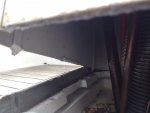
image.jpg
 
Jaguar Landrover use adhesive bonded aluminium for bodywork but a relative who works for them told me that they still use rivets as a backup for critically stressed areas. Can't you add a some self tappers - if you get the pilot holes the correct size they can give a very strong joint, particularly in sheet metal where the metal can deform in a spiral manner around the screw thread.
 
You can only get full strength from metal adhesive with proper surface preparation, cleanliness, low humidity, clamping pressure and temperature control. All those are achievable in a factory, none in a boat. Can you put a hand sized inspection hatch in and bolt it? If you use metal fasteners of any kind, bolts or self tappers, use Duralac to stop corrosion.
 
Hi all

A crash gybe yesterday resulted in the main sheet getting wrapped around my Lewmar steering pedestal and ripping it off it's base. Close inspection shows that the column was only secured to the base part by four small sections of tack weld.

That must have been exciting and sounds like a good scenario for a "What now skipper?" exercise.
 
My default repair for this is to disconnect the steering, engine controls and wiring, remove the pedestal, and get the join welded both inside and outside all the way around.
You know you'll never be happy with anything but welding it.
 
Last edited:
presumably the steering stresses pass up through the pedestal so i personally would weld, as already suggested
However, I expect one of our aeronautical experts might tell you how aeroplanes are glued together ( I do nt mean the wood ones either)
 
I don't see why not. I'm rather out of touch with what structural epoxies are available nowadays, but had great success with Ciba 9000 series in the past. It's been holding a lather together for over 20 years of service now. Make sure you choose a grade which suits the job (materials, gap) and curing conditions (temperature, humidity) and get weaving.

The boot floor of my DS is held in with epoxy too.
 
I don't see why not.

Without taking the pedestal off and to a workshop it will be difficult to get the surfaces cleaned, dry and prepared correctly without which there will be no certainty that it has made a sufficiently strong bond, and if the OP goes to that length then he might as well get it welded. Manufacturing of load bearing joints using adhesives requires this level of detail to achieve the full bond strength. The MAIB Cheeki Rafiki report describes the lengths Beneteau go to to ensure their bonds are correctly made.

It does sound like the pedestal wasn't made particularly well in the first place. I would not have expected a main sheet to have done that sort of damage in a gybe.
 
Last edited:
Without taking the pedestal off and to a workshop it will be difficult to get the surfaces cleaned, dry and prepared correctly without which there will be no certainty that it has made a sufficiently strong bond, and if the OP goes to that length then he might as well get it welded.

Perhaps, though welding is what failed. The big advantages of glue for repairs like this - other than strength - are lack of distortion and no heat damage to finishes.

The MAIB Cheeki Rafiki report describes the lengths Beneteau go to to ensure their bonds are correctly made.

Cheeki Rafiki is perhaps not the best testimonial they could have had for their structural engineering skills. Coming next: the lengths de Havilland went to to ensure that the windows on the Comet were properly made ...

It does sound like the pedestal wasn't made particularly well in the first place. I would not have expected a main sheet to have done that sort of damage in a gybe.

Agreed. Those wee welds look very flimsy.
 
Perhaps, though welding is what failed. The big advantages of glue for repairs like this - other than strength - are lack of distortion and no heat damage to finishes.

It looks like the lack of welding failed. :) To prevent heat distortion when welding aluminum it's common to do non-continuous welds, but that's taking it a bit far.

I was wondering about heat damage to what I presume is powder coating. It will burn off or have to be removed for a considerable distance.

Steering is important to a boat. I'm not sure I would like to trust my steering to an uncertain metal/metal glued joint. No Lotus Elises chassis have fallen apart as far as I'm aware, but doubtless they manufacture them under tight quality control.
 
Last edited:
As Angus said I would bolt it, at least you can rely on it. If you use adhesive in less than perfect contitions you will worry. A small access hatch is not a bad thing to have anyway. Don't scrimp on the duralac.
 
Thanks all for your advice. I think I am going to give gluing a go, I will prep as best I can (abrasion to remove oxide and then clean with acetone, and pick a dry day) and then glue using a purpose made epoxy. I will report back. The way I see it is that I have nothing to lose as if the glue joint fails, I can just clean it up and weld it anyway. But gluing it means I can get the boat back in commission ASAP (I am only fooling about in the Solent so nothing to intrepid). I am doing a major refit later in the season and I will take a view on welding the pedestal if I don't think it is strong enough. I will really pull it about and see if I can break it.

Thanks all

Puggy
 
A decent fillet of epoxy should be pretty strong.
Do a small test piece first and see how strong it is.
I have had good results with epoxy and ali.
I might put chopped glass in as a filler and heat with hot air gun to around 70degC.
Abrade, clean and degrease first.
The hot air will ensure it's dry.
Mask everything, the epoxy will run when warm.
You may need to stop it running out the bottom or whatever.
And make sure you don't epoxy over any screws or whatever.
 
I'm not entirely sure what you are bonding to what in the photo, but if it's the edge of the box with the welds to the frame beneath it with the threaded holes then you are asking for trouble IMHO.

Good structural bonding works face to face rather than edge to face
 
Hi all

A crash gybe yesterday resulted in the main sheet getting wrapped around my Lewmar steering pedestal and ripping it off it's base. Close inspection shows that the column was only secured to the base part by four small sections of tack weld.


Thanks

Puggy

Is the pedestal too old for Lewmar to be interested? Not a good result in the circumstances you describe.....
 
Long term I would go for metal straps fastened with bolts. If I am thrown against the pedestal they would not give way under my weight (73kilos)...
 
That must have been exciting and sounds like a good scenario for a "What now skipper?" exercise.

there was quite a good moment with my father in law holding the now nearly detached pedestal looking at me as if to say "is this normal?". Fortunately I have hopeless zero feedback over geared hydraulic steering (all contributing to said gybe in inexperienced hands) and the pipes are flexible from under the cockpit floor up to the helm and so the steering wasn't compromised. Could have been a lot worse.
 
Top