Can I cross the channel in a Cat C?

Category C

a Category C is for coastal waters, and for wind MAX force 6 and wavehight of MAX 2 m.

(http://www.britishmarine.co.uk/upload_pub/RCD_Boatbuilders_Guide_Apr06.pdf)


A trip passing the Channel means being always within 30-40 miles from shore is in my opinion coastal, so the Category is not the problem.

In the end its upto the captain (you) whether you consider your boat as seaworthy and capable for this trip. In other words good seamanship ??

Enjoy the trip

r
 
We have a Sealine S23 with a single engine, KAD32, and a category C rating. This classes us as inshore I believe.
If we cross to Cherbourg from Weymouth is our boat OK for this?
Would our insurance fail to cover us?
Will we live to tell the tale?
I mean Cherbourg is not much further than Brixham and we survived despite being down to dry biscuits and tonic water.
We rounded Portland Bill, admittedly 7 miles out, so this must count for something.
Do I need a bigger boat?


Sounds like your S23 is tried,tested and proven reliable (by you) . And you have done the equivalent journey along the UK coast. Don't listen to people who harp on about only having a single engine. Plenty of ships out there have one engine.

Go to www.sealineforum.com and you will certainly find experience and advice. Possibly even may find people who would are planning a similar trip.
 
We have a Sealine S23 with a single engine, KAD32, and a category C rating. This classes us as inshore I believe.
If we cross to Cherbourg from Weymouth is our boat OK for this?
Would our insurance fail to cover us?
Will we live to tell the tale?
I mean Cherbourg is not much further than Brixham and we survived despite being down to dry biscuits and tonic water.
We rounded Portland Bill, admittedly 7 miles out, so this must count for something.
Do I need a bigger boat?

I went from Portsmouth to Le Harve in a Bayliner 2651 (23ft hull), you obviously need settled calm weather 1-3 , SW4 in my opinion would be too much, you would get there but wish you hadnt tried.

just check with your Insurance and go in company with a bigger boat who can tow you when you run out of fuel/foul a prop in a shipping lane.

Alderney is closer
 
Last edited:
We have a Sealine S23 with a single engine, KAD32, and a category C rating. This classes us as inshore I believe.
If we cross to Cherbourg from Weymouth is our boat OK for this?
Would our insurance fail to cover us?
Will we live to tell the tale?
I mean Cherbourg is not much further than Brixham and we survived despite being down to dry biscuits and tonic water.
We rounded Portland Bill, admittedly 7 miles out, so this must count for something.
Do I need a bigger boat?
This can be done, and of course you will be more relaxed if you go with someone. In fact, when there is no one in sight, it is quite easy to get a bit nervous as to whether you are really heading for land;). Get a bit of fog/mist and you will wish for another boat. Still, a dead calm day, fine weather, then yes, it is an easy trip. Bit boring, as there isnt much to do, btw.
Remember, you also have to get back again, so have no set dates as you need the weather , not a weekend off work.
There are some big ships out there, so you really do want some good visibility, and then just stay well clear.
Cherbourg is a vast harbour entrance, which is obviously good news, but a pretty dull place.
 
No, the real problem with rcd is that most think it's some sort of rigerous testing system like encap for cars - where each boat is assessed and given a catagory based on performance etc.

The fact is though it isn't. Builders self certify and pay a fee, which is scaled. Class D is the cheapest, then C and so on. Yes for A there are certain criteria as an extra they have to meet, but it's still self cert.

Big manufacturers can put the whole range in as class B (look at bayliner who do this - even their 25 is class B) while smaller or niche manufacturers will go class C or even D - especially if they consider their market to be predominantly inland.

RCD does not even give you a guide to the maximum limits of a boats design as has been suggested, it just gives you the limits as to what was paid for.

I'm going to take issue with that. The whole point of the RCD and other European standards is to provide a level playing field for manufacturers in that a common standard with which manufacturers have to comply applies across the whole of the EU market. In that sense it enables trade and assists manufacturers to export to other EU markets. I am old enough to remember how things were prior to the EU Directives for common standards and it was a nightmare for manufacturers because every EU country had their own standards, often very different from other EU countries. Typically, the French in particular were very adept at dreaming up standards and enforcing them in such a way as to protect their own industry from imported goods. As I say it was extremely difficult and costly for manufacturers to modify their products to suit every different EU market. The RCD and other directives like it have made it far easier and cheaper for manufacturers to export to other EU countries and this is one of the success stories of the EU.
As for self certification, that takes place in every industry but it is not universal. Some manufacturers do employ outside agencies to provide certification services but most do not and that is a good thing because the cost of certifying every new product and every modification to a product would prove prohibitively expensive without self certification. In my experience, albeit outside the boat industry, manufacturers take the self certification process extremely seriously and the reason for that of course is fear of prosecution. Here in the UK when an industrial accident happens involving machinery, one of the first things H & SE does is check that the machinery complies with the appropriate directives and prosecution will likely follow if it doesn't.
As for the various RCD categories, yes we all know that they are no more than a broad indication of the capability of a particular boat but at the very least, boat owners can be assured that their boats have been designed and constructed to an agreed common standard rather no standard at all or whatever the manufacturer thinks he can get away with
 
We have a Sealine S23 with a single engine, KAD32, and a category C rating. This classes us as inshore I believe.
If we cross to Cherbourg from Weymouth is our boat OK for this?
Would our insurance fail to cover us?
Will we live to tell the tale?
I mean Cherbourg is not much further than Brixham and we survived despite being down to dry biscuits and tonic water.
We rounded Portland Bill, admittedly 7 miles out, so this must count for something.
Do I need a bigger boat?

Well - nobody else has mentioned it - but I'd look for flat water - which means the wind with the tide ... as the wind is predominately south westerlys that means a rising tide.
Someone else mentioned 3.5hrs to ride - with a ~6hr tide window it's perfectly possible to time it so you end up at Cherbourg - UpTide! and Wind with an easy ride into the harbour - with a Southwesterly you can get into the Eastern entrance easily enough and enjoy the smoother water inside.

On my crossings - which usually take 12 hours - we get a bit of wind over tide - you can tell when that happens because the water heaps up into these large lumps ... well - it does when it's F5+ that's ok for a sailboat but I understand not as comfortable in a mobo .. (mainly cos you try and go 3 or 4 times my speed!)
 
We have a Sealine S23 with a single engine, KAD32, and a category C rating. This classes us as inshore I believe.
If we cross to Cherbourg from Weymouth is our boat OK for this?
Would our insurance fail to cover us?
Will we live to tell the tale?
I mean Cherbourg is not much further than Brixham and we survived despite being down to dry biscuits and tonic water.
We rounded Portland Bill, admittedly 7 miles out, so this must count for something.
Do I need a bigger boat?

some folk actually swim over :D
so you should be ok ;)
 
At the risk of Fred Drift, please do tell why.

Curiousity is doing for me!

"Velocity Never Exceed" is the speed at which Airbus or Boeing say that if you keep below it, bits of the wings or other control surfaces will not start to fall off the airframe.

As to what happens if you exceed that speed: it's undefined. Maybe you get safely back down on the ground with bits of tail fin or aileron missing, maybe you plunge into the sea at 400kts with an entire wing missing.

Normal cruise speeds are set well below VNe, and a pilot will never intentionally go anywhere near the limit.
 
Yes you will be fine crossing the Channel but only if you do all the prep work first. Boring I know but 100% necessary to plan, check and check.
For a first crossing I would, if at all possible, go with another boat. The weather will play a big big part in the crossing. If you go in really good weather you will enjoy the crossing not just the arrival. If however you want it to much and go out not so good weather then you will not enjoy the crossing and put yourself off the return and future crossings.
 
If however you want it to much and go out not so good weather then you will not enjoy the crossing and put yourself off the return and future crossings.

My first crossing was in a NE F6 - wet and miserable ... luckily I was on someone elses boat and 11 hours later we got in - had a meal followed by a good nights sleep and parties with a load of other forumites ... heading back was calm and we motored/slept most of the way ...
Neither one put me off - but personally I would prefer a bit of wind for the outward journey ... ;)
 
I read somewhere here that Cat C is fine from french point of view but check insurance first.
 
channel crossing

Hi

I did it in the s23, no problem, but having siad that we had 2 other larger boats (sealines) with us as a safety measure as its single engine, enjoyed it so much got a bigger boat S28 with twin engines, no stopping us now.
 
"Velocity Never Exceed" is the speed at which Airbus or Boeing say that if you keep below it, bits of the wings or other control surfaces will not start to fall off the airframe.

As to what happens if you exceed that speed: it's undefined. Maybe you get safely back down on the ground with bits of tail fin or aileron missing, maybe you plunge into the sea at 400kts with an entire wing missing.

Normal cruise speeds are set well below VNe, and a pilot will never intentionally go anywhere near the limit.

Sorry for thread drift but isn't 400kts about 150 LESS than typical cruising speed??
 
Ooh, out of my depth now, but i am sure a pilot will correct me:

True airspeed plus the wind speed is useful for "when will we get there", and will be your higher figure.

Indicated airspeed is read from the pitot tube, displayed on the primary "airspeed" gauge, and varies with altitude compared to the true airspeed. Stall /max speeds etc. for an aircraft don't vary much as altitude changes when expressed in indicated airspeed, so it's a useful figure for knowing if you are about to fall out of the sky or rip the wings off.

At sea level, indicated airspeed is approximately equal to true airspeed.
At 35,000ft, 250 knots indicated airspeed is something like 430 knots true airspeed!

Better explanation here:
http://tscm.com/mach-as.pdf


.
 
Last edited:
True airspeed is useful for "when will we get there", and will be your higher figure.

Ground speed = SOG for 'when will we get there' :)

Indicated airspeed is read from the pitot tube, displayed on the primary "airspeed" gauge, and varies with altitude compared to the true airspeed. Stall /max speeds etc. for an aircraft don't vary much as altitude changes when expressed in indicated airspeed, so it's a useful figure for knowing if you are about to fall out of the sky or rip the wings off.

At sea level, indicated airspeed is approximately equal to true airspeed.
At 35,000ft, 250 knots indicated airspeed is something like 430 knots over the ground!

MNE probably more relevant to an civilian air transport jet. Think it's about 0.90 for an A340.

Btw, Fred is still drifting and he says he had no anchor!

As to crossing the channel, you could do it in a bathtub if your insurance covers you and you can comply with COLREGS in the event of traffic conflict. IMHO, while the whole RCD thing gives a very generalised impression of a vessels true sea keeping, I'd suggest a class C vessel in the right weather would be fine. The crews tolerance is more likely to be a limiting factor than the vessel (ie sealegs, experience, etc). Bear in mind most of the little ships and small craft that rescued the BEF at Dunkirk, would today have been classed as cat D or even less!!!
 
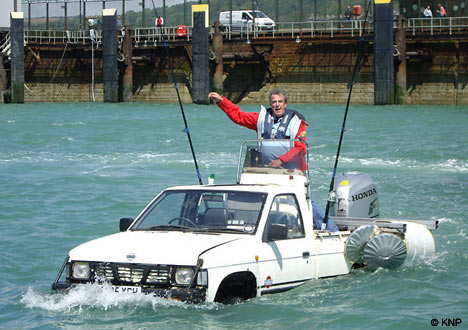
Some sail, some swim an some drive cross the channel
topgear1KNP2006_468x330.jpg


Can be found on Youtube (10 min., search for WTVPPTV-bQM)
 
Top