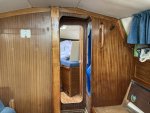
Can I assume it is varnish?

jaminb

Well-Known Member
Joined
7 Jan 2021
Messages
450
Visit site
I thought the wood finish on the interior of my 2006 Jeanneau was lacquered, but i have just tried cellulose thinners on part of the trim I want to tidy up and it has had no effect.

Can I assume it is varnish? Do I need white spirit to soften varnish or can I wet and dry? I was going to spray lacquer to refinish but can I just use varnish with a brush for a smooth shiny finish?

Thank you
 
Very few boat builders use varnish as it takes too long to dry between coats and varnish tends to attract dust during the drying time. Lacquer is the usual finish on all wood interiors. Have you checked on your owners web site for a specific answer.

For my 1980 Westerly Fulmar, I have just finished a complete bare wood strip down and relacquered with the same lacquer that Westerly used. Lacquer is usually sprayed on, but it can be brushed, which is what I did. The difference was stunning as per this photo, the port side of the main bulkhead has not been touched and the original lacquer has gone cloudy.

IMG_2477 1000pix.jpg

Lacquer comes in different finishes from full gloss (100%) to matt (0%), I opted for 20% as that is what Westerly used. The lacquer I bought was Morrells 450 low odour high build acid catalyst lacquer. It is available from their trade counters, but you need to order it the day before as it is not a stock item. Cost is just under £60 for 5 litres of lacquer with catalyst and 5 litres of thinners. Far cheaper than any varnish. Lacquer has the advantage of being fast drying and you can apply up to 4 coats in a day, hence why boat builders use it.

For the full view of the nearly finished interior, have a look at this video of Concerto at the Southampton Boat Show in September.


There is some further information in a talk I gave to the Westerly Owners Association on interior woodwork. This was before I tackled the main cabin and changed from using a cabinet scraper to a wide chisel sharpened on a small diamond grinding machine and leaving the burr on the chisel to use as a scraper.

https://wiki.westerly-owners.co.uk/images/2/25/Interior_Woodwork_Concerto_PowerPoint.pdf
 
Very few boat builders use varnish as it takes too long to dry between coats and varnish tends to attract dust during the drying time. Lacquer is the usual finish on all wood interiors. Have you checked on your owners web site for a specific answer.

For my 1980 Westerly Fulmar, I have just finished a complete bare wood strip down and relacquered with the same lacquer that Westerly used. Lacquer is usually sprayed on, but it can be brushed, which is what I did. The difference was stunning as per this photo, the port side of the main bulkhead has not been touched and the original lacquer has gone cloudy.

View attachment 129437

Lacquer comes in different finishes from full gloss (100%) to matt (0%), I opted for 20% as that is what Westerly used. The lacquer I bought was Morrells 450 low odour high build acid catalyst lacquer. It is available from their trade counters, but you need to order it the day before as it is not a stock item. Cost is just under £60 for 5 litres of lacquer with catalyst and 5 litres of thinners. Far cheaper than any varnish. Lacquer has the advantage of being fast drying and you can apply up to 4 coats in a day, hence why boat builders use it.

For the full view of the nearly finished interior, have a look at this video of Concerto at the Southampton Boat Show in September.


There is some further information in a talk I gave to the Westerly Owners Association on interior woodwork. This was before I tackled the main cabin and changed from using a cabinet scraper to a wide chisel sharpened on a small diamond grinding machine and leaving the burr on the chisel to use as a scraper.

https://wiki.westerly-owners.co.uk/images/2/25/Interior_Woodwork_Concerto_PowerPoint.pdf
Not a criticism, since I do it myself, but why do you leave the screwheads visible instead of disguising them with matching wood plugs (pellets)?

Nice work and thanks for the useful PDF. (y)
 
Last edited:
I have a 2004/5 Jeanneau, and in several areas have VERY LIGHTLY sanded the flat veeered areas and used first several coats of gloss alkyd varnish (I usually use Ronseal but not the water-based stuff) and then two coats of Epifanes rubbed-effect varnish mixed with a few drops of gloss to stop it being too dull.

Trim is mostly solid wood - which is where most of the damage to finish takes place, these get sanded back harder, then the same treatment. The end result is virtually indistinguishable from the original finish. Photo here shows the saloon table revarnished two years ago - everything else in that photo is original finish. I do know how to paint and varnish though: you do need some skill. saloon-table.jpg
 
Thanks Concerto and jwilson. I studied the Cocerto presentation when you advised me on my cabin cabin sole boards.

Jwilson your interior looks very similar to mine (but bigger?) even down to the white leather. When you varnish do use a brush or a roller?
 
To answer the OP's quest, some laquers may be affected by solvents that soften them, such as meths, acetone, or cellulose thinners, but not all are. In particular Morrel laquer as described by Concerto doesn't appear to be, well not on my Westerly Seahawk anyway. I have been following the refurbishment of Concerto (the Fulmar, not the poster) but I am persuaded by the post from Jwilson to continue using Ronseal satin varnish as I have had good results in the past. I have found it easy to use and cheaper than chandlery varnish.
 
All of those were how Westerly finished the boat. Virtually all of these screws have been undone to remove the timber for refinishing, so capping the screws would have been a pain to remove and refit.
Yes, I understand you.

My white-painted plywood locker fronts had all been secured to the frames behind with countersunk screws and their heads covered with filler before painting.

I wanted to take them off to paint inside the lockers and do some other repairs so I had to excavate each screw head (and there were a lot of them) and scrape its slot clean to enable me to unscrew them.

When refitting I used raised head countersunk Posidrive screws so that they would be easier to remove them next time.

The result does not look as nice as it did when the screwheads were invisible but this was one of those cases where practicality outweighed looks so I am happy with it, but a vistor once commented that he didn't like it (he won't be invited onboard again ;))
 
I am rediscovering all the different ways they put boats together before factory methods took over and worked all (or at least most) of it out in advance. My GH has a mixture of really nice teak and mahogany wooodwork except for the panelling around the saloon, the bunk fronts and the furniture in the forecabin which is fake teak formica. I think somebody in Devon in the late 1970s bought a job lot as the same was used by Marine Projects in the early Moodys.. I am painting it all white and my first job is to do all the locker lids (all 18 of them!) which are formica edged with a teak moulding. They all hook in and are locked in with those little catches you access through a hole in the front. They must have had a little production line at Erskines making up these lids! I need to get behind the panels the lids are set in to remove an upholstered bar and today I discovered that the whole panels are held in with cupped screws - at least I think that is what they are there for. All this basic stuff is in contrast with the beautifully made coachroof beams.

By today's standards lots of it is crude, but it does mean that it is not difficult to make it look better - one of the reasons I bought the boat.
 
A good brush is always worth using. In the past I always used Harris Perfection brushes, but now use a good quality synthetic hair brush. They give a good finish and are cheap enough to throw away after a few uses, whereas traditional brushes need a little breaking in and do wear out.
 
A good brush is always worth using. In the past I always used Harris Perfection brushes, but now use a good quality synthetic hair brush. They give a good finish and are cheap enough to throw away after a few uses, whereas traditional brushes need a little breaking in and do wear out.
One of the really irritating things about modern life is that a synthetic brush will give as good a finish if not better than an expensive professional quality traditional one, which offends my aesthetic sensibility. When I had a large and complicated area at home to paint I did find that a good bristle brush would carry a much larger load and was much quicker in use.
 
Top