Can fluorescent tube fixtures be repaired?

I can't imagine how someone would get killed by 12v DC.
I didn’t say they would. I said it is a bad habit to get into. Do it on board, no problem. Do it at home - could be a problem

He needs a new diffuser anyway. Bare LEDs have extremely high luminance are damaging to your eye, which is why there is a photo biological safety standard for LED luminaires.

StackPath

Otherwise, welcome to retina burn
 
I didn’t say they would. I said it is a bad habit to get into. Do it on board, no problem. Do it at home - could be a problem

He needs a new diffuser anyway. Bare LEDs have extremely high luminance are damaging to your eye, which is why there is a photo biological safety standard for LED luminaires.

StackPath

Otherwise, welcome to retina burn
I can find no evidence of LED tubes being banned in Sweden, or anywhere else, Fluorescent tubes later this year, yes. Perhaps you could provide a link?
LED tubes, that I have come across, and I have replaced a few, are wired with L & N at one end with the two pins at the other end shorted. It is possible to wire them with L at one end and N at the other with a link between the two holders. This prevents the tube being inserted the "Wrong way" and causing a short circuit.
I cannot understand why you would want to check for pin orientation if you already have one end in place, the orientation has been achieved!! In any case with tubes wired as described above there would be no power at that end no matter which way round the tube was inserted. If the tube ws put in one way it would have illuminated the other would have shorted out!
Perhaps of course you may have a greater depth of knowledge in this field than I do, in which case I will stand corrected.
Why does the OP need a new diffuser. Has he not just removed it to show the fitting?
Does any of the above have have any bearing on the original post? Urban myth comes to mind!
EDIT. There are some double ended LED tubes which could possibly cause an accident as described. If no RCD fitted!. Otherwise stand fast with what I have said.
 
Last edited:
The list of AC electrical devices things that could electrocute you if inappropriately handled whilst the power is on would be very long, too long to ban every item on it.
 
I can find no evidence of LED tubes being banned in Sweden, or anywhere else, Fluorescent tubes later this year, yes. Perhaps you could provide a link?
LED tubes, that I have come across, and I have replaced a few, are wired with L & N at one end with the two pins at the other end shorted. It is possible to wire them with L at one end and N at the other with a link between the two holders. This prevents the tube being inserted the "Wrong way" and causing a short circuit.
I cannot understand why you would want to check for pin orientation if you already have one end in place, the orientation has been achieved!! In any case with tubes wired as described above there would be no power at that end no matter which way round the tube was inserted. If the tube ws put in one way it would have illuminated the other would have shorted out!
Perhaps of course you may have a greater depth of knowledge in this field than I do, in which case I will stand corrected.
Why does the OP need a new diffuser. Has he not just removed it to show the fitting?
Does any of the above have have any bearing on the original post? Urban myth comes to mind!
EDIT. There are some double ended LED tubes which could possibly cause an accident as described. If no RCD fitted!. Otherwise stand fast with what I have said.
I am sorry but you are incorrect.

I was technical manager for one of Europe’s leading commercial lighting companies for many years. I saw all sorts of things come to the market. It was my job to be aware of them and to brief the sales force as to why certain things were a bad idea.

Those led replacement tubes are right at the top of the stupid ideas list.

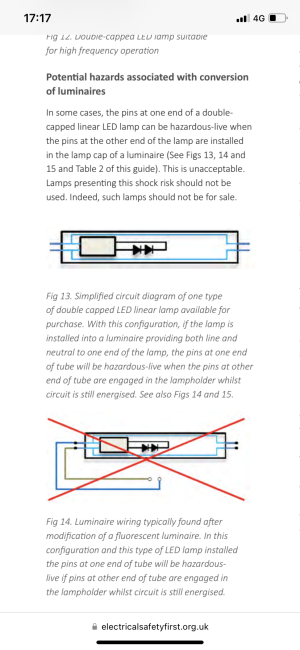
Page 9 onwards

https://www.electricalsafetyfirst.org.uk/media/1206/best-practice-guide-9.pdf

IMG_4076.png
The OP states his optic had blackened. Therefore next to no light will come out of it.

If he uses LED strip without an optic he is introducing a bio hazard into his environment that can result in retina burn over a period of time. Additionally the light distribution will be in a narrow beam which unless ihe is lucky won’t be the light distribution he is after. He will have a puddle of light directly under the light fitting and nothing anywhere else.

My qualifications on this are

MSc Light and Lighting
25 years in the lighting industry mostly in design, product design and technical project management roles.

Trust me, I know what I am talking about
 
It is getting dark in the engine room... Two light fixtures with 2x T8 fluorescent light tubes. So not that much light to begin with. This morning one fixture had blackened completely. The other one have been weak for some time and habitualy kills of tubes. I have checked the tubes, and made sure that there is voltage past the on switch. Is there something to be done here or do I have to find some new fixtures?

View attachment 156834
As per post 13, if the fitting itself is good the boatlamps led fitting is good and doesn't cause interference.
 
As per post 13, if the fitting itself is good the boatlamps led fitting is good and doesn't cause interference.
Seriously ?

Have you read the thread ?

Have you actually looked at the Boatlamps page you refer to ?

They only list 3 T8 lamps, all of which are 24v and the shortest is 2ft. Which do you think would suit the OP best ?
 
I am sorry but you are incorrect.

I was technical manager for one of Europe’s leading commercial lighting companies for many years. I saw all sorts of things come to the market. It was my job to be aware of them and to brief the sales force as to why certain things were a bad idea.

Those led replacement tubes are right at the top of the stupid ideas list.

Page 9 onwards

https://www.electricalsafetyfirst.org.uk/media/1206/best-practice-guide-9.pdf

View attachment 156904
The OP states his optic had blackened. Therefore next to no light will come out of it.

If he uses LED strip without an optic he is introducing a bio hazard into his environment that can result in retina burn over a period of time. Additionally the light distribution will be in a narrow beam which unless ihe is lucky won’t be the light distribution he is after. He will have a puddle of light directly under the light fitting and nothing anywhere else.

My qualifications on this are

MSc Light and Lighting
25 years in the lighting industry mostly in design, product design and technical project management roles.

Trust me, I know what I am talking about
I find that wiring diagram to me very doubtful. It has the pins at each end of the replacement tube connected together. This would provide a short circuit to supply. No light and cook the ballast choke.
Essentaily a 240v flouro tube has mains applied active to one end neutral to the other but via a ballast choke. (current limiting) In each end of the tube is a filament connected across the 2 pins. Power might come to bottom pins while the top pins are connected from each end via a starter. On switch on the starter provides a connection so that power flows through the 2 filaments and starter. After a short period the starter opens which can if the timing in the cycle is correct provide a large back EMF one filament to the other getting the tube to arc across the gas. The filaments being hot aid in striking the arc.
Now a 12v flouro while using same style of tube does not use the filaments. The AC generated by the transistor switch produces high voltage peaks which ensure immediate strike while the average voltage of the wave shape is correct to give normal brilliance.
Fitting an LED type tube without wiring change would involve enough LED diodes to equate to the 240v supplied or a switch mode voltage reducer to feed LED diodes. Power would come from one or both pins of each end. So yes one end fitted in to socket touch the other end of tube could give you a connection to mains active. The LEDs or converter providing connection.
A plug in no wiring change tube for 12v might work to varying degrees running on the high voltage generated by the transformer. But of course as said before the biggest problem of 12v flouro is the power converter transformer so most likely not a fix.
I may be incorrect in some detail in which case please tell me. My theory is often out of date. ol'will
 
I did read the thread.
Not a lot to add - only a vote for low voltage (12v), desired Kelvin and lumen. Strategic fitment to get light everywhere also when working where you may cast a shade in front of you. "Ultra-Bright" might be a buzzword when searching.

If any risk of adverse side effects I'd stop sitting in the engine room, staring at the light [irony intended].
 
Last edited:
I find that wiring diagram to me very doubtful. It has the pins at each end of the replacement tube connected together. This would provide a short circuit to supply. No light and cook the ballast choke.
Essentaily a 240v flouro tube has mains applied active to one end neutral to the other but via a ballast choke. (current limiting) In each end of the tube is a filament connected across the 2 pins. Power might come to bottom pins while the top pins are connected from each end via a starter. On switch on the starter provides a connection so that power flows through the 2 filaments and starter. After a short period the starter opens which can if the timing in the cycle is correct provide a large back EMF one filament to the other getting the tube to arc across the gas. The filaments being hot aid in striking the arc.
Now a 12v flouro while using same style of tube does not use the filaments. The AC generated by the transistor switch produces high voltage peaks which ensure immediate strike while the average voltage of the wave shape is correct to give normal brilliance.
Fitting an LED type tube without wiring change would involve enough LED diodes to equate to the 240v supplied or a switch mode voltage reducer to feed LED diodes. Power would come from one or both pins of each end. So yes one end fitted in to socket touch the other end of tube could give you a connection to mains active. The LEDs or converter providing connection.
A plug in no wiring change tube for 12v might work to varying degrees running on the high voltage generated by the transformer. But of course as said before the biggest problem of 12v flouro is the power converter transformer so most likely not a fix.
I may be incorrect in some detail in which case please tell me. My theory is often out of date. ol'will

I don’t understand your point or which diagram you are referring to. I don’t mind what you believe. That’s up to you. but It’s been 25 years since high frequency control gear became common place. You only refer to switch start.

The OP has mentioned blackening. I have taken that to be off the diffuser but if it is of the ends of the lamps then the most likely cause if that happening frequently will be down to mercury content and preheat current.

Pre heat current is continuous over time and does not happen on start up only. Due to environmental regulations, lamp
Manufacturers have had to reduce the mercury content of the lamp. This required a change in the pre heat current of high frequency control gear. New lamps with old control gear gives lamp end blackening and much shorter life.
 
I find that wiring diagram to me very doubtful. It has the pins at each end of the replacement tube connected together. This would provide a short circuit to supply. No light and cook the ballast choke.
Essentaily a 240v flouro tube has mains applied active to one end neutral to the other but via a ballast choke. (current limiting) In each end of the tube is a filament connected across the 2 pins. Power might come to bottom pins while the top pins are connected from each end via a starter. On switch on the starter provides a connection so that power flows through the 2 filaments and starter. After a short period the starter opens which can if the timing in the cycle is correct provide a large back EMF one filament to the other getting the tube to arc across the gas. The filaments being hot aid in striking the arc.
Now a 12v flouro while using same style of tube does not use the filaments. The AC generated by the transistor switch produces high voltage peaks which ensure immediate strike while the average voltage of the wave shape is correct to give normal brilliance.
Fitting an LED type tube without wiring change would involve enough LED diodes to equate to the 240v supplied or a switch mode voltage reducer to feed LED diodes. Power would come from one or both pins of each end. So yes one end fitted in to socket touch the other end of tube could give you a connection to mains active. The LEDs or converter providing connection.
A plug in no wiring change tube for 12v might work to varying degrees running on the high voltage generated by the transformer. But of course as said before the biggest problem of 12v flouro is the power converter transformer so most likely not a fix.
I may be incorrect in some detail in which case please tell me. My theory is often out of date. ol'will
Sorry it doesn't. You will have the line from each end to one internal connection and the neural from each to the other. I did refer to problems with double ended tubes like that and the fact that they could pose a danger. I have never found this sort of tube for sale in the UK (Not to say it isn't) only the ones with line and neutral at one end and the pins at the other end shorted. As I said, this poses a problem if the wiring is not correct and the tube is inserted the wrong way round. I have never had any problems stripping out all the control gear in fittings with failed electronic ballasts and rewiring properly to accept LED tubes. See attached PDF.
Tinto obviously has a lot of experience in this field which I fully respect. However I think he is on a bit of a hobby horse here and banging a drum about Retinal burn. As far as I am aware LED tubes have built in diffusers and the dangers of Eye damage must apply equally to all LED's. Not just tubes!
He has also made some sweeping statements "All electricians do it" LED tubes are "Stupid" etc. All electricians don't do it and I doubt if tubes have the capability to be stupid, or otherwise! Also perhaps he could elucidate on the statement that I am wrong. I think I was correct in what I actually stated.
 

Attachments

Sorry it doesn't. You will have the line from each end to one internal connection and the neural from each to the other. I did refer to problems with double ended tubes like that and the fact that they could pose a danger. I have never found this sort of tube for sale in the UK (Not to say it isn't) only the ones with line and neutral at one end and the pins at the other end shorted. As I said, this poses a problem if the wiring is not correct and the tube is inserted the wrong way round. I have never had any problems stripping out all the control gear in fittings with failed electronic ballasts and rewiring properly to accept LED tubes. See attached PDF.
Tinto obviously has a lot of experience in this field which I fully respect. However I think he is on a bit of a hobby horse here and banging a drum about Retinal burn. As far as I am aware LED tubes have built in diffusers and the dangers of Eye damage must apply equally to all LED's. Not just tubes!
He has also made some sweeping statements "All electricians do it" LED tubes are "Stupid" etc. All electricians don't do it and I doubt if tubes have the capability to be stupid, or otherwise! Also perhaps he could elucidate on the statement that I am wrong. I think I was correct in what I actually stated.
 
I have converted countless incandescent and fluorescent fixtures to LED by fitting LED strips. If you want lots of light, fit more strips, choose the warmth to suit. Some fittings are easily replaced in their entirety, but others are not so simple, there may be cosmetic issues. I have never had any problems whatsoever.

If it's a fluorescent fixture, simply remove all components, just leaving the switch (if fitted) and the positive/negative wires. Connect the two wires and you're done.

I don't do many AC fluorescent fitting conversions, i just don't come across that many on boats, but the few i have done have had the live and neutral at the same end and as above, all of the fluorescent components removed. If someone was to put their finger on the pins at the other end, with the power on, perhaps they should not be working with electricity.

I'm still sceptical that it would kill someone. There is no reason that the pins at the opposite end should be anything other than retaining pins with no connection to the supply. I'll try to remember to check with a meter.

There is, or course, a number of other designs of LED replacement, such as those already highlighted, which may pose risks that the ones i have used don't pose. Links to other documents have not shown LED tubes to have been made illegal anywhere, but have only shown guidelines. It seems to me that safety standards could be updated to prohibit some of the designs, whilst allowing the ones above.
 
I have changed some of my workshop and garage AC fluorescent lights to LED Tube.

This is this is the type I used

http://a365.acdc.co.za/Images//spec/LEDT8-A4C.pdf

The reason the connections are at both ends si so the tube an be fitted either way round and still work.

If the AC connection is only at one end the tube would only work one way round
The tubes i've fitted do have the connections at one end and can only be fitted one way around, as you say. The wires are fitted to one connector.

The tubes you have used would also work with the wires fitted to one connector, but would then mean they need to be fitted one way only. This is because both neutral and live are at the same end of the tube.

Nothing whatsoever wrong with your tubes Roger, just a slightly different design. As with the ones i used, i can't see how you could get electrocuted whilst fitting one.
 
This just demonstrates that thre are always different ways to do the same job and both are acceptable.

The issue is that some people think there is only one way that is their way

Engineering is not like that.

More than one way to skin a cat
 
The tubes i've fitted do have the connections at one end and can only be fitted one way around, as you say. The wires are fitted to one connector.

The tubes you have used would also work with the wires fitted to one connector, but would then mean they need to be fitted one way only. This is because both neutral and live are at the same end of the tube.

Nothing whatsoever wrong with your tubes Roger, just a slightly different design. As with the ones i used, i can't see how you could get electrocuted whilst fitting one.
I have changed some of my workshop and garage AC fluorescent lights to LED Tube.

This is this is the type I used

http://a365.acdc.co.za/Images//spec/LEDT8-A4C.pdf

The reason the connections are at both ends si so the tube an be fitted either way round and still work.

If the AC connection is only at one end the tube would only work one way round
If you look at the pins where the Neutral connection is you will see that they are shorted together. What I have been saying along.
Think I will retire defeated from this thread!
 
This just demonstrates that thre are always different ways to do the same job and both are acceptable.

The issue is that some people think there is only one way that is their way

Engineering is not like that.

More than one way to skin a cat
Nice to see you back on the forum Roger, just a shame you still won't read what has been said.

I did not say your way was wrong.

I did note that you don't understand how the tubes you use are connected. You say that "The reason the connections are at both ends si so the tube an be fitted either way round and still work." but that's not actually true. As i said, the neutral and live connections are both at one end of the tube, look at the data sheet you posted.
 
Nice to see you back on the forum Roger, just a shame you still won't read what has been said.

I did not say your way was wrong.

I did note that you don't understand how the tubes you use are connected. You say that "The reason the connections are at both ends si so the tube an be fitted either way round and still work." but that's not actually true. As i said, the neutral and live connections are both at one end of the tube, look at the data sheet you posted.
Cant resist, can I!! Paul. if you turn the tube round end for end (http://a365.acdc.co.za/Images//spec/LEDT8-A4C.pdf) the shorted end will feed the L to the other end of the fitting and to the N via the link and the tube. So the tube will work either way round. If you don't wire it as the data sheet and take the L & N to one end only, with no link between ends, the tube will provide a short circuit when fitted one way round. You can ignore the F symbol not sure what that is, never seen it. Definitely going for a beer!:ROFLMAO:
 
Top