Can a calorifier be fitted to a seawater cooled engine.

I've been looking at this for our 2GM20 sea water cooled, looking at the manual not sure where to fit calorifier flow and return as detail on viv's site for the Bukh mods but cannot see similar on the 2GM20

 
Given that raw water cooled engines run cooler and take longer to warm up, due to ingestion of cold water rather than pre-heated, the idea that running a calorifier could result in both an extension of the warm up time . . .

Couldn't that potential downside be avoided, where circulation to the calorifier is by electric pump, by the pump only being switch on (either manually or automatically) once full temperature is reached?
 
Well that's obvious if I may say so. Of course not all of it can go into the calorifier, but the purpose of the back-of-fag-packet was to show that there's loads of heat available, so not to worry, it's pretty much always enough (for a calorifier). As for I 'assumed the boat was beong driven at max power' I certainly didn't: I assumed it was being driven at the very moderate power of 10HP, which is ony 20% of the rated HP of my engine as I thought that more reasonable. I was then saying that even if you have a smaller boat which takes less power to drive, say only 2.5HP, then you'll still have heat enough. Do you disagree and feel that you won't get enough heat for a calorifier from, say, a 10HP engine?

I am simply passing on information. Bukh have stated in the past that the DV10 is not man enough to supply a calorifier because of exactly the reason that I quoted - the coolant temperature is depressed and warm up time is longer. I have read the same about single cylinder Volvo engines based on experience rather than something the manufacturer may have said. I agree that a third of 7.5 kW at full power would seem to be sufficient, although adding a calorifier probably increases the effective coolant capacity from ~ 2 litres to 17 or 22, dependent upon the calorifier. Do owners of single cylinder engines run them flat out all the time? Once delivering smaller proportions of maximum power the available waste heat seems to become marginal.

Little Sister's idea of turning on the circulation pump when the coolant is up to temperature may well work but it's one more thing to remember to do.
 
..... Do owners of single cylinder engines run them flat out all the time? ....
Little Sister's idea of turning on the circulation pump when the coolant is up to temperature may well work but it's one more thing to remember to do.
Yes, if you're going to fire up a 1GM, you are probably going to want several HP out of it.
Boats with over-large engines are at greater risk of not warming up.

You can use a thermostat, either car/motorbike types, or electric, to alter where the coolant flows according to how warm it is.

I'm not sure I'd want to run a 1 GM long enough to heat water for showers for two, but we mostly valued our hot water for washing up. Saves a lot of Camping Gaz and generally easier to keep everything properly clean.
 
At present I am looking at a boat with a Yanmar direct seawater cooled engine.

Is it possible to somehow link the engine block to a calorifier with perhaps some form of circulating pump.

One concern I have is the possibility of electrolytic problems between the cast iron block and the copper coil in the calorifier.

Any thoghts

Yes you can and I did on a previous boat. Engine was a Volvo 2003 seawater cooled. Water was plenty hot enough for a good shower, washing up and even clothes washing occasionally.
 
Was there ever any resolution to the OP here? I'm considering a boat with a Yanmar and can't find any information about a send and return for the calorifier. Despite any arguments about whether the resulting water temperature would be hot enough, a clear indication as to whether its physically possible would be great.

Anyone?! Vyv, I'm bowing to your infinitely superior knowledge here, but I notice on your website, there are no specific fixes for the yanmar range.
 
Following conversation with Vyv I modified my 2GM20 to provide water in and out. Not yet plumbed it into clorifier yet but have run flow through it and it works. I can take some photos of the mods.
 
One connection was easy as it just required a barrel nipple, tee and valve. The other a little harder as it required drilling and tapping the housing that holds the top anode to fit a barrel nipple and valve. Will take some photos this weekend
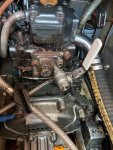
 
One connection was easy as it just required a barrel nipple, tee and valve. The other a little harder as it required drilling and tapping the housing that holds the top anode to fit a barrel nipple and valve. Will take some photos this weekend
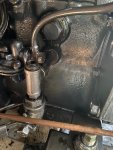
You are a gentleman and a scholar sir! Cheers for that.
 
One connection was easy as it just required a barrel nipple, tee and valve. The other a little harder as it required drilling and tapping the housing that holds the top anode to fit a barrel nipple and valve. Will take some photos this weekend
Looking forward to hearing of your success! If you can send some photos I will add them to the website.
 
Had to drill and tap but as the cover comes off did it on the bench, 1/4 bsp male nipple fitted and then ball valve, the casting is quite thick there and angled about 10degrees to clear edge of gasket, the return water feed just fitted again a 1/4 bsp nipple to threaded tee to turn it pointing down onto again a ball valve

1625847149584.jpeg

1625847118050.jpeg
 
Top