Daverw
Well-Known Member
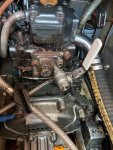
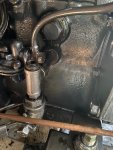
I've been looking at this for our 2GM20 sea water cooled, looking at the manual not sure where to fit calorifier flow and return as detail on viv's site for the Bukh mods but cannot see similar on the 2GM20


Given that raw water cooled engines run cooler and take longer to warm up, due to ingestion of cold water rather than pre-heated, the idea that running a calorifier could result in both an extension of the warm up time . . .

Well that's obvious if I may say so. Of course not all of it can go into the calorifier, but the purpose of the back-of-fag-packet was to show that there's loads of heat available, so not to worry, it's pretty much always enough (for a calorifier). As for I 'assumed the boat was beong driven at max power' I certainly didn't: I assumed it was being driven at the very moderate power of 10HP, which is ony 20% of the rated HP of my engine as I thought that more reasonable. I was then saying that even if you have a smaller boat which takes less power to drive, say only 2.5HP, then you'll still have heat enough. Do you disagree and feel that you won't get enough heat for a calorifier from, say, a 10HP engine?
Yes, if you're going to fire up a 1GM, you are probably going to want several HP out of it...... Do owners of single cylinder engines run them flat out all the time? ....
Little Sister's idea of turning on the circulation pump when the coolant is up to temperature may well work but it's one more thing to remember to do.

At present I am looking at a boat with a Yanmar direct seawater cooled engine.
Is it possible to somehow link the engine block to a calorifier with perhaps some form of circulating pump.
One concern I have is the possibility of electrolytic problems between the cast iron block and the copper coil in the calorifier.
Any thoghts
You are a gentleman and a scholar sir! Cheers for that.One connection was easy as it just required a barrel nipple, tee and valve. The other a little harder as it required drilling and tapping the housing that holds the top anode to fit a barrel nipple and valve. Will take some photos this weekend
Looking forward to hearing of your success! If you can send some photos I will add them to the website.One connection was easy as it just required a barrel nipple, tee and valve. The other a little harder as it required drilling and tapping the housing that holds the top anode to fit a barrel nipple and valve. Will take some photos this weekend