Can 355 amps at 48 volts kill you?

24V can be fatal, but you have to be both wet and very unlucky indeed. Resistance from hand to hand, wet, is about 1 kilohm, so 24V can push about 25mA through you, which is just above what's required through the heart to do nasty things. Of course the full whack will not go through your heart, but if it's already a bit dodgy, enough might to set it off.

24V can certainly be felt if you're wet, and could be quite painful.

+1 I got a nasty shock of a 24volt system battery when I touched the engine and the positive terminal with salt water on my hands. Just never thought it could happen at such low voltage.

At the other end of the voltage spectrum, I got a 500,000 volt belt from a Van de Graff generator when I stood too close to the top sphere. Spark was about 4 in long and hit my head, no lasting effects (ish)
 
Luckily the smart person who connected it put the shunt in the supply line from the batteries. My problem with the Duck's statement arises from a dim and distant memory of resistors in parallel.

I'm absolutely right, I'm afraid. I'm thoroughly unsound on yacht buying procedures but I know this stuff.

When you add a second resistor in parallel with a first, you do indeed get more current through the lower resistance leg than through the higher. However, the current through the one that was there first doesn't change.

Example: 24V across 1 ohm: I = V/R = 24/1 = 24A

Add a 0.1 ohm resistor in parallel: I = V/R = 14/0.1 = 240A

Total current: 264A of which 24A goes through the 1 ohm leg and 240A goes through the 0.1 ohm leg.

That's exactly how the formula for adding resistors in parallel is derive:

Itotal = I1 + I2 + I3 ...

V/Rtotal = V/R1 + V/R2 + V/R3 ...

= V (1/R1 + 1/R2 + 1/R3 ...)

=> 1/Rtotal = 1/R1 + 1/R2 + 1/R3 ...

In the above case the total resistance 1/R = 1/1 + 1/0.1 = 11 => R = 1/11, and I = 24/(1/11) = 264A.
 
At the other end of the voltage spectrum, I got a 500,000 volt belt from a Van de Graff generator when I stood too close to the top sphere. Spark was about 4 in long and hit my head, no lasting effects (ish)

When I was at school I made a Tesla coil which threw out 4" sparks on a dry day. Quite harmless because the current was tiny, though it was best to use a metal spoon to take the spark to avoid pin-point burns on your fingers. The Tesla coil was driven by a monster of an induction coil which could also throw 4" sparks, but nice, big, fat continuous ones, and since it drew around 150W from the 12V supply it ran on, there was a respectable current in them. Not something to take across your body.

Mind you, the Victorians used to treat all sorts of complaints with smaller inductor coils. I have one in my collection which includes an anal probe. For depression, apparently. It would certainly liven me up.
 
Ho hum - can't see the fault with that so mea culpa, ego iniuriam.

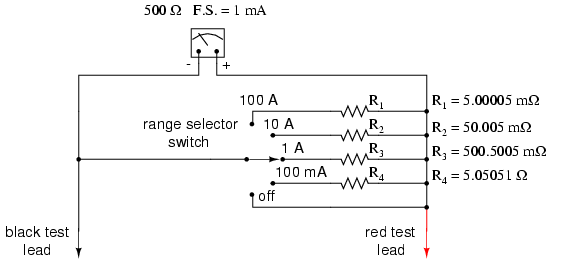
Pictorially showing shunts in parallel to meter

00164.png
 
When you add a second resistor in parallel with a first, you do indeed get more current through the lower resistance leg than through the higher. However, the current through the one that was there first doesn't change...
Another way of looking at it is that the voltage is the same (assumption), the resistor is the same, so the current remains the same.
 
The thing to watch safety-wise with low voltage, high current circuitry is wearing rings and watches. They will melt if shorted and you will be lucky not lose a finger or even a hand.
 
...Mind you, the Victorians used to treat all sorts of complaints with smaller inductor coils. ...

Yes, they were keen on electrical therapy weren't they - I have a 'magneto-electric machine' similar to this http://ancientpoint.com/inf/33498-v...electric_shock_machine_coil_1870_medical.html and remember taking it into school over half a century ago when the class joined hands in a ring to experience its effect (albeit without the damp sponges that IIRC were put into the brass tubes for maximum effect) - don't suppose that would be countenanced today. I also remember a sixth form Physics question inviting calculation of a fatal current assuming the resistance of the human body was 33k ohms - within the accepted range today, I believe - but it did not emphasize that it could fall to 1k ohms with wet skin, or to 500 ohms with broken skin.
 
Another way of looking at it is that the voltage is the same (assumption), the resistor is the same, so the current remains the same.

Or as we used to say, "The first resistor doesn't know the second one is there".

The thing to watch safety-wise with low voltage, high current circuitry is wearing rings and watches. They will melt if shorted and you will be lucky not lose a finger or even a hand.

I used to work with very powerful magnets, and it was very important to have nothing ferrous about one's person. A colleague of mine wrenched a knee when a magnet he was passing grabbed his foot and clamped it firmly against the side of its container ... that's how he found that cheap shoes from M&S had a spring steel resinforcement inside the sole.

Yes, they were keen on electrical therapy weren't they ...

They had a tendency to believe that anything new and scientific must have health benefits. Radioactive chocolate, anyone?

radium-chocolate.jpg
 
... They had a tendency to believe that anything new and scientific must have health benefits. ...

Indeed. Aficionados of Patrick O'Brian's books may know that his father was a physician who developed (actually, in the early Edwardian era) novel electrolytic treatments, which O'Brian's biographer described as "... frightful in their application" - not unlike 'your' depression treatment, but different :dread:. (King, Dean, Patrick O'Brian, A life revealed, Hodder and Stoughton, 2000, p.21).
 
The most painful was from 50V DC, not quite enough to fling your hand away.

I can assure you 400v DC is very unpleasant. Unlike AC you simply cannot detach yourself. That was as a young Radio Amateur aged about 17. I doubt I would survive such a shock now. (I also had a 1200v DC supply for the final PA anode, but fortunately never touched that).
 
Indeed. Aficionados of Patrick O'Brian's books may know that his father was a physician who developed (actually, in the early Edwardian era) novel electrolytic treatments, which O'Brian's biographer described as "... frightful in their application" - not unlike 'your' depression treatment, but different :dread:. (King, Dean, Patrick O'Brian, A life revealed, Hodder and Stoughton, 2000, p.21).

Coincidentaly an article on TV last night about people using electric current in the 1 to 2 ma range DC on the skull to improve concentration. Apparently you can buy the devices on ebay for 100s of squids. A lot for a battery and resistor. Snake oil?

Regarding parallel resistors. When you switch on an electric jug at home you are going inp[arallel with your neighbours electric lights. No they don't notice any difference. This is because the supply has a very low resistance or capacity to supply a lot of current. If enough electric jugs were switche on to a limited capacity supply then voltage would drop and every one using it would notice.

Now regarding the amp meter shunt discussion. You can look at the circuit in 2 ways. You can regard the amp meter itself as a volt meter. It has a 100 ohms ressitance and 1ma deflects to full scale. So it is a 100mv meter. It measures the voltage across the shunt a low resistance resistor when current flows through the shunt. So at 100 amps the resitance of the shunt must be .001 ohm. However the purists will realize that 1ma will flow in the meter which is not part of the measured current that drops the voltage in the shunt. So shunt must be slightly higher ressitance for total accuracy. Usually ignored.

Now the other way of looking at the shunt is to look at the ratio of current through the meter 1 ma versus the current through the shunt to be measured. 100Amps We have a ratio of 100 000 times the current in the shunt. So we need 1/100000 part of the meter resistance of 100 ohms or .001 ohms.

Incidentally when working with low resistance it is often more convenient to use the measure of conductance rather than resistance. This is called the "mho". It is the inverse of the ohm. So 1 ohm is one mho, .1 ohm is 10 mho .001 ohm is 1000mho. The beauty of the mho is that when the resistors are in parallel you just add the mhos. A bit of useless information.
 
1881 ? In practise it didn't. I reckon mhos was probaly in use for best part of anothetr100 years

I believe so, yes. Like the ohm (and the volt, and the amp) the siemens predates and was adopted by the SI system. From memory, the ohm and the siemens were originally competing units for resistance. It was decided in 1881 that the ohm would win, and by way of a consolation prise for the siemens supporters, the mho was dropped as the inverse ohm and the siemens used instead for conductance, admittance and susceptance. I bet that caused a confusing few years.

I'd love to know how the mho managed to survive, or perhaps to re-establish itself, in electronics. Certainly in the stuff I used to do in superconductivity and electromagnetic modelling everybody always used the siemens.
 
Can 355 amps at 48 volts kill you? >Can 355 amps at 48 volts kill you? Can 24v at 355 amps kill you too?

Given your body is a constant resistance, it really is a combination of both. Higher voltage means higher amperage, and thus higher voltage has more potential to kill. It takes only 100mA to stop your heart.

Using static electricity generator you can produce high voltage and no amps. At university we used to attach the generator to a metal door handle and when somebody opened it from the other side their hair was standing up.
 
I believe so, yes. Like the ohm (and the volt, and the amp) the siemens predates and was adopted by the SI system. From memory, the ohm and the siemens were originally competing units for resistance. It was decided in 1881 that the ohm would win, and by way of a consolation prise for the siemens supporters, the mho was dropped as the inverse ohm and the siemens used instead for conductance, admittance and susceptance. I bet that caused a confusing few years.

I'd love to know how the mho managed to survive, or perhaps to re-establish itself, in electronics. Certainly in the stuff I used to do in superconductivity and electromagnetic modelling everybody always used the siemens.

2 excuses one given by the handle "olewill" and secondly living in the scientific backwater of down under. olewill duly chastised (and will still call it a mho.
 
Can 355 amps at 48 volts kill you? >Can 355 amps at 48 volts kill you? Can 24v at 355 amps kill you too?

Given your body is a constant resistance,......

It isn't.

You can get a good welding arc from 4 car batteries in series.
You might want to touch that... I don't.
 
Top