
Calorifier connections?

Koops

New Member
Joined
22 Jan 2023
Messages
9
Visit site
I’m wanting to drain the domestic water system on my recently purchased 2002 Windy ready for the winter and am seeking understanding of the calorifier arrangement, which isn’t covered by the boat’s manual.
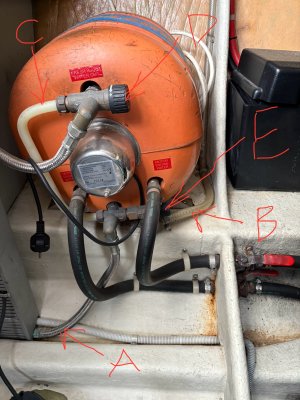
Reference the photo attached, can anyone tell me/confirm:
Whether ‘A’ is the water inlet (from pump/tank)?
Purposes of valves D and E, also associated pipes B and C?IMG_2517.jpeg
 
I’m wanting to drain the domestic water system on my recently purchased 2002 Windy ready for the winter and am seeking understanding of the calorifier arrangement, which isn’t covered by the boat’s manual.
Reference the photo attached, can anyone tell me/confirm:
Whether ‘A’ is the water inlet (from pump/tank)?
Purposes of valves D and E, also associated pipes B and C?View attachment 203946

A is from the pump
B is the outlet from the pressure relief valve
D is the thermostatic mixing valve (stops scalding water from going to the taps)
C is the cold inlet for D
The braid covered hose is hot water to the taps
E is the pressure relief valve, turn it a little way and it drains the tank
The two black hoses at the bottom are the coolant hoses to/from the engine
 
A is from the pump
B is the outlet from the pressure relief valve
D is the thermostatic mixing valve (stops scalding water from going to the taps)
C is the cold inlet for D
The braid covered hose is hot water to the taps
E is the pressure relief valve, turn it a little way and it drains the tank
The two black hoses at the bottom are the coolant hoses to/from the engine
Thanks Paul, just what I needed 😊. I’ll try turning E to drain the calorifier, although I suspect that the height of the discharge pipe B means that it won’t drain under gravity. Perhaps I will disconnect pipe B and let the water flow to the bilge pump which is nearby….
 
Thanks Paul, just what I needed 😊. I’ll try turning E to drain the calorifier, although I suspect that the height of the discharge pipe B means that it won’t drain under gravity. Perhaps I will disconnect pipe B and let the water flow to the bilge pump which is nearby….
Or take C off at the bottom.
 
I used to drain the calorific in my boat on the River Severn, so fresh water, and freezing ambients. I had to blow air through from a tap to empty the last couple litres. I’ve never done this with the boat on the sea.
 
I used to drain the calorific in my boat on the River Severn, so fresh water, and freezing ambients. I had to blow air through from a tap to empty the last couple litres. I’ve never done this with the boat on the sea.
I’ve had opinions about winterising my boat from Weymouth boating locals, ranging from do nothing to drain domestic water system / add non-toxic antifreeze to toilet and traps / drain inboard engine raw water system and replace with antifreeze! The boat is staying in the harbour water over winter….
 
My previous Azimut was on the Hamble at Deacons for 6 years. The only time I had a frost problem was when out of the water on the hard. The galley tap split. I keep a couple of small heaters set to switch on below 5-8 c. Plus a dehumidifier running 4 hours a day.
 
Top