Calling all Yanmar/Diesel engine enthusiasts

MagicalArmchair

Well-Known Member
Joined
11 Jan 2013
Messages
1,540
Location
Kings Hill, Chatham Marina
Visit site
I wrote a little service guide to help others who, like me, serviced their own 2GM20s.

http://www.albinballad.co.uk/how-tos/yanmar-2gm20-engine-winterising-and-service/

As some may have read in my many (many) posts on here, due to my mast truss being sick and simultaneously embarking on a substantial refit of Triola, my total time on the water this season (and total time used on the engine) could likely be counted in minutes, and not hours! So I came to winterise the engine today, a few questions cropped up:

  • The thermostat! In the above guide, note I do NOT ever remove the thermostat, I have read some posts on here recommending that when running antifreeze through the engine with the engine 'cold', it is removed to let the antifreeze run through the block rather than just flushing the bypass. I have also read that with the thermostat out, the water favors the bypass anyway! I did remove the thermostat for the first time when I ran antifreeze through, and note, it looks pretty caggy.

    RUDsjOnl.jpg


    Question 1 - Replace the thermostat and keep this caggy one as a spare?

    Question 2 - Best to remove the thermostat when running antifreeze through the engine? Or does it not make any difference seeing as the water prefers the bypass anyway?

  • The oil! I was about to Pela the whole lot out, and due to the engine not being run, it looks like new! Replacing it and the oil filter seems like an exercise in futility.

    z7ZhD0Am.jpg


    Question 3 - Do I bother to replace the oil?

  • The waterways! I think I need a flush... check out the amount of build up in the housing for the thermostat and in this waterway that leads down from the thermostat to the impeller.

    dTMYdG3l.jpg

    5ssRknSl.jpg


    Question 4 - Rydlyme - I have read around these here parts that this is good medicine for a cagged up engine. What is the process? 1. Rydlyme in bucket, take a hose from the water intake on the engine to said bucket. 2. Capture Rydlyme from exhaust outside the boat, run it back up in another bucket. 3. Rinse, repeat? . Won't that spray the poor happless soul under the exhaust with hot Rydlyme?? Or do you run a pipe from the exhaust to a bucket closer to the ground? (my exhaust is well out of reach when out of the water...)

  • The rust! On the front and back of my engine, we have a few patches of rust. I have wire brushed these back and taken hoses and the belts off for better access. I plan to use Hydrate 80 (a rust converter) on the patches and then remortgage the house to buy some Yanmar paint. Picture below after taking it all apart and wirebrushing it.

    viboWkFl.jpg


    Question 5 - I appeared to have some water leaks from around the pipes. Is there anything I can put on the hose tails to make a better watertight connection? Or do we suspect the jubilee clips just aren't tight enough?

My engine starts on the button every time, and has never let me down. I'd like to repay it by looking after it well. All help will be much appreciated (and apologies for the great length of post - points for not falling asleep...!)
 
Last edited:
Some of the easier answers:

Forget about oil and filter change. It's just manufacturers / oil company BS. It needs changing when it needs changing which depends purely upon usage rather than time.

If the thermostat only has one opening flange then it is a simple open or close arrangement through the block and heat exchanger. If you run without the thermostat it will flush the block. I can't tell from the photo what yours is like.

Put silicone grease on the hoses and spigots before clamping. That should minimise any leaks due to stretched hoses.

Richard
 
Oil filter could well do another year I reckon. Dunno abt oil and how long engine has to run to reach undesirable acidity.
Rydlyme....I did my Volvo this year. This time, take the thermostat out as the stuff doesnt like the brass; ditto the engine anode. A chum used an electric pump to shove the stuff around on his taking the output from the exhaust elbow back to bucket.
On mine I took off thermostat cover and poured the stuff straight down into block and let it sit. Got entertaining mucky bubbles.
Both methods worked fine
 
Thanks for the responses.

Question 1 - Replace the thermostat and keep this caggy one as a spare? - This one works fine, that said, a new one can't hurt though, so I'll keep this one as spare

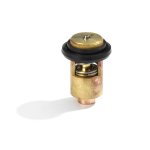
Question 2 - Best to remove the thermostat when running antifreeze through the engine? Or does it not make any difference seeing as the water prefers the bypass anyway? - Its one of these:

yanmar-thermostat-gm-2034-p.jpg

It looks like a simple open/close arrangement, so removing the thermostat should flush the block?

Question 3 - Do I bother to replace the oil? - Consensus == No, well that's one less thing to do!

Question 4 - Rydlyme - Thanks Spuddy, I have a little 12V electric pump I used to flush the heater core on my RX8, so I can employ that here. So I just detach the pipe that feeds the exhaust elbow and return that to my bucket o' slop?

Question 5 - I appeared to have some water leaks from around the pipes. Is there anything I can put on the hose tails to make a better watertight connection? Or do we suspect the jubilee clips just aren't tight enough? - So Silicon grease is the stuff? Is it worth using that on gasgets too? I had a slight dribble around the impeller gasket too (I am very cautious when doing up those little bolts, so they may just not have been torqued up enough.)
 
I agree with your decision to fit a new thermostat whilst you have it out as one failing in service is not usually a "good thing" but I can now see from the new photo that it is a bypass valve so the advice to remove it when flushing may well be very good practice but that's beyond my experience.

I use a smear of silicone grease on all fittings which need to be water-tight and I use a good helping on the impeller gasket /O-ring and the impeller itself. On fittings which don't have water running through them and get a lot hotter like the exhaust manifold gasket I use copper grease as that is much better at high temperatures.

Richard
 
Question 5 - I appeared to have some water leaks from around the pipes. Is there anything I can put on the hose tails to make a better watertight connection? Or do we suspect the jubilee clips just aren't tight enough? - So Silicon grease is the stuff? Is it worth using that on gasgets too? I had a slight dribble around the impeller gasket too (I am very cautious when doing up those little bolts, so they may just not have been torqued up enough.)

Good time to think about fitting a Speedseal. Does away with both the silly little screws and the gasket.
 
Good time to think about fitting a Speedseal. Does away with both the silly little screws and the gasket.

http://www.speedseal.com/Pages/howitworks.htm

Humm, I am struggling to see the benefits (other than not needing the flipping gasgets :) ). In order to get to the impeller housing I need to get the engine to pieces anyway (the pivot and lock bolts), so my trusty boat socket set would already be at hand if push came to shove...
 
http://www.speedseal.com/Pages/howitworks.htm

Humm, I am struggling to see the benefits (other than not needing the flipping gasgets :) ). In order to get to the impeller housing I need to get the engine to pieces anyway (the pivot and lock bolts), so my trusty boat socket set would already be at hand if push came to shove...

It allows you to run dry without damaging the impeller and those little screws have a habit of disappearing into the bilge or worse still breaking - plus, as you have found difficult to get a seal with the gasket. Does not wear like thee plain brass standard cover.
 
I believe that the thermostat on a raw water cooled Yanmar GM is similar to the one on a Bukh 20, in which the opening due to heating of the block simultaneously closes the bypass. Circulating water, Rydlyme or anything else with the engine cold will simply pass the fluid through the bypass and out of the exhaust. It has been suggested that if treating the engine cold with Rydlyme it is best to remove the thermostat and fill the block with the solution. If treating it hot by circulating via bucket under the exhaust then leave the thermostat in.
 
Two extra thoughts, which may or may not help.

If you are circulating Rydlime by catching it from the exhaust, find a hose which will push up into the exhaust fitting so as to direct the flow into the bucket. If you fit a hose tail to the bottom of the bucket you should be able to take that direct to the impeller, too.

Jubilee clips, though very handy to use are not the best clamps to make a hose water tight, particularly on a small diameter hose. The straight screw section tends to prevent them forming a proper circle. Therr are some bolt up types which are much better, but difficult to ifnd in stainless. For a permanent fixing, you can't beat the deformable clips which are pinched up with a pair of pincers - but my aged memory just won't recall the proper name...

Rob.
 
It allows you to run dry without damaging the impeller and those little screws have a habit of disappearing into the bilge or worse still breaking - plus, as you have found difficult to get a seal with the gasket. Does not wear like thee plain brass standard cover.

I think you might be refering to the Speedseal Life rather than the Speedseal which you recommended to MagicalArmchair?

I have two "Lifes" and did not bother with the ordinary version although I assume that the ordinary one is cheaper.

Richard
 
I think you might be refering to the Speedseal Life rather than the Speedseal which you recommended to MagicalArmchair?

I have two "Lifes" and did not bother with the ordinary version although I assume that the ordinary one is cheaper.

Richard

Yes, it was the Life version for the run dry bit, but the ordinary one which I have fitted to two different engines, one a Yanmar the other a Volvo are still worth having. The Yanmar was on a 1GM which is the worst designed pump ever and the Volvo because the 6 little bolts invariably bolted for the bilge when you tried to remove them in a hurry. Will put one on my new Volvo as soon as it is out of warranty.
 
I believe that the thermostat on a raw water cooled Yanmar GM is similar to the one on a Bukh 20, in which the opening due to heating of the block simultaneously closes the bypass. Circulating water, Rydlyme or anything else with the engine cold will simply pass the fluid through the bypass and out of the exhaust. It has been suggested that if treating the engine cold with Rydlyme it is best to remove the thermostat and fill the block with the solution. If treating it hot by circulating via bucket under the exhaust then leave the thermostat in.

As someone in a v similar position, I can unscrew the themostat and insert a hose attached to a funnel into the thermostat housing. How do I ensure that the Rydlyme goes into the block? Do I need to find some way of pumping it in (whilst maintaining a perfect seal between the hose and thermostat housing)?

Also, has anyone found any prices for Rydlyme. Finally can anyone provide an opinion of its relative efficacy versus SaltAway?
 
Oil filter could well do another year I reckon. Dunno abt oil and how long engine has to run to reach undesirable acidity.
Rydlyme....I did my Volvo this year. This time, take the thermostat out as the stuff doesnt like the brass; ditto the engine anode. A chum used an electric pump to shove the stuff around on his taking the output from the exhaust elbow back to bucket.
On mine I took off thermostat cover and poured the stuff straight down into block and let it sit. Got entertaining mucky bubbles.
Both methods worked fine

The method that holds the most merit has to be running the engine up to temperature, two buckets, one in the saloon and one outside the boat. Use a pipe pushed into the exhaust to transfer the Rydlyme from the exhaust to the bucket outside the boat, then use a small electric pump and hosepipe to transfer the gollop from the ground up to the bucket in the saloon, and connect the bucket in the saloon directly to the water strainer, completing the circuit. The only trouble is, if what Spuddy says is true, it will eat your thermostat!

So, questions from this then:

1 - Will Rydlyme eat brass??
2 - How long to get a 2GM20 up to operating temperature, and how long should you run this stuff through?
3 - Is the above circuit sound?

Not sure how much it costs, French Marine are listed as a stockest, I'll give them a call tomorrow...
 
As someone in a v similar position, I can unscrew the themostat and insert a hose attached to a funnel into the thermostat housing. How do I ensure that the Rydlyme goes into the block? Do I need to find some way of pumping it in (whilst maintaining a perfect seal between the hose and thermostat housing)?

Assuming that the thermostat is in the conventional position at the highest point of the block, simply drain all the water currently in there out into the bilge, then pour the Rydlyme solution in to replace it. The only place it can run out is via the hose to the manifold, but this will not happen until the block is full, so not a problem.

1 - Will Rydlyme eat brass??
Rydlyme is intended for descaling domestic central heating systems, which contain dozens of brass fittings. No, it won't.
 
Thanks vyv_cox.

Interesting information here:

http://www.rydlymemarine.com/assets/1/7/Inboard_descaling_instructions.pdf

Okay, this suggests taking the thermostat OUT, and running it through the system cold with a little electric pump. What vyv_cox has pointed out previously is that this method suggested by Rydlyme will just squirt all the gollop down the bypass and not clean the block at all, err. I'll seek clarification from Rydlyme...
 
Further research uncovered this:

http://www.sailnet.com/forums/diesel/68909-winterizing-yanmar-2qm20h-raw-water-cooled.html

<snip>One trick I use on the RWC 1 & 2 GM's is to pull the stat then pinch the hose between the block inlet Tee and the t-stat housing using a pair of needle nose vise grips. This ensures that the the antifreeze I am pumping will NOT take the path of least resistance and flow direct to the exhaust. The pinching of this hose FORCES the antifreeze to flow through the cylinder block and head BUT only with the t-stat removed. DO NOT pinch this hose with the t-stat in place or you could melt your exhaust system! </snip>

A cunning suggestion from the yanks? Or dangerous in its simplicity? The chap sounds like he knows his onions...
 
Further research uncovered this:

http://www.sailnet.com/forums/diesel/68909-winterizing-yanmar-2qm20h-raw-water-cooled.html


A cunning suggestion from the yanks? Or dangerous in its simplicity? The chap sounds like he knows his onions...

A good suggestion .... I do very similar with the hose clamp on the car brake lines. In fact, the hose clamp (£5 Halfords) is designed for all hoses so would be ideal. It is designed not to crush or damage the hose and has a rounded profile so I would use the proper tool rather than a pair of pliers as you could damage the inside of the hose and won't know about it until it's too late.

Richard
 
Top