Calculating Ballast ratio for MAB with no accurate data

PhillM

Well-Known Member
Joined
15 Nov 2010
Messages
4,008
Location
Solent
Visit site
I am trying to fill in a racing rating for club racing and form is asking about the Ballast ratio. I know what the term means, I even know how to calculate it but what I dont know is what the actual weights are.

She is a 1961 Cheverton Caravel MK2. Wood hull, iron keel - "long keel with bow cut" off is I think the correct description. 3 Ton displacement. 24.5 ft LOA, 19 ft LWL. 8 ft beam. The same model was a JOG entry in the 60's and was built under Lloyds supervision.

I am told that an estimate would be OK as a starting position, as the rating gets reviewed in line with results, but I dont have a clue where to start and I also don't want to be a bandit!!

Anyone got any idea what the estimate should be or any idea how to find out without taking her out of the water and trying to measure the keel (which I think cuold be difficult to calculate accuratly from beause of its curved shape)?
 
You've got a couple of options. The first is you should be able to see the boundary of the iron ballast on the bottom of the keel. Take lots of measurements and knowing the density of cast iron, work out the weight. Then take the total displacement of your boat (even allowing for weight gain over the years on a wooden boat) and work out the ballast ratio. Be careful to use it's true displacement and not it's Thames Measurement figure (often given in tons for boats of its era).

Option B is to use 40% and go from there.
 
I doubt the rating is that sensitive to ballast ratio, so I wouldn't worry too much.
I would guess closer to 30% than 40%.
 
PhillM,

presumably you have photo's of her out of the water, the extent of the ballast inside often shows ?

I agree getting her lifted or dried out would be a possibly expensive pain, but it might be possible to guestimate from the photo's.

I take it there aren't any details surviving about the boats, which is a little surprising and rather sad.

As for racing, have you tried the RYA for a Portsmouth Yardstick rating, possibly from older tables ?

Not quite as daft as it sounds, they have P.Y's for all sorts of boats which don't normally race; the figures they give are sometimes daft as a proper handicap requires racing results handed in and analysed, but if someone gives a figure you may as well use it and save the hassle of trying to be realistic !
 
Last edited:
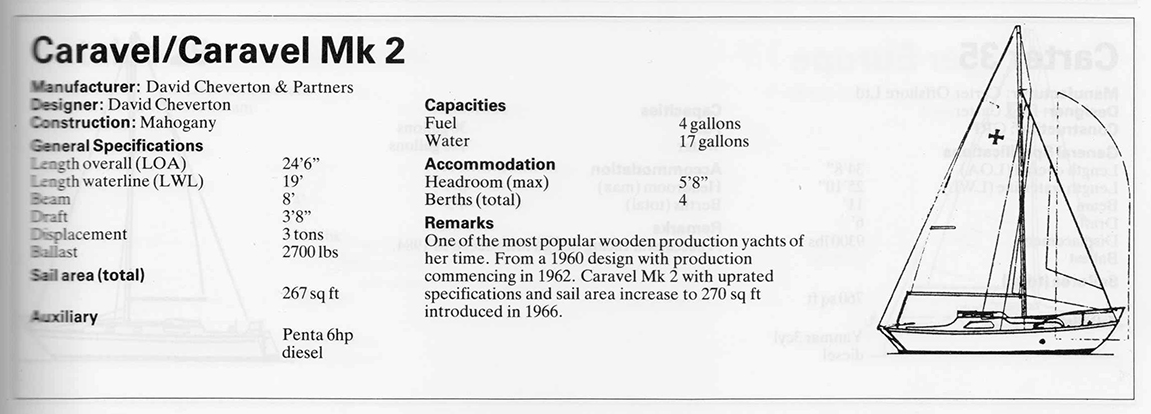
In 1964 the Mk II Caravel was advertised as having a displacement of 3 tons (presumably English 2240 lb tons) hence 6,720 lbs, and ballast of 2,700 lbs.
 
In 1964 the Mk II Caravel was advertised as having a displacement of 3 tons (presumably English 2240 lb tons) hence 6,720 lbs, and ballast of 2,700 lbs.

But where did you get that ballast figure of 2700Lb. from? From an assumption of a ballast ratio of 40%? It's the ballast ratio that he wants to know.
 
In 1964 the Mk II Caravel was advertised as having a displacement of 3 tons (presumably English 2240 lb tons) hence 6,720 lbs, and ballast of 2,700 lbs.

That's great information. Thank you

Do you mind me asking the source? Do you have an old advert or other source as I am sure that it would have lots of other useful information. I am in touch with a few other owners and I am sure we would all be very grateful for a copy of anything you have.
 
But where did you get that ballast figure of 2700Lb. from? From an assumption of a ballast ratio of 40%? It's the ballast ratio that he wants to know.
From the 1964 edition of Bristows Book of Yachts - details in the many editions of Bristows normally came from the builder, in this case Cheverton at Bath Rd., Cowes. If the OP emails me on jwilson at the address yachtsnet.co.uk I can scan the page and send it - I can't spot how to add an attachment to a PM on this forum.
 
Last edited:
From the 1964 edition of Bristows Book of Yachts - details in the many editions of Bristows normally came from the builder, in this case Cheverton at Bath Rd., Cowes. If the OP emails me on jwilson@spamnet.co.uk I can scan the page and send it - I can't spot how to add an attachment to a PM on this forum.
wouldnt a PM be safer

click on user name & remove yer mail address
 
That sounds about right. In those days we used to strive for 40 - 43% for any boat with racing aspirations. If I remember the neither the RORC or CCA penalised ballast until in excess of 45%.
 
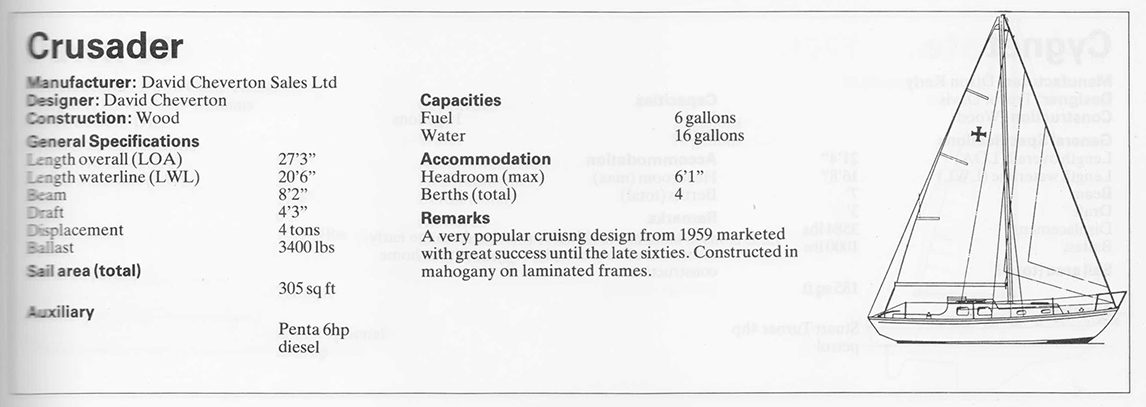
This is what I have from a Dayton's Guide to Yachts of Yesteryear published in 1988

Caravel.jpg
 
wouldnt a PM be safer

click on user name & remove yer mail address

Fascinating: I stupidly typed my full email address and then 30 mins later realised I'd done it. However the forum software changed it to a spamnet address which is not mine. Anyway, I've edited the post now and the meaning should be clear to humans if not email harvesters.

How do you add an attachment to a PM here - anyone know?
 
Fascinating: I stupidly typed my full email address and then 30 mins later realised I'd done it. However the forum software changed it to a spamnet address which is not mine. Anyway, I've edited the post now and the meaning should be clear to humans if not email harvesters.

How do you add an attachment to a PM here - anyone know?
I changed it in my reply Jimmy
 
Fascinating: I stupidly typed my full email address and then 30 mins later realised I'd done it. However the forum software changed it to a spamnet address which is not mine. Anyway, I've edited the post now and the meaning should be clear to humans if not email harvesters.

How do you add an attachment to a PM here - anyone know?
You can add a image or video to a pm in the same way as on a thread. Click the images in the toolbar above the box that you write in.
Jim
 
I am trying to fill in a racing rating for club racing and form is asking about the Ballast ratio. I know what the term means, I even know how to calculate it but what I dont know is what the actual weights are.

She is a 1961 Cheverton Caravel MK2. Wood hull, iron keel - "long keel with bow cut" off is I think the correct description. 3 Ton displacement. 24.5 ft LOA, 19 ft LWL. 8 ft beam. The same model was a JOG entry in the 60's and was built under Lloyds supervision.

I am told that an estimate would be OK as a starting position, as the rating gets reviewed in line with results, but I dont have a clue where to start and I also don't want to be a bandit!!

Anyone got any idea what the estimate should be or any idea how to find out without taking her out of the water and trying to measure the keel (which I think cuold be difficult to calculate accuratly from beause of its curved shape)?

Original brochure details on this site http://www.cheverton.org.uk/caravel.html

Someone on here might be able to tell you http://www.classicboat.co.uk/forums/showthread.php?t=270842

Also "Cheverton Caravel Owners Club
Mike Winter tell us that the Cheverton Yard on the Isle of Wight, built Caravels in the 1950s, prior to the yard being sold to Fairey Marine after which it concentrated on military craft. Mike has this boat moored in Weymouth is looking to contact other owners of David Cheverton boats with the thought of starting a club if one does not exist at present. He can be reached by email at ifamike@btopenworld.com"
 
Thanks again for all the info. I will circulate to the other Cheverton owners I know including Gone Sailing of this forum who runs the Cheverton website.

Sailorman: All you now have to do is "Win" good luck

Last year at Cowes Classics my strategy was to "start at the back and stay out of everyone's way". We came second to last, so it just goes to show :) But it was great fun and I am sure that the competitive strak will kick in once I feel I have the boat and my skills up to where I want them to be.

Slightly off topic, taking the numbers above how would you describe the AVS and Stability for the boat?

I have always assumed that the older design would be a more stable and more able to right themselves than more modern designs, but I used an online calculator today and it appeared to say that AVS was 110%. Does that mean that she is less able to resit capsize and if she does go over, will she stay there?
 
Top