Cabin Sole Boards - starting afresh

Talulah

Well-Known Member
Joined
27 Feb 2004
Messages
5,826
Location
West London/Gosport
Visit site
If you were to make cabin sole boards out of solid wood instead of veneered plywood what wood would you use to get a similar effect?
Veneered plywood is often Teak and Holly effect but you certainly wouldn't use solid teak and holly. Just too expensive. What about Mahogony? What contrasting wood would you use to go with that?
 
Just from a cost point of view (and assuming you're determined to use solid timber), I would use iroko and inlay a few strips of redwood using a router (redwood being the softwood sold as planed-all-round softwood at timber merchants, not B and Q as they sell planed up rubbish.
But from a practical point of view I would use WBP ply - if you can select something with a fairly decent face it will probably have a reddish brown face veneer (a bit like mahogany) and you can inlay some redwood strips just as with solid wood. A few coats of varnish or whatever you prefer as a finish and it will look ok. You're only going to walk on it after all.
From a comfort point of view I would use WBP with cheap polysomething carpet (or carpet tiles) on top. Much more comfortable, less noise, and when it gets too grubby you chuck it away and replace.
 
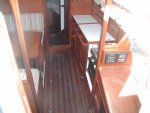
I used solid wood on top of 19mm ply like this.

The timber I used was Iroko and Jacaranda. The Iroko goes dark brown over time and the Jacaranda stays near white
 
Would a solid board not distort? The only experience I have is seeing solid flooring laid in a conservatory that had to be re-laid after 2 years because it had distorted due to changes in temperature and humidity. A cheaper laminated board was successfully laid.
 
Yes, I'd be concerned about distortion too. I've seen similar constructions cup. The textbooks would say it needs an equivalent layer of wood on the back. That iroko and jacaranda looks very classy indeed, Roger. Is the hardwood layer thin enough so that the comparatively thick ply keeps it flat?
 
Among the advantages of using ply for a cabin sole is the stability and strength it offers. If you replace it with solid (strip) wood, then it will have to be much thicker to remain stable and solidly fastened to prevent warping. Finishing can be easier with solid timber as a dent will add character rather than look shoddy as it does on ply laminate. My own sole is (I think) alternate strips of teak and mahogany, it is finished in Deks Olje #1 which gives a soft sheen and is easy to refinish.companionway.jpg

The wood is around 3/4 inch thick.

Rob.
 
Just from a cost point of view (and assuming you're determined to use solid timber), I would use iroko and inlay a few strips of redwood using a router redwood being the softwood
:) the other way around.
Reason for using stripped flooring was to have those thin strips made of hardwood, protruding slightly from beginning - make anti-slip. Strip-planking of it all prevented distortions.

Reason of using strips, instead of just a wide board, is to combat warping and distortions. Exactly same principle as in plywood - direction of grain is changed from one layer to the other, so it counteracts. So never use just a board with inlays - it's made of alternatively laid strips of wood. Otherwise - use plywood and put strips in - but this is erzatz for imitating the looks of real thing.

In fact floor made of proper wood is better then ply, more resistant and lighter for same strength, long lived too; but of course work and time consuming, so rarely used today.
In case you are decided I have exact methodes, woods, thicknesses etc described somewhere, as can't recall it for a moment.

P.S. One boat I know had mahogany wide strips and thin strips of "african blackwood" whatever species this is. Another combination I know was used is larch and Jatoba - Jatoba certainly is very hard and blackish, have it under me at the moment; but larch must be cut "the marine way", vertical grain, and traditionally dried; just it's cheaply available here, like pine which also may be used, but also vertical grain only - or you get splinters in the toe...
Another combination is Fraxinus excelsior - common ash it's in English, just not sure - white and hard, combined with coloured but softer wood.
From UK perspective probably mahogany (you will not have real mahogany, nonexistent now, so check actual name and properties) mixed with hard oak or ash - colouring will be other way around but oak/ash is hardwood here and will give the real effect, that is of nonskid. Or may be soaked with woodstain well.
Another thing to remember - such floors were made as solid, nailed to sole beams. Same way as decks. In case a loose, lifting panels were sought, they were made with underlying 'stiffeners' or such, beams across, and strips often glued together or nailed to each other (diagonally, alternating the nail angle) as in strip-planking.

(where is the point of writing some here when "service unavailable" results in loss of all that's been written? Geee... )
 
Last edited:
Top