Buying my first british boat - Princess V65. What to look for?

Brunan

Active Member
Joined
31 Oct 2017
Messages
50
Location
Sweden
Visit site
So after several italian and german boats I'm about to but my first british one!

In this case a Princess V65 from 2007 with MAN v10's.
Princess is a new brand for me, what should I look for when perform the survey of this modell?
Also If there is anyone that can tell me how logic behind the Princess hull numbers that would be great for me to understand the example I will be looking at.

BR Krister
 
Our Princess 67 is about the same size and vintage.
I can't help with "what to look out for".
Much the same for any boat.
Princess hulls seem to be robust and I don't know of any problems with them.
That vintage will be hand laid (they injection mould these days).
But I have never heard of osmosis on a Princess so the hull should be good.
All the problems will be in the components - steering systems, engines, generator, air con, etc....
Everything that a surveyor should pick up.

AFAIK the hull numbers don't really mean much.
They are sequential and Princess will be able to "narrow down" the build from the hull number.
The yard number will be something like P65123
In the factory, they also referred to the "slot number".
I believe that slot numbers refer to the "orders placed in the factory".
So a boat could have a slot number of 57 with a hull number of P65083
As I say not really much help.
If you are referring to the HIN (printed on the starboard stern quarter) , I can't see any correlation between the yard/slot number and HIN number for our Princess 67.
 
Here is a link to another Princess V 65 from 2007 for sale.
2007 Princess V65 Motor Yacht for sale - YachtWorld
I can't help the OP with any specific knowledge on the V65, but I noticed the engines he mentioned, because gut feeling alone made me consider them on the weak side, for that type/size of boat.
And it appears that I wasn't too far off the mark, because the boat in your link is the very same model/year, but powered by the MAN V12/1360hp.
Which means that the boat was designed to take the longer V12, optimizing everything for their output, and then offered with the V10 to make her price a bit more attractive.
Not that Prin is alone in doing that - I can't think of any builder who never used this trick, in fact. But a trick it is, anyway...
Brunan, unless she's the bargain of the century, I'd rather look for one which was built with the (much better) V12s.
 
I can't help the OP with any specific knowledge on the V65, but I noticed the engines he mentioned, because gut feeling alone made me consider them on the weak side, for that type/size of boat.
And it appears that I wasn't too far off the mark, because the boat in your link is the very same model/year, but powered by the MAN V12/1360hp.
Which means that the boat was designed to take the longer V12, optimizing everything for their output, and then offered with the V10 to make her price a bit more attractive.
Not that Prin is alone in doing that - I can't think of any builder who never used this trick, in fact. But a trick it is, anyway...
Brunan, unless she's the bargain of the century, I'd rather look for one which was built with the (much better) V12s.
Not sure that your point is that valid in this case.
When I looked, the Man V10s are rated at 1100HP each,
And, you say that the V12s are 1360HP.
Compare that HP with our P67 which is a very similar hull but I suspect that we are a little bit heavier.
Our MTUs are 1200HP each.
Yes, the V10s would be less power but our P67 is good for 33 knots on her 1200 HP engines (actually 34 knots when she was new).
IMO, the 1100 HP Mans on a lighter V65 boat wouldn't be THAT bad.
I know that the V65 is supposed to be a sports boat but, fr me, I wouldn't run her more than about 25 knots anyway.
And I'm sure that the V10s would manage that.

Much more important to look at the other stuff on the boat.

I had a look at the V65 market and personally I'm not a great fan of the boat.
I know it is what you are used to but I much prefer the flybridge alternatives (either the P65 or, of course, our P67)
 
Mk.2 Princess V65 is an okay boat. She seems to be in all the reviews the weaker for sea keeping versus the other 19 meters competitive (main stream) hard top yachts of that era.
Targa 62/64 scores high. then Sunseeker 62/64 Predator, and Azimut 62 S are all being told of being better sea boats.
Mk.1 which was very popular to its very large cockpit space is a very wet submarine ride.
Even though the Mk.2 has the same hull as the Mk.1 they improved this by moving the engines aft in order to offer a large midships cabin.
But Mk.2 also looses the large cockpit, due to it being split with a patio door. Still she is the most spacious in its category for that era, also thanks to it for it being a bit bigger to most of the direct competition (see above).
 
I can't help the OP with any specific knowledge on the V65, but I noticed the engines he mentioned, because gut feeling alone made me consider them on the weak side, for that type/size of boat.
And it appears that I wasn't too far off the mark, because the boat in your link is the very same model/year, but powered by the MAN V12/1360hp.
Which means that the boat was designed to take the longer V12, optimizing everything for their output, and then offered with the V10 to make her price a bit more attractive.
Not that Prin is alone in doing that - I can't think of any builder who never used this trick, in fact. But a trick it is, anyway...
Brunan, unless she's the bargain of the century, I'd rather look for one which was built with the (much better) V12s.

Think the V10 should be fine, if they wouldn't be they would have not been an factory option. Then of course you can prefer the V12's but I seldom run more than 8knots anyway :)
 
Not sure that your point is that valid in this case.
I'm not sure either - mine was just inference reasoning, with no first hand experience on the V65.
I wouldn't put the MAN V10 and your MTUs V8 in the same league, anyway.
Chalk and cheese springs to mind.
 
Sometimes I want to run at 30 knots then I want to have capability to do, so yes for me it's a good option.
Agreed - essentially, thats what we do.
Not 8 knots though - these boats are doing over 6 knots at "tick over".
I usually run at 10 knots - thats a tad faster than the displacement speed. At 10 knots, I feel that the stern has started to dig in and gives the whole boat a more stable feeling.
Then, to ease the boredom. we pop her on the plane for a few miles every 15 miles or so.
Then that awful bit at the end of an open passage where you can see the land but it seems to take forever to get there - we tend to open the throttles at that point as well.
I think it is good for the engines to give them a bit of exercise at the end of a slow passage.
Mind you, I always keep it far less than 30 knots - we cruise at 10 knots or 25 knots.

Here is a video from the time when we did a passage like that from Spain down to MapisM's area of the Med.
Sorry about the jerkiness - taken before image stabilisation was the norm in cameras.
This video shows the kind of thing that I say above:-

 
There’s nothing wrong with the idea of running D speed in a high speed planing boat .With the odd blast now and again to blow it out .If the hrs are low never be 1000 s
I have access via MDMS a full suite of engine parameter nerdy info .
Running at 9 knots which is 9.5 down wind , the revs are 870 rpm , EGT circa 350 degrees and fuel something stupidly low like 18 L /hr a side , , but crucially load around 55 % .

Thing is on the plotter I can see time to destination.
Say 45 mins so that’s fuel wise 3/4 of 36 L = 27 L used .Full tanks over 2000 L , so hardly a drop used .
How ever if calm ish and baking hot it’s nice to enjoy the breeze back from out fav anchor spot to the berth .Often with the geny and Aircon on initiating cooling below .

Turning it around if I get it up , there is a kinda dead spot between 20 - 25 knots , it’s no fast enough to sit level , it rides bow high unkess I give it excess tab to lift the stern .
Over 26 knots it’s settles into a optimal lowering 4 degree planing angle .
28/29 knots is the sweet spot both in hull attitude with zero tab ( it’s creating loadsa stern lift naturally without tabs ) and engine note .The turbos ( MANs I like the “ whine “ ) sound great at 1780 rpm , boost is full all is well .

Now let’s turn to the other stuff .
EGT s a healthy 550:degrees in theory the best temp to reduce engine wearing soot clusters in the semi unburnt low EGT scenarios like @ 9 knots 350 degrees .
Load a healthy 75-77 % , still a bit left over to increase to the magic 80 % .Many American sport fishers swear that longevity reduces significantly if you constantly have to keep exceeding 80 % load .I not gonna contest that do not need to !
Theses guys are not pratting about doing leisure 100 hrs / year they are clicking up over a 1000 + hrs a season for the past 20 years .That community, sport fisher know what prematurely knackers engines and what extends longevity .

So fuel burn same trip at 28/29:knots .
Well the plotter say something like 13 mins to destination.
L/hr says 85 , so 170 , being generous just short of a 1/4 hr so about 42 L
13/60 x 170 exactly is 36.8 L

So for the sake of saving ( 27) to 36.8 , less than 10 L .
In terms of overall running costs those saved 10 L are negligible, out of 2000 + litres .

Another thing .
If I pootled back then next day pootled again to an anchorage ( remember EGTs 350 ) , 1 hr 1/2s running 2x 45 mins I notice this .
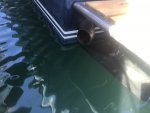
In the waves sometimes the rear quarter stern pipes submerge and a oily film gets washed out .You know the rainbow effect .This last quite a while and remember we have to climb / dive in etc .
How ever if I run to the anchorage at 28 knots , nothing , no oily residue gets washed out .

0E32AD2A-ECBE-4118-B14B-B76710FB39EC.jpeg
So while Mr Google sort of helps reading around the subject , the oily residue of properly un burnt fuel running at D is there in plane sight .

My inclination would be in a planning boat plane it as much as possible and find away of accommodating the fuel bills .
In the interests of engine longevity.Basically the rings at 350 degrees are not hot enough to seal as desired they are designed for 500-650 ish .
My boat in the past 6 seasons refused to consume ( or leak ) any oil .
The levels have been spot in mid marks between 480 and 1000 hrs with annual oil changes .I know why ;)
 
Last edited:
So the ring expansion is insufficient at 350 degrees compared to say 550 and oil gets past then and burnt .
Lowers the oil level - no biggie you can top up .
But soot products go the other way and enter the oil.
Secondly this extra oil burn can foul up the injector tips , bits of crap star forming on the nozzle spray holes .
Thirdly the diesel itself never quite completely burns as best it could at theses lower temps + pressure and again largish crap particles of unburnt diesel swirl about .1 further clogging up the injectors .This is different as well as the burnt excess oil .
2- theses unburnt diesel particles are unlike the oil pretty abrasive.
Its the abrasive side that does the unseen insidious damage .

Modern CR injectors have multi smaller holes than say the ones in a Gardner 6XLB or Trad Perkins etc that’s why the older school engines went on for ever a tick over , D speed or what ever .
Having said that with today’s modern CR the ECU s measure so many things they can reduce the squirt down to suit the lower EGTs indeed actually do sequential multi squirts per cycle anyhow .Not just one squirt like earlier engines .
That electrotwackerey like in Hurricane s MTU save the day I think reduces the agglomeration down so he can get away with pootling .
Oil consumption as I said is do able .
But injector health from the excess oil is still compromised.

All depends what you have what year, the generation of the injector and ECU system running them .
There is no one statement that fits all here .

As I said for me none CR basic ECUs by CR standard I see the rainbow oil residue after a pootle and think hmm my poor injectors and cylinder bore s .
 
Sorry I can not get the link to work but here is the text from a marine diesel forum .

———/————

Engine soot is a common byproduct in diesel engines. Soot is formed as the result of incomplete fuel combustion. Diesel fuels are composed of hydrocarbons, containing both carbon and hydrogen, and when undergoing complete combustion, the only byproducts are CO2 and water. Fact is, no diesel engine is completely efficient and complete combustion does not occur. Complete combustion would require a very lean ratio of fuel to air, whereas real engine conditions exhibit richer fuel mixtures. The less air that is present in the ratio, the more favorable the conditions for soot accumulation.

Soot formation is more pronounced in newer, but any diesel engine. While fuel is injected during the compression stroke and ignited spontaneously from the pressure in diesel engines. Diesel engines produce fuel-dense pockets in the combustion chamber that produce soot when ignited. Newer exhaust gas recirculation (EGR) diesel engines, designed to reduce NOx emissions by routing part of the engine exhaust stream through an intercooler and back to the intake manifold, further compound soot problems in diesel engine oils.

Excessive soot concentrations in oil can be caused by a number of factors. Worn out rings or injectors, excessive idling, poor fuel spray patterns and incorrect air-fuel ratios are major causes of soot formation. A faulty fuel nozzle may spray more fuel than desired, increasing the fuel-to-air ratio and causing incomplete combustion and soot accumulation, or the air filter may become clogged, decreasing air supply and increasing the fuel-air ratio.

Soot particles are spherical in shape and 98 percent carbon by weight. They are a very small size of around 0.03 microns, but they often agglomerate to form larger particles. Although the majority of soot produced during combustion exits through the exhaust, some passes through the rings of the combustion chamber and enters the engine oil. As long as these soot particles remain suspended in the oil and are not allowed to agglomerate, they pose little risk to engine parts. It is up to the motor oil dispersants to keep soot particles dispersed. However, in high soot conditions, dispersants can become quickly depleted.

High soot load conditions lead to loss of oil dispersancy as oil dispersant additives are consumed. As dispersancy is lost, soot particles agglomerate and form larger particles that build up on engine surfaces. This soot and sludge eventually impedes oil flow, and it can also form in oil filters, blocking oil flow and allowing dirty oil to circulate through the engine. In addition, high soot levels within a motor oil increase its viscosity, further impeding oil flow and increasing engine wear. Anti-wear additive performance is also affected in high soot conditions as additives are gradually removed from the oil by adsorption to soot particles, leading to increased wear and premature engine failure.

Another negative effect of high soot conditions is the formation of carbon particles on the piston ring grooves, causing degradation of the oil seal between the ring and cylinder liner and abrading the ring and liner. As the gap between the ring and liner increases, combustion byproducts such as gases and unburned fuels blow into the crankcase, a problem known as blow-by, eventually causing expanding gases to lose ability to push the piston down and generate the power necessary to propel the vehicle. Horsepower is lost and fuel efficiency decreases. Ring sticking and poor heat transfer from the piston to the cylinder wall can also result. Carbon, varnish, soot, wear metals, acids and HEAT are all normal operating factors to consider when planning an effective diesel maintenance program.

Current industry standards outline acceptable levels of oil contaminants through a standardized oil sample test programs. These tests are available through engine manufacturers and testing laboratories. These standards have been set by the Society of Automotive Engineers (SAE), the Automotive Petroleum Institute (API) and the engine manufacturers worldwide.
 
Well - now we all know - then!!


Actually, the difference in fuel burn between displacement and planing is significant and its not all about saving a few quid.
Using the above cruising concepts, we can cruise from our home berth out to the Balearic Islands - stay on anchor for a week or so and return without having to waste time going in for fuel.
A complete round trip, even without getting close to empty.
Believe me it DOES make a difference.
 
Last edited:
Well - now we all know - then!!


Actually, the difference in fuel burn between displacement and planing is significant and its not all about saving a few quid.
Using the above cruising concepts, we can cruise from our home berth out to the Balearic Islands - stay on anchor for a week or so and return without having to waste time going in for fuel.
A complete round trip, even without getting close to empty.
Believe me it DOES make a difference.
Agreed on a long trip , the distance i illustrated was approx iirc 7 miles .
So using 7
70 miles saves 100 L for me , the diff was 10 L on that fav local get out and swim anchorage trip .
700 miles saves 1000 L .
Yours numbers I guess are at least 2 x ?
So 2000 L saving over a typical Med big island 700 mile ish cruise is certainly significant .

And you are right on your second point the phaff of a busy fuel pontoon in high season @ near 5 pm when all the hire boats are buzzing around waiting to refill .Or a SY just ties up when you arrive . 1 hr later it’s still filling .
 
So after several italian and german boats I'm about to but my first british one!

In this case a Princess V65 from 2007 with MAN v10's.
Princess is a new brand for me, what should I look for when perform the survey of this modell?
Also If there is anyone that can tell me how logic behind the Princess hull numbers that would be great for me to understand the example I will be looking at.

BR Krister
Hello Brunan, did you find a v65 or go a digfernt direction?
 
Top