Bukh Stop Solenoid diesel Bukh dv10

sctpc

Member
Joined
23 Jul 2012
Messages
24
Location
Melbourne Australia
Visit site
Hi I have a problem with my dv10 sending an alarm I thought it was ether the Amps, Oil or temp but on pulling my panel off the voltage was coming from the stop solenoid wire (2) when I disconnected it the alarm stopped I can stop, start the DV10 all looks good.

My Question is what is wrong as this wire was not live then it is? where would it get voltage from? could the stop solenoid be shorting back up the wire, I am concerned one day I wont be able to stop it.
 
You can stop it if you put a bit of caot hanger wire in and pull to stop.

Worked fore me till my local auto electrician found me a replacement at less than half the price.

Good luck and fair winds. :)
 
were would you put the wire I dont have easy access to the back of it? and why would the wire now have current to the alarm? :confused::confused::confused: I dont know if I can trust it but in AU I have not found a mechanic who knows much about Bukh hence joining the great forum.
 
Hi I have a problem with my dv10 sending an alarm I thought it was ether the Amps, Oil or temp but on pulling my panel off the voltage was coming from the stop solenoid wire (2) when I disconnected it the alarm stopped I can stop, start the DV10 all looks good.

My Question is what is wrong as this wire was not live then it is? where would it get voltage from? could the stop solenoid be shorting back up the wire, I am concerned one day I wont be able to stop it.

The engine is stopped by energizing the stop solenoid when the key is turned to the "stop" position. Once the engine has stopped the key should be returned to the "off" position. The key should not be kept in the "stop" position for longer than is necessary to stop the engine due to the realtively large current which will flow through the stop solenoid

This is explained in the owners manual.

My wiring diagram is not clear but it appears that there is a connection between the stop solenoid wiring and the alarm circuit. Presumably the alarm normally sounds while the key is in the "stop" position ?

Perhaps you should check that the key switch is not faulty and allowing the stop circuit to be energised while in the "Off" position
 
Last edited:
The engine is stopped by energizing the stop solenoid when the key is turned to the "stop" position. Once the engine has stopped the key should be returned to the "off" position.

Perhaps you should check that the key switch is not faulty and allowing the stop circuit to be energised while in the "Off" position

The key in the stop is still starting alarm well the engine is stopping when I turn it to "off" all is good.

when I disconnected 2 wire the power is always (when key is on ) powered to 12v the other end goes to the the "stop solenoid" this is where the 12v is coming from and when the 2 wire is plugged in it charges the alarm.

Sorry to confuse you its hard to explain as I dont know how its getting power as nothing has changed.
 
I'm not convinced this is a problem.
From your description, it all appears to be normal operation.
Position "e" or "stop" has two functions -
1. energises the stop solenoid, and
2. tests the alarm circuitry.

see page 23 here (& VicS post).
http://www.bluemoment.com/manuals/Bukh_DV_10_L_Owners_Handbook.pdf

(the bukh electrical panels can vary a lot - my own setup has the stop solenoid on on a seperate push button - I don't believe I have an audible alarm circuit).
 
The key in the stop is still starting alarm well the engine is stopping when I turn it to "off" all is good.

when I disconnected 2 wire the power is always (when key is on ) powered to 12v the other end goes to the the "stop solenoid" this is where the 12v is coming from and when the 2 wire is plugged in it charges the alarm.

Sorry to confuse you its hard to explain as I dont know how its getting power as nothing has changed.

The wire to the stop solenoid should get its power from the key switch when the key switch is turned to the "Off" position

There should no power on this wire at any other time.
If there is, either the switch is faulty or there is fault somewhere in the wiring.

Try disconnecting the wire from the switch.
If the power is removed from the wire and the alarm stops sounding then it indicates that the switch is probably faulty.


If there was wiring fault the wire would probably have power on it all the time, the solenoid would be energised and you would not be able to start the engine ...
 
Last edited:
I'm not convinced this is a problem.
From your description, it all appears to be normal operation.
Position "e" or "stop" has two functions -
1. energises the stop solenoid, and
2. tests the alarm circuitry.

see page 23 here (& VicS post).
http://www.bluemoment.com/manuals/Bukh_DV_10_L_Owners_Handbook.pdf

(the bukh electrical panels can vary a lot - my own setup has the stop solenoid on on a seperate push button - I don't believe I have an audible alarm circuit).

+1
you turn the key anticlockwise till the engine stops, alarm sounds throughout and continues after stopping, then you turn the key to off, alarm goes out. Mine has been like that for 13yrs, its normal operation. don't mess with it.
 
Vics thats what I did if you go to CIMOs pdf, page 24 the "No 20 Diode" I had to pull off "No 2" wire that comes up from "Rod 4" saying 1.5mm sort coming direct is the one sending the 12v back to the switch.

So in my thinking the lower (rod, Diode ) is sending up the 12v from
A. A short coming from the stop coil
B. 1.5mm brun is not active when No2 is not pluged in No 20
C. the lower rod Diode no 3 & 7 connect from the key Aux and supply retrospectively I have not checked if they have voltage or not and would not know if they should when the motor is running.

The key to diode 20 has no power till I turn off, if I have disconnected the cable from the other terminal 20 no 2.

Cimo I know there is a problem as the voltage is coming up from the motor diode but with the wire at No 20 disconnected all works well, now if something had been new or done I could blame it but all I have done since it last worked is,
Changed my Exhaust injection elbow changed the oil, filter the anode and the raw water pump impala then shut the boat up for winter last week this problem was hear to great me.
 
I had another look, although the pdf for page 24 is not great quality unfortunately.

according to the legend on page 23,
20 is the diode plate (does it have resistors also?).
2 is the alarm sounder.
1 is the ignition switch.

If the alarm is sounding while the key is in position "a" or "off", you've obviously got a short somewhere. It's highly unlikey that the solenoid is producing the 12v you are seeing on the "sort" (or black) wire. So that would leave the ignition switch itself (as per VicS), or indeed the Diode plate.

You should be able to fault find with your meter? If its feasible, take note of the wiring and completely remove the ignition switch from the circuit (less confusing perhaps if you were to avoid voltage readings).

Use the lowest ohms setting on your meter and check for shorts on the ignition switch - check thru each ketswitch position.
Use the diode setting to check each individual diode on the diode plate.

(tip - I'd check the diode plate first, before removing the switch).

good luck & let us know how you get on.
 
I have also had another look at this.

You say that disconnecting the black wire , which is the connection to the stop solenoid , from terminal 2 of the diode plate silences the alarm.

I am somewhat confused by this .

There should only be power on this wire when the key switch is in the "Stop" position. The power comes from the key switch (terminal 58)

If there is power on this wire from elsewhere then it indicates a fault in the wiring, or a wire touching the terminal on the solenoid perhaps.

If there is power on this wire from elsewhere the solenoid will be energised and it will not be possible to start the engine!

Still therefore puzzled. It seemed far more logical that a faulty key switch was the cause but disconnecting the black wire would not silence the alarm in that case. Merely deactivate the stop solenod

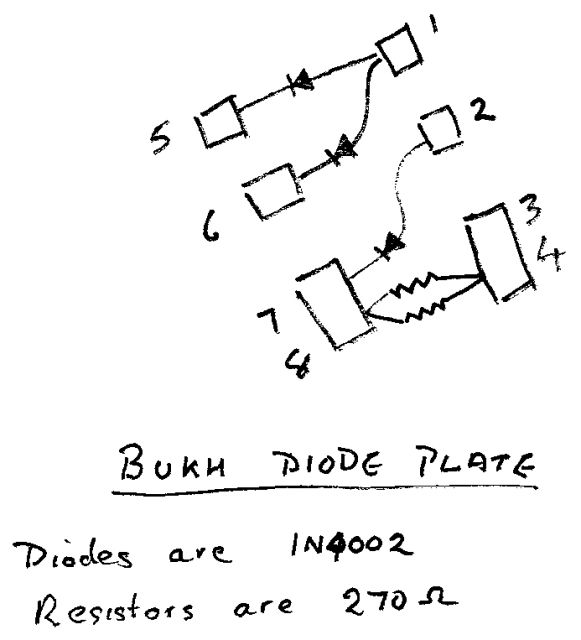
However in the course of the investigations I have found details of the diode plate which may be of interest and help to understand how the alarm circuits function.


The upper two diodes allow the alarm to sound in the event of a high water temperature or a low oil pressure.

The lower diode allows the alarm to sound if the keyswitch remains in the "stop" position after the engine has stopped.

The two resistors provide excitation current to the alternator in addition to that provided by the generator warning lamp. They became necessary when the warning light power was reduced from its original 2 watts to 0.5 watts.
 
Last edited:
I have also had another look at this.

You say that disconnecting the black wire , which is the connection to the stop solenoid , from terminal 2 of the diode plate silences the alarm.

I am somewhat confused by this .

There should only be power on this wire when the key switch is in the "Stop" position. The power comes from the key switch (terminal 58)

If there is power on this wire from elsewhere then it indicates a fault in the wiring, or a wire touching the terminal on the solenoid perhaps.

If there is power on this wire from elsewhere the solenoid will be energised and it will not be possible to start the engine!

Still therefore puzzled. It seemed far more logical that a faulty key switch was the cause but disconnecting the black wire would not silence the alarm in that case. Merely deactivate the stop solenod

However in the course of the investigations I have found details of the diode plate which may be of interest and help to understand how the alarm circuits function.


The upper two diodes allow the alarm to sound in the event of a high water temperature or a low oil pressure.

The lower diode allows the alarm to sound if the keyswitch remains in the "stop" position after the engine has stopped.

The two resistors provide excitation current to the alternator in addition to that provided by the generator warning lamp. They became necessary when the warning light power was reduced from its original 2 watts to 0.2 watts.

Brilliant thread, guys. I have a BUKH 10hp. and often wondered how the stop / solenoid alarm functions.
Many thanks,
Lancelot
 
Brilliant thread, guys. I have a BUKH 10hp. and often wondered how the stop / solenoid alarm functions.
Many thanks,
Lancelot

Maybe for you I still have to work out this strange problem :(

Vic what do you think the Diode could have gone to let the current travel the wrong way to set off the alarm?

Even when I disconnected 2 the oil, temp and amp alarm still work that what has me so baffled when I pull the wire it works normal, as per last summer and the last 2 years I had the boat.

I am appreciative for all your help I just could not get out to the boat last week as its still winter in AU
 
It seems that the BUKH control panel wiring has changed over the years. My (1984) BUKH20 panel circuitry is (was) more complicated than VicS diagram.

My panel used resistor-diode logic to determine when the alarm should sound essentially dependent on the combined states of the oil pressure switch; alternator warning light circuit; and 'ignition' switch position. (I have the original circuit somewhere if anyone REALLY wants it).

As reported several times before, this particular BUKH panel variant suffers from corrosion of the PCB - on the component side- causing all sorts of erroneous alarm conditions.

I long ago rewired my panel in a much more straightforward manner.
 
This is probably bleeding obvious, but have you measured the diodes (forward/reverse resistance). Leakage current? - may be worth changing the diodes. Do the resistors read OK.?
Lancelot
 
Maybe for you I still have to work out this strange problem :(

Vic what do you think the Diode could have gone to let the current travel the wrong way to set off the alarm?

Even when I disconnected 2 the oil, temp and amp alarm still work that what has me so baffled when I pull the wire it works normal, as per last summer and the last 2 years I had the boat.

I am appreciative for all your help I just could not get out to the boat last week as its still winter in AU

If the diode in the stop circuit failed open circuit the alarm would not sound when the key was left in the stop position.

If it failed short circuited the stop solenoid would be energised from the alternator field circuit and the engine would stop/not run!
 
This is probably bleeding obvious, but have you measured the diodes (forward/reverse resistance). Leakage current? - may be worth changing the diodes. Do the resistors read OK.?
Lancelot

Well I haven't got back to the boat yet i`m planing to go tomorrow depending on wind as I have to row out, I now have the wiring diagram so at least I can trace where is goes down to the stop solenoid but ill have to empty a locker to get anywhere near the wiring.
 
I have been following this thread as i have a problem with my Bukh 20 I don’t get an alarm sounding at all, (buzzer ok) the manual says the diode plate should look like the one in Vics diagram. But mine looks like this

View attachment 19936
 
I have been following this thread as i have a problem with my Bukh 20 I don’t get an alarm sounding at all, (buzzer ok) the manual says the diode plate should look like the one in Vics diagram. But mine looks like this

View attachment 19936

Your picture is too small. It does not seem to be athumbnail linking to a larger picture.

Can you follow the instructions for posting images as attachments, using a larger one

Better still use photobucket
 
Top