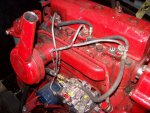
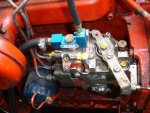
Bukh injection pump(?) leak

FURTHER UPDATE:
I found that the Bukh Workshop manual does have info on removal/replacement of the injection pump (I'd somehow missed it before), albeit in Bukh's usual somewhat opaque translation. It convinced me the job was beyond what I should take on just now.

I did find the following useful explanation and drawings of the Bosch VE pump, and both how it works and which bit is which is now much clearer to me. http://stuff.is-a-geek.net/OnlineDocs/Vehicles/vepump.html

Fox's and several others didn't want to do the job of taking off and replacing the pump - too booked up, most of them say. I have now, though, found someone called Travis(?) who can. (I think he's based at Ipswich Haven.)
 
LittleSister if you are looking at the manual it will go into the complicated process of timing the pump upon refitting which you need the proper specific pump dial gauge. It is not as complicated as the manual makes out, but if you don't feel confident it is best to leave to someone else. The gearwheel driving the pump needs to come off or at least the nut removed and you will notice the pump is keyed to the gearwheel. The timing needs to be marked before removing the pump as the gearwheel can be put back in the wrong position. It is very likely the seals of the pump have become hardened/flattened with age and that is what is causing the leak. The hydraulic head seal is a favourite on you're pump. They can not be replaced in situ, the pump has to be stripped. You have a rotary pump, not an inline pump so no cams. When one seal goes the rest can't be in great condition, all the seals will be replaced when the pump is repaired. Good luck.
 
LittleSister if you are looking at the manual it will go into the complicated process of timing the pump upon refitting which you need the proper specific pump dial gauge. It is not as complicated as the manual makes out, but if you don't feel confident it is best to leave to someone else. The gearwheel driving the pump needs to come off or at least the nut removed and you will notice the pump is keyed to the gearwheel. The timing needs to be marked before removing the pump as the gearwheel can be put back in the wrong position. It is very likely the seals of the pump have become hardened/flattened with age and that is what is causing the leak. The hydraulic head seal is a favourite on you're pump. They can not be replaced in situ, the pump has to be stripped. You have a rotary pump, not an inline pump so no cams. When one seal goes the rest can't be in great condition, all the seals will be replaced when the pump is repaired. Good luck.

Thank you. It's all gradually becoming clearer.

I am almost getting to the stage where I would consider tackling the removal of the pump, but not the refitting/resetting.

Do I understand you correctly that if the position of the pump gearwheel relative to the corresponding gear on the engine is maintained (e.g. by marking where the two wheels meet, not turning the engine while pump is out, and refitting with the marks corresponding), that removes some of the initial set-up palaver described in the manual? Presumably fine adjustment still needs to be done using the elongated slots in the mounting flange, which also requires the dial gauge, the adapter to fit it to the pump, and the flywheel to be marked up against TDC?

I am intending, as you suggest, to get a full service of the pump, rather than just the presumed failed seal replaced. Getting the pump serviced seems the easy bit, as there are specialists willing to do the job. Getting someone to remove and replace the pump (and hoping they know what they're doing) has been the challenging bit.
 
Yes, if you mark up the crank/flywheel, and pump gearwheel positions and don't move anything and put everything back as they came off all should be ok. Try to turn the engine to where the manual says before removal. Mark the pump mounting to the engine before removing the bolts in the slots. You can also tell where the pump originally sat from the original engine paint, but scribe a mark on the pump body where it meets the engine. Your aim is to put it back exactly where it was. The average mechanic will do it this way anyway. One last point. The pump is quite hard to turn, and the shaft will spring round as you turn it (it is not a smooth action) so it may be difficult to get the keyway of the pump shaft to line up with the gearwheel. Not that difficult but a bit of trial and error, a tip is to paint the end of the keyway so its easier seen from the gearwheel side. Also be aware that the keyway may be loose, so don't loose it down the timing case when taking pump off! It may need peened lightly to make it a tight fit. Simply take your time, you will get there.
 
I see no one has mentioned the name T Norris Marine of Isleworth who are the
Bukh agents in the UK may have fuel pump timing instructions.
Their phone number is:- 020 8560 3453.
 
Last edited:
The OP. has a Bukh nor a Gardner or Fordson Major. The Bukh fuel pump body sits above and is operated by cams on the camshaft so can be lifted off without timing issues so long as it is replaced using the identical shim pack. Timing adjustment is made by adjusting the shim pack thickness. Most good injection specialists have a calibration rig for the pumps. These pumps are not unique to just Bukh but are used on many marine and agricultural engineering.

I know little about it, as can be seen from my previous posts, but I think you are mistaken.

As far as I can see -
The pump does not sit above the camshaft, and there is no reference to cams or shims in the Bukh manual.
The pump is on the side of the engine, and connected to it only by a gearwheel, fuel pipes and retaining bolts.
Timing is set by the position of the pump gearwheel vs. the engine's intermediate gearwheel, with fine adjustment by rotation of the pump body before clamping it up.

But thank you for trying to help!
 
I know little about it, as can be seen from my previous posts, but I think you are mistaken.

As far as I can see -
The pump does not sit above the camshaft, and there is no reference to cams or shims in the Bukh manual.
The pump is on the side of the engine, and connected to it only by a gearwheel, fuel pipes and retaining bolts.
Timing is set by the position of the pump gearwheel vs. the engine's intermediate gearwheel, with fine adjustment by rotation of the pump body before clamping it up.

But thank you for trying to help!

Sorry about that. All the Bukhs I have seen have the fuel pump mounted on the back of the crankcase as the one shown in an earlier post here. Also all the YouTube videos I have looked at have this type. I will see if I can find references to yours. As others have said you have to be very careful removing the type of pump you have to ensure that timing is retained when reassembling on the engine.
 
I'm pleased to report it's all now sorted.

My thanks to Travis (Diesel Marine, Ipswich), who removed and refitted the pump, and Peter (Attleborough Diesel Services) who serviced and refurbished it, both of whom were prompt, effective and very pleasant to deal with.

As a result of the advice I've received here, and seeing from a distance the removal/refitting job done, I now have a better understanding of it all, but hope the rejuvenated pump will outlast me and I never have to put that knowledge to the test!

Even had I had that knowledge previously, I would never have been able to get the gearwheel off the pump: it was extremely firmly stuck on the taper. It took a lot of skill and persistence from Travis, and the testing to destruction of a very expensive puller, to get it off.

Thanks again to all who provided advice and suggestions. :encouragement:
 
I'm pleased to report it's all now sorted.

My thanks to Travis (Diesel Marine, Ipswich), who removed and refitted the pump, and Peter (Attleborough Diesel Services) who serviced and refurbished it, both of whom were prompt, effective and very pleasant to deal with.

As a result of the advice I've received here, and seeing from a distance the removal/refitting job done, I now have a better understanding of it all, but hope the rejuvenated pump will outlast me and I never have to put that knowledge to the test!

Even had I had that knowledge previously, I would never have been able to get the gearwheel off the pump: it was extremely firmly stuck on the taper. It took a lot of skill and persistence from Travis, and the testing to destruction of a very expensive puller, to get it off.

Thanks again to all who provided advice and suggestions. :encouragement:

Thanks for letting us know all is good. The Bukh instructions for setting the correct gear mesh are difficult to find and I think from memory were quoted on one other forum so worth getting in the expert who has to persist till he gets it right. Enjoy your leak free sailing.
 
Thanks for letting us know all is good. The Bukh instructions for setting the correct gear mesh are difficult to find and I think from memory were quoted on one other forum so worth getting in the expert who has to persist till he gets it right. Enjoy your leak free sailing.

Thanks.

The instructions for pump timing are in the DV36 workshop manual (available online from Bukh (they still make them) and elsewhere), but in typical Bukh manual style they are somewhat sparse and cryptic (It's rumoured that the translation from Danish to English was via German!) They also assume that you are staring from scratch, fitting a new pump to a new engine.

As it happens, the pump had obviously been removed at sometime earlier in the engine's 40 year life, and someone had already marked the gearwheels. The fine adjustment of timing is done by rotating the body of the pump on its slotted mountings. Travis marked the exact position of the pump before removal, and when refitted to align these the engine started and ran fine. No recourse was therefore needed to the palaver with dial gauges, measuring and marking the flywheel against TDC, etc. (As Blackmercury had advised above.)

Excellent news. Are you able to carry out the plan you hoped for?

Was that the plan for world domination, or the shifting of the boat to Southwold? I'm planning on doing the latter on Sunday.

As a more general update, Diesco in Ipswich has definitely closed down according to several sources, and the cost of the pump servicing was vastly more than any of the figures quoted above.
 
I had the same issue 4 years ago and emailed the photo below to Al at Bukh. His reply was:

"The leak is caused by the failure of the 'o' ring part number 610A2414 which is fitted around the delivery valve which is the part that screws into the top of the fuel pump.
The parts are £2.38 each plus VAT and postage."

Replacing the o ring cured the leak.

View attachment 81529
Hey steve123

What whas the operation to change that seal? I have the exact same issue on a dv20 now. Can you just unscrew the pump carefully and replace the seal, then screw it back together without the need to adjust anything?
 
Hey steve123

What whas the operation to change that seal? I have the exact same issue on a dv20 now. Can you just unscrew the pump carefully and replace the seal, then screw it back together without the need to adjust anything?

I mean unscrew the delivery valve, and leave the pump in its place. Replace seal at the bottom of delivery valve, then just mount it back.

Sorry, its a littlebit hard for me all the technical terms. Please explain if i have got it all wrong
 
I mean unscrew the delivery valve, and leave the pump in its place. Replace seal at the bottom of delivery valve, then just mount it back.

Sorry, its a littlebit hard for me all the technical terms. Please explain if i have got it all wrong
I got the guy in the boatyard in France, where I keep the boat, to change it.
I was looking over his shoulder so not exactly sure but think it was as you described - replace the seal with the pump in place and nothing to adjust afterwards. I'd replace the both seals - if one is leaking the other is likely to leak soon.
 
I mean unscrew the delivery valve, and leave the pump in its place. Replace seal at the bottom of delivery valve, then just mount it back.

Sorry, its a littlebit hard for me all the technical terms. Please explain if i have got it all wrong

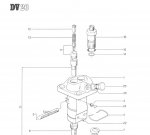
Yes you can, items 14(soft metal washer, probably copper) and 15(O ring).
bukh1.jpg
 
Everyone keeps talking about the 0 ring however the important seal here is not the O ring but the annealed copper washer. That must also be fished out as it may not stick to the delivery valve body and then it must be annealed by heating to red heat and plunging into water or replaced with a new copper washer. Even the new one should be annealed as it would have been work hardened during the manufacturing process.
 
Last edited:
Top