Bukh DV20 Exhaust elbow

Looks the same as bukh anode on Norris website and they only supply oem ( see pix)
View attachment 89593
Yes, I managed to find dimensions quoted as Diam. 12mm, len. 35mm width with 5mm (M5) threaded section. Exploded diagrams also show anodes with squared off ends.

I still have a strong memory of buying ones with rounded tips. I bulk bought from Denmark a few times as I knew I'd keep the boat for many years and a nearby boat also bought a few. I seem to remember ones in chandlery didn't match the ones I bought.

However, I would expect TS Norris to be selling the correct part. Probably just my failing memory as my last anode purchase was probably about 15 years ago.:D
 
Last edited:
The last few I bought from an eBay seller were Dia: 12.0mm Length: 35.5 and the threaded stub was 11.0mm long

I have been buying anodes annually since 1997 but, as far as I recall, none had a rounded end but that does not mean there never were any; just that I haven't seen them.
 
Now where was that info on flushing. Is there a drain plug for access?

There's a drain plug under the rear of the manifold and another on the side of the block (same side as the manifold), plus the one holding the anode. I used to flush out each winter by connecting to fresh water and running the engine for about 30-40 minutes. I'd let it cool down quite a bit and remove the drain plugs from top down. A fair amount of rust would come out of the one on the side, helped by poking around with some wire.

I didn't ever add any chemicals as the DV20 ran well and never showed any sign of overheating. I'm not certain about the best way to carry out a chemical flush. The thermostat would divert water from the block initially and I suppose it could be removed to make certain water was going through the block immediately. You would need some method of recirculating the cleaner.

I imagine that you wouldn't want to go near 60C with citric acid or sulfamic acid. I'd be tempted to simply warm the engine up using a fresh water hose prior to flushing. You could let it cool, remove the thermostat housing and drain via the side of the block. I think that you could then replace the drain plug and pour citric acid solution into the hole for the thermostat housing. I think that this would allow the block to slowly fill but you might need to remove the anode plug as well to fill more quickly and then replace it (minus the anode).

I never tried this out but all you are trying to do is fill the block and manifold waterways with a warm citric acid solution. Not ideal as you aren't re-circulating the liquid but it is cheap enough to repeat a couple of times. Perhaps others can suggest a better method.

Citric acid (or citric/malic acid) is cheap and easy to buy. It should clean reasonably well though being at 40C would help.
Sulfamic is stronger and I haven't ever bought any (though I used to have lots lying around on the lab. shelf in a previous life).
Rydlyme and other commercial product are probably stronger still. I'd hazard a guess that it would be based on hydrochloric acid.
 
Last edited:
Thanks mistroma for comprehensive reply.

My problem (as you can read above) is that so far I am unable to unbolt the thermostat housing. The long vertical Allen key bolts are solid. I am working on some form of dam to let them soak in diesel though so far hard to figure a way of sealing as the shape is irregular and complicated.
 
Thanks mistroma for comprehensive reply.

My problem (as you can read above) is that so far I am unable to unbolt the thermostat housing. The long vertical Allen key bolts are solid. I am working on some form of dam to let them soak in diesel though so far hard to figure a way of sealing as the shape is irregular and complicated.


How about taking the complete manifold off and placing in a bucket of diesel. By far the easiest way and local heat can be applied to the thermo housing in a far safer way.

You know it makes sense..........................
 
How about taking the complete manifold off and placing in a bucket of diesel. By far the easiest way and local heat can be applied to the thermo housing in a far safer way.

You know it makes sense..........................
Or take the head off and give an overhaul. I'll bet it's a long time since it had one, if ever. (y)
 
How about taking the complete manifold off and placing in a bucket of diesel. By far the easiest way and local heat can be applied to the thermo housing in a far safer way.

You know it makes sense..........................

Agreed that is the only solution. Bit wary of all the seized nuts and bolts it will take to remove the whole manifold plus access off the side of the engine bay to lift it sideways off the studs.

For now I will fit the new exhast elbow and see how it runs.
 
The head will come off with the exhaust manifold attached. A relatively easy job in itself.

However you have to disconnect and disturb some fuel lines...

Shouldn't be a problem but identifying an ensuing minor leak can be. Depends on access.
 
How about taking the complete manifold off and placing in a bucket of diesel. By far the easiest way and local heat can be applied to the thermo housing in a far safer way.

You know it makes sense..........................

Looking at the lockdown situation I am thinking of following advice on the forum and taking the exhaust manifold off to have a decent go at the thermostat housing.

I can't find the assembly drawing in the workshop manual. Is it just the four nuts on the side (because of acccess from front I will need to remove the alternator first). Hopefully there is just enough room to lift of sideways.
 
Looking at the lockdown situation I am thinking of following advice on the forum and taking the exhaust manifold off to have a decent go at the thermostat housing.

I can't find the assembly drawing in the workshop manual. Is it just the four nuts on the side (because of acccess from front I will need to remove the alternator first). Hopefully there is just enough room to lift of sideways.
Pretty certain that exhaust manifold removal was suggested earlier. I think that I confirmed someone else's experience that it worked as a way of getting diesel/penetrating oil to the thermostat housing heads. I have held on to the allen bolts I dug out of my bin just in case you need any.

My memory of removing the exhaust manifold is that it was a pretty simple job involving 4 nuts on the side of the manifold. I think that I also said the gaskets had a pretty simple design and that I had material likely to be suitable to make replacements if you can't but them readily. There are 2 gaskets on the manifold, unless I'm mistaken. You should be able to check if there's room to remove the manifold, just measure the width of the manifold from block to end of the studs. You have sufficient room as long as you have the same distance between the nearest bulkhead and the end of the studs (assuming the studs are the parts sticking out most from the manifold).

I wouldn't remove the head unless you already intend to carry out other work. It will add extra work, especially as you might as well do several other things anyway (e.g. lap valves, de-coke, etc.). Manifold removal is simple enough and no big deal if you decide to remove the cylinder head at a later date.
 
Last edited:
Pretty certain that manifold removal was suggested earlier. I think that I confirmed someone else's experience that it worked as a way of getting diesel/penetrating oil to the thermostat housing heads. I have held on to the allen bolts I dug out of my bin just in case you need any.

My memory of removing the manifold is that it was a pretty simple job involving 4 nuts on the side of the manifold. I think that I also said the gaskets had a pretty simple design and that I had material likely to be suitable to make replacements. There are 2 gaskets on the manifold, unless I'm mistaken. You should be able to check if there's room to remove the manifold, just measure the width of the manifold from block to end of the studs. You have sufficient room as long as you have the same distance between the nearest bulkhead and the end of the studs (assuming the studs are the parts sticking out most from the manifold).

I wouldn't remove the head unless you already intend to carry out other work. It will add extra work, especially as you might as well do several other things anyway (e.g. lap valves, de-coke, etc.). Manifold removal is simple enough and no big deal if you decide to remove the cylinder head at a later date.

Thank you for the input. Much appreciated. I am not really confident to attempt the head with all the associated pipes and fuel injectors.

I will check if I have enough clearance to just remove the manifold sideways. Your bolts could well be needed!
 
I forget, haveyou been able to remove the in/out fittings in the thermo housing? If so ,how about a tight fitting inner tube slipped over housing and a jubilee clip to make a tight seal at the bottom.I would just lean on the thermostat bolts and they either come out or break. Either way, then there is nothing holding housing down. Housing will need persuading to come off.Then out with the visegrips. Worse case is centerpunch and drill out broken stud.
 
I forget, haveyou been able to remove the in/out fittings in the thermo housing? If so ,how about a tight fitting inner tube slipped over housing and a jubilee clip to make a tight seal at the bottom.I would just lean on the thermostat bolts and they either come out or break. Either way, then there is nothing holding housing down. Housing will need persuading to come off.Then out with the visegrips. Worse case is centerpunch and drill out broken stud.

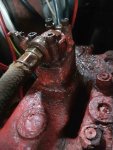
Thermostat still secure in place. The out-hose has come off so at least I can get the new elbow on. I have not given the in-hose a lot or persuasion yet, but I hope it will move.

One of the helpful members here suggested some sort of dam to fill with diesl as well, possibly using plasticine. I was thinking of using a plastic milk container with the seal around the bottom.

Problem is how to get diesel to the bottom manifold itself where the threads are. The lower gasket probably will seal off the bolts to allow any diesel there. Anyway the awkward shape would make it difficult to seal off the area to let diesel get to the gasket at the bottom. Coming in from the top might work. So if I forget trying to get past the bottom gasket then a rubber tube higher up could be a possibility. Worth a try before taking off the manifold I guess.

Thank you all for bearing with me. It helps to talk as they say and I guess many of you have been here before and survived to tell the tale!

20200426_093438.jpg
 
Last edited:
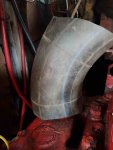
New exhaust elbow just arrived. Will have a refit session at the weekend.

The elbow end of the water hose just has the screw fitting, no compression olive or similar. Is that correct. Just push in hose all the way and tighten?

I am about the start the replacement elbow job on my DV20 too, and having ordered the elbow noticed the water hose in my new set also has no olive. I assume therefore that this is the way it is meant to be, but if you find that you need one please do let us know!
 
I am about the start the replacement elbow job on my DV20 too, and having ordered the elbow noticed the water hose in my new set also has no olive. I assume therefore that this is the way it is meant to be, but if you find that you need one please do let us know!

The supplier French Marine haven't replied yet. But since yours arrived same as mine there probably isnt one
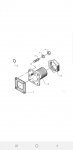
Also today bought spring washers for the flange as they were not there when I removed it, but are shown in the diagram. They are stainless as brass springs to match the nuts would be a bit pointless I thought as they would compress with no spring left. Did you find any washers when you removed your flange (if you had to remove it like I did because the whole assembly was solid.
Screenshot_20200503-181012_Dropbox.jpg
 
I am about the start the replacement elbow job on my DV20 too, and having ordered the elbow noticed the water hose in my new set also has no olive. I assume therefore that this is the way it is meant to be, but if you find that you need one please do let us know!
One end simply screws into the thermostat housing and the other has a fitting which slides over the tail on the hose. It compresses to seal when tightened. No olive required. You can see the fitting on one of my hoses in post #131.

Update: Just noticed that Joyfull posted a better picture in post #147. The 3-4 replacements I bought over a 24 year period never included an olive, just the hose and single fitting shown.
 
Fully expecting to have to remove the whole flange when I get a chance, but have not yet had the opportunity to try. From the looks there are no spring washers currently fitted.
 
Fully expecting to have to remove the whole flange when I get a chance, but have not yet had the opportunity to try. From the looks there are no spring washers currently fitted.

Ok. As I said there were no washers when I undid my flange nuts but there clearly are in the Parts manual exploded view.

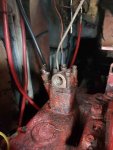
I am now in the process of trying to build a dam around the thermostat housing to fill with diesel to soak the bolts. I am using an old wheelbarrow inner tube. It wont be possible to seal off the bottom to get diesel into the bottom gasket, but will at least allow diesel to possibly get down the bolts and the middle gasket. If this doesn't work then there is room to get the manifold off sideways thankfully as long as the nuts want to move.

20200504_174828.jpg20200504_174839.jpg
 
Fully expecting to have to remove the whole flange when I get a chance, but have not yet had the opportunity to try. From the looks there are no spring washers currently fitted.

Mine always had spring washers. I used to take the elbow and flange home and put in a vice to dismantle. I used to soak in diesel and don't think heat was required. Quite stiff but not usually a huge problem in a vice.
 
Top