Bukh DV20 Exhaust elbow

'

You will need a new copper joint washer (unless you find the old one and anneal it) an.

When you find the new anode you will very likely find it won't go in the hole because there may be the remains of the old one stuck in there. If so knock it through. It won't do any harm.

I occasionally run a tap through the hole to clean the threads. If you feel like doing that be careful you don't break it otherwise you'll be in the soup bigtime!

No sign of a copper washer in the bilge and I was careful looking for one when I unscrewed. The bolt is a bit narled so I guess last man in did not bother with a washer. Fortunately the best nuts and bolts shop in town is still opening weekdays (and still exists!) so I will try in the week.
 
No sign of a copper washer in the bilge and I was careful looking for one when I unscrewed. The bolt is a bit narled so I guess last man in did not bother with a washer. Fortunately the best nuts and bolts shop in town is still opening weekdays (and still exists!) so I will try in the week.
.

I wonder if "the last man" is feeling his ears burning!
 
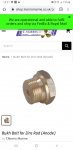
Am I seeing the existing copper washer stuck on the bolt?

If so do I just leave as is. It doesn't want to move.

Should I grease the bolt before replacing or just wire brush?

20200426_112324.jpg
 
Last edited:
It’s just a ‘seat’ for the copper washer to have even pressure.Even if there was an existing washer hiding there another won’t make any difference!
PS, check that the washer hasn’t stuck to the engine.
 
It’s just a ‘seat’ for the copper washer to have even pressure.Even if there was an existing washer hiding there another won’t make any difference!
PS, check that the washer hasn’t stuck to the engine.

Yes. I can see that seat on the replacement bolt. I will check engine and bilge again.

Screenshot_20200426-142100_Chrome.jpg
 
Thank you for the picture, very useful. I wish that mine looked like that. Somehow I have a feeling that my long bolts are not going to budge.

The bolts are quite long and thin, could shear if stuck but remnants should come out with penetrating oil and heat . I can probably post some old ones if that happens.

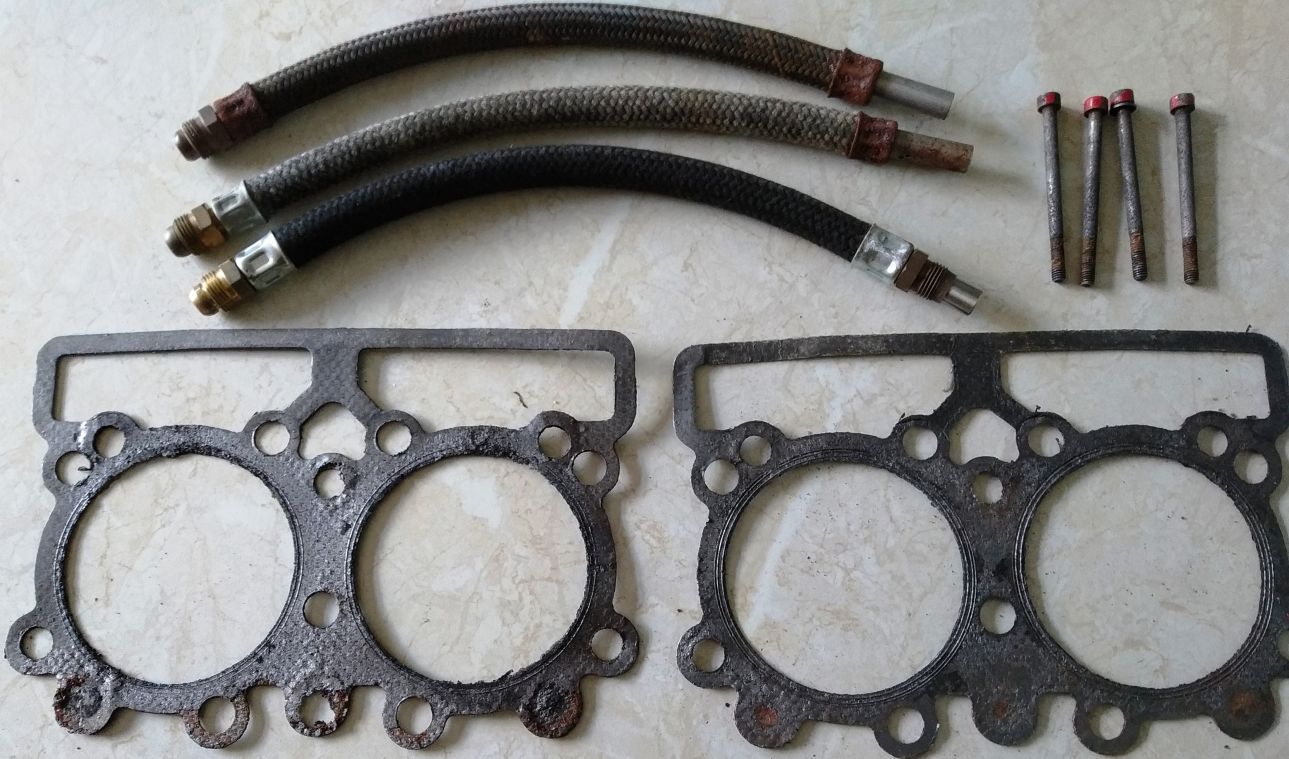
Embarassing amount of junk in the garage, just takes a global pandemic to get me started on a clear out. :D I found the following old useless Buhk bits.

1) Head gaskets
They were actually fine but I had read that 1980 DV20 gaskets were leaking after about 5-6 years. I replaced them soon after buying the boat in 1986. No idea why I kept them as they'd be useless but they slid down the back of a shelf and out of sight.

2) Exhaust elbow hoses
I must have replaced one around 1987 and another around 1992-3. Then I tried painting the interior of a new one as I mentioned previously and those lasted for about 8+ years. The original hose was perfect and never removed when swapping elbows. Hence the collection of slightly rusty new ones.

3) Thermostat housing bolts
I think that these came from a scrap DV20 I found somewhere around the time I was planning to dismantle the thermostat housing. I was worried about shearing the existing bolts but they did come out with a lot of persuasion and diesel.

I was going to bin the lot but can hang on to the bolts and the newest elbow hose on the off chance anyone needs them.

Bukh_Bits.jpg
Bukh_Bits.jpg
Bukh_Bits.jpg
 
The bolts are quite long and thin, could shear if stuck but remnants should come out with penetrating oil and heat . I can probably post some old ones if that happens.

Embarassing amount of junk in the garage, just takes a global pandemic to get me started on a clear out. :D I found the following old useless Buhk bits.

1) Head gaskets
They were actually fine but I had read that 1980 DV20 gaskets were leaking after about 5-6 years. I replaced them soon after buying the boat in 1986. No idea why I kept them as they'd be useless but they slid down the back of a shelf and out of sight.

2) Exhaust elbow hoses
I must have replaced one around 1987 and another around 1992-3. Then I tried painting the interior of a new one as I mentioned previously and those lasted for about 8+ years. The original hose was perfect and never removed when swapping elbows. Hence the collection of slightly rusty new ones.

3) Thermostat housing bolts
I think that these came from a scrap DV20 I found somewhere around the time I was planning to dismantle the thermostat housing. I was worried about shearing the existing bolts but they did come out with a lot of persuasion and diesel.

I was going to bin the lot but can hang on to the bolts and the newest elbow hose on the off chance anyone needs them.

Bukh_Bits.jpg
Bukh_Bits.jpg
View attachment 89146

Thank you for sorting all that out!

My thermostat housing bolts just not wanting to budge. They are very solid and I can't see anyway to get diesel down I into the threads.

I will keep trying until the new elbow arrives (hopefully with a new hose - otherwise I will come back to you).

If I am back and running ok with the new elbow and anode then thermostat will rest in peace. I guess the only approach would be to dismantle the exhaust manifold from the side of the engine and get it all to a workshop. Though looking at that now I dont think there is enough space in the engine bay to pull it off the studs sideways!!

At this rate I will be checking in for your head gasket as well!
 
Are you able to apply some heat to the thermostat bolts (only) before trying to unscrew them? The lengthways expansion will reduce the tension they are under, and it may also help weaken their attachment to their surroundings.

You could also try tapping them in the clockwise (tightening) direction, again to break the 'seal', before trying to unscrew them?

Good luck anyway!
 
Are you able to apply some heat to the thermostat bolts (only) before trying to unscrew them? The lengthways expansion will reduce the tension they are under, and it may also help weaken their attachment to their surroundings.

You could also try tapping them in the clockwise (tightening) direction, again to break the 'seal', before trying to unscrew them?

Good luck anyway!

I can only realistically apply heat to the head of the bolts but the thread is way down probably 90mm away buried in the manifold. I will give it a try.

I have tried tightening.

So far I haven't pushed it to the limit. It feels like something will break as all four are equally solid.

As the engine runs, once I fix the exhaust elbow and the anode I am tempted to leave alone and just go sailing again once we are allowed.
 
I had exactly the same issue 4 years ago in NZ.

I was handicapped by not having my UK tools and workshop available but managed to remove the themo housing and bolts.

I took the whole manifold home and chucked it in a bucket of diesel for a week while I got on with pulling the pistons, cleaning out the waterways in the cylinder block and head and sorting the valves and seats, pistons and rings.

After taking the manifold from the diesel and drying it I applied heat with a butane gas torch to the thermo housing, concentrating on the area around one of the long cap screws. These are of very high quality and are quite springy.

I used a REALLY good quality 5mm allen key socket and gave it a really good thump downwards with a heavy hammer before trying to shift it. First Mate played the gas torch on the corner of the thermo housing by the cap screw we were undoing.

Softly, softly catchee monkee, little by little, back and forth, a little more movement each time, it came out, corrosion full depth of the screw, but broken down by the diesel and heat/expansion. It was so tight the thread unscrewed but I could not pull it out of the thermo housing.

Repeated with the other 3, all out, thermo housing off.

Punched them out with a 5mm pin punch. To stop the manifold turning while using the gas torch and breaker bar I screwed it to a 6X6 wooden beam using hex head coachscrews - no large vice!

I used a 6.5mm drill bit turned with a vise grip, followed with a 7mm drill bit to clear the rust. The cap screws were cleaned using a power drill with a brass wire brush clamped in my workmate type bench.

With the manifold off it can be soaked in diesel, but cant be held against rotation without a big vice, hence screwing it down to a substantial beam of timber. IMHO, the key was the long soaking plus the judicious use of a large gas torch.

I hope this helps.
 
I had exactly the same issue 4 years ago in NZ.

I was handicapped by not having my UK tools and workshop available but managed to remove the themo housing and bolts.

I took the whole manifold home and chucked it in a bucket of diesel for a week while I got on with pulling the pistons, cleaning out the waterways in the cylinder block and head and sorting the valves and seats, pistons and rings.

After taking the manifold from the diesel and drying it I applied heat with a butane gas torch to the thermo housing, concentrating on the area around one of the long cap screws. These are of very high quality and are quite springy.

I used a REALLY good quality 5mm allen key socket and gave it a really good thump downwards with a heavy hammer before trying to shift it. First Mate played the gas torch on the corner of the thermo housing by the cap screw we were undoing.

Softly, softly catchee monkee, little by little, back and forth, a little more movement each time, it came out, corrosion full depth of the screw, but broken down by the diesel and heat/expansion. It was so tight the thread unscrewed but I could not pull it out of the thermo housing.

Repeated with the other 3, all out, thermo housing off.

Punched them out with a 5mm pin punch. To stop the manifold turning while using the gas torch and breaker bar I screwed it to a 6X6 wooden beam using hex head coachscrews - no large vice!

I used a 6.5mm drill bit turned with a vise grip, followed with a 7mm drill bit to clear the rust. The cap screws were cleaned using a power drill with a brass wire brush clamped in my workmate type bench.

With the manifold off it can be soaked in diesel, but cant be held against rotation without a big vice, hence screwing it down to a substantial beam of timber. IMHO, the key was the long soaking plus the judicious use of a large gas torch.

I hope this helps.

Wow. Amazing skill and perseverance.

In situ on the boat I am limited with access and ability to get some loading on the wrench. Diesel hardly penetrates the top of the housing. Even getting heat to it will be difficult and only to the top and side.

I will play around a bit more before putting on the elbow, though with not much conviction.

Thinking laterally maybe there is some sort of descaler fluid I could pour into the water hose exit before putting the pipe back that would clean the thermostat valve. It has probably been in there many years with not many engine hours.

Do you think that would that help a bit or cause a problem and best leave alone?
 
You need to remove the manifold and take it to a workplace where you can try my suggestions. Or, if it aint broke, dont fix it. It is your call!

By soaking in diesel for a week the bottom of the cap screws, where the threads are, do get wetted - well, mine did anyway. My screws had rusted to the housing full length and the heat was the key to breaking that down. That area of the screws/housing was as dry as a nuns crutch.

I would not do a job like that on board.
 
You need to remove the manifold and take it to a workplace where you can try my suggestions. Or, if it aint broke, dont fix it. It is your call!

By soaking in diesel for a week the bottom of the cap screws, where the threads are, do get wetted - well, mine did anyway. My screws had rusted to the housing full length and the heat was the key to breaking that down. That area of the screws/housing was as dry as a nuns crutch.

I would not do a job like that on board.

Agreed. Any thoughts on a descali
You need to remove the manifold and take it to a workplace where you can try my suggestions. Or, if it aint broke, dont fix it. It is your call!

By soaking in diesel for a week the bottom of the cap screws, where the threads are, do get wetted - well, mine did anyway. My screws had rusted to the housing full length and the heat was the key to breaking that down. That area of the screws/housing was as dry as a nuns crutch.

I would not do a job like that on board.

Agreed.
 
You need to remove the manifold and take it to a workplace where you can try my suggestions. Or, if it aint broke, dont fix it. It is your call!

By soaking in diesel for a week the bottom of the cap screws, where the threads are, do get wetted - well, mine did anyway. My screws had rusted to the housing full length and the heat was the key to breaking that down. That area of the screws/housing was as dry as a nuns crutch.

I would not do a job like that on board.

That's what I did when replacing the thermostat and the only way to get diesel to the threads. I managed to get an amazing amount of crud out of the block and manifold. I used to give it a good hose through and pressure wash every winter. Quite a lot came out of the lower drain with help from bent piece of wire.

I would expect that descaling the manifold would be fairly easy when it is at home and thermostat removed.

You could use citric acid or (80% citric, 20% malic acid) solution, easy enough to buy crystals on eBay. Powerful central heating cleaners are often just citric acid or citric/malic acid. Those sometimes come with an indicator to change colour if more acid is needed or neutraliser for final flush. I've used this mix for central heating and simply flushed until no acid left (test sample with some bicarbonate, no fizz/no acid :D).

Sulfamic acid could be used but citric should be fine.
 
I fitted a new cylinder liner to my raw water cooled BUKH DV10 in 2015 and when I had extracted the original one I was surprised how little scaling there was inside the block. The engine was new in 1982 and I have had it more than 20 years.

More worrying, I did not find the blade that had come off the Johnson pump impellor some years before! :LOL:
 
Top