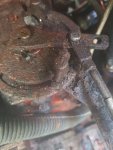
Bukh DV20 Exhaust elbow

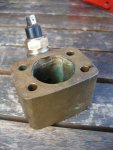
The Themostat housing on our Bukh DV20 is cast iron. I had the head and sump off 4 years ago and pulled the pistons after a water ingress issue.

The thermostat housing was very tricky to remove as the 6mm HT Steel long - 65-70mm? -cap screws holding it to the head had rusted to the housing. I needed all my tricks of over 50 years on the tools and being a veteran vehicle specialist to get it off.

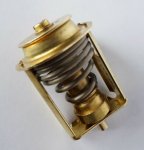
It is also two piece, the bottom, sealed by the rubber seal and a top sealed by a gasket.

It all cleaned up OK. I used a 6.5mm bit turned in a vise grip followed by a 7mm bit to clear the rust from the long holes. The cap screws were cleaned using a wire brush in a power drill clamped in my workmate type folding bench.

All working well now. I re-used ALL the main engine components except a head gasket and few others. Warned of high cost in NZ I took a head gasket and some gasket paper with me.

I was pleased to get the piston rings from their badly corroded grooves, clean them up, ditto the pistons and reassemble.

Two valve seats needed re-cutting and one valve re-facing. The cost of Bukh parts in NZ is OTT. I even put the BE shells back.

Bukh's are a great low tech, low stressed engine and are easily dismantled. The engine in the Hartley 32 was installed high so it is easy to remove the sump.

For which I was very thankful..............................
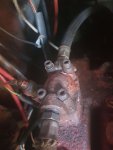
 
The thermostat housing is cast iron I think, certainly not brass it's a grey metal.

It is fastened by 4 female hex headed set screws which go through the housing cap, into which the water hose fitting is tapped, through the housing itself and into the exhaust manifold.

I took all mine off to sort out a leaky gasket between the housing and exhaust manifold. In the process one of the set screws sheered off inside the housing, and a section of the housing itself broke off. Luckily the exhaust manifold itself was undamaged, although one of the tappings for the set screws looked like a weak point.

In short I stand by previous advice, don't mess in the area unless you have to. But if you do, be very careful with the set screws and do your best to encourage them to free easily. Some good advice on that above I didn't have advantage of at the time.
 
The thermostat housing is cast iron I think, certainly not brass it's a grey metal.

It is fastened by 4 female hex headed set screws which go through the housing cap, into which the water hose fitting is tapped, through the housing itself and into the exhaust manifold.

I took all mine off to sort out a leaky gasket between the housing and exhaust manifold. In the process one of the set screws sheered off inside the housing, and a section of the housing itself broke off. Luckily the exhaust manifold itself was undamaged, although one of the tappings for the set screws looked like a weak point.

In short I stand by previous advice, don't mess in the area unless you have to. But if you do, be very careful with the set screws and do your best to encourage them to free easily. Some good advice on that above I didn't have advantage of at the time.

Understood. I will try and avoid disturbing the thermostat housing. Those four long bolts diwn into the manifold dont look like good entertainment.

I will work on releasing tbe screw in hose as best I can. Worst case I can cut off and try and work out some sort of jubilee clip.
 
Having another try to undo the exhaust hose today.

Just looked again at the top of the thermostat housing. There is a glint of a new washer under one of the four allen key bolts that I presume hold the top on. (See photo) But the other three look they have not moved for a long while so any force and they might shear as described in the post above. There is a sensor wire and a large nut on the outside. Is the thermostat in that chamber? I can't find any drawings in the manual I downloaded for any of this area. In 306 pages it jumps from electrics to gearbox and fault finding. Nothing on the exhaust system (or am I missing something?)

20200423_102532_1.jpg
 
The wire is the temperature sensor as you say, the thermostat sits under the dome right in the middle of the 4 bolts.
The bolts look pretty caked up, I would perhaps give them a clean down with a wire brush first and clean out the hex sockets to see if you can actually seat a hex key in there first. Sooner or later the housing has to come off, the input hose looks pretty crap too so it would be better to free the housing now rather than waiting for it to get worse. The bolts are threaded only at the exhaust end, in the housing the shank is ‘bare’.
If a bolt does shear then you have 2 options; take it to an engineer who should be able to extract the bolt, possibly re-drilling and tapping for a larger bolt. OR get a ‘new’ (used) exhaust from Marine Enterprises.
 
I only had one bolt shear, that was because it had rusted itself inside the lower part of the housing. Because the other three had come out OK, I could get the housing off by rotating and so unscrewing the entire item like a huge bolt head.

The head of the thermostat is in the domed bit of its housing and its main part rests inside the lower part of the housing. It's brass so won't rust, but the seal it sits on might have deteriorated and effectively glued it into position. Try not to damage the thermostat if you remove it.
 
Here's some pictures showing what you are trying to get off (except this one is, unusually, bronze). Also, unlike yours, it has two terminals because it came from an engine with the full instrument panel.bukh thermostat tower (3).jpgbukh thermostat tower (4).jpg

bukh thermostat tower (1).jpgbukh thermostat tower (2).jpg
 

Attachments

  • bukh thermostat tower (3).jpg
    bukh thermostat tower (3).jpg
    234.2 KB · Views: 6
The drawing you seek is on O11 (page 174 of 324) under ‘Cooling system’
View attachment 88932

My download must be the old manual 306 pages. I found the thermostat housing diagram but it is different to your diagram and mine. I will look online for the newer? Manual.

I have also found that the gearbox dipstick is seized so I can't check level, top up or change the oil. It has a narrow L shape handle with no doubt will snap off if I use undue pressure. Any ideas how to free up? More bukh heaven!

20200423_121727.jpg
 
My download must be the old manual 306 pages. I found the thermostat housing diagram but it is different to your diagram and mine. I will look online for the newer? Manual.

I have also found that the gearbox dipstick is seized so I can't check level, top up or change the oil. It has a narrow L shape handle with no doubt will snap off if I use undue pressure. Any ideas how to free up?
View attachment 88941
The gearbox dipstick just pulls up. It has one (or two?) rubber o-rings on it to seal it.

That slotted-head screw in the lower right corner is a wrong 'un, by the way. There should be a special clip to keep the fork on the end of the cable in place.

Looks like your engine could do with some TLC! When you've got it all sorted out and cleaned you can paint it with Hammerite red paint (available from Halfords etc).
 
The gearbox dipstick just pulls up. It has one (or two?) rubber o-rings on it to seal it.

That slotted-head screw in the lower right corner is a wrong 'un, by the way. There should be a special clip to keep the fork on the end of the cable in place.

Looks like your engine could do with some TLC! When you've got it all sorted out and cleaned you can paint it with Hammerite red paint (available from Halfords etc).

Gearbox dipstick very reluctant to move. If it is just pull up I guess I can try and lever up with chisel and hammer on either side. I have already soaked in diesel several times.

The four allen key bolts securing the thermostat housing very reluctant. Is there anything better than diesel to try and soak and encourage them?

Water pipe still firmly stuck one end in the thermostat housing and one end in the broken piece of the old elbow.

That's not the only dodgy cable connection. Screw and nuts used on the other morse connection just waiting to come undone.

Do I need clevis pins?

20200423_143149.jpg
 
Diesel is about as good as you are likely to get unless you can find something specialised. I remember a comparison of penetrating oils many years ago, WD40 was rubbish (as expected), diesel was almost as good as the very expensive products.

I'll see if I can dig out the thermostat housing bolts I saw falling into the bin when I emptied a box of bits. I can always post them at some point if you shear some of your existing ones.
 
Top