Bukh 20 over-revving out of control

GreekYiannis

Well-Known Member
Joined
24 Sep 2012
Messages
82
Location
Saronic gulf
Visit site
I've just had the horrifying experience of my BUKH 20 over-revving out of control and flinging engine oil all over the boat.
The engine had been running for about an hour and sounded fine. It was at about half revs. It has been starting every time and the oil pressure and engine temp have been dead-on. But suddenly and without warning - the engine revved up sky high (higher than I've ever heard it) and would not respond to the control. I quickly shoved in the diesel cut-off and the engine stopped. But not before throwing engine oil out all over itself and the box it lives in. When i lifted the cover to stop the engine, it sprayed oil all over the boat.
I heard no bangs or bumps before this happened.
My first thoughts are:
1. Something like a diesel regulator spring broke and thus the engine speed was 'unregulated' - hence the sky high revs.
2. A hole in a piston appeared shoving oil up through the inlet manifold and out of the air filter.

If anyone has any ideas, I'd be truly grateful. I'm off for a shower to wash out the engine oil out of my hair!
Many thanks guys.
 
The fact that it stopped when fuel shut suggests it is could be a governor fault. A run away engine burning lub oil would not stop when fuel turned off and neither would a secondary fuel source such as calor gas getting into the inlet manifold. The oil was most likely being forced out the breather or dip tube due to over pressure in the crankcase caused by excessive rpm.

It could be your telegraph linkage coming off but these are often sprung to close in that event, but if not sprung and the linkage did come off then the control rod from the telegraph could have knocked the throttle full open?

Have you tried restarting it to see what happens?
 
Last edited:
Hi Cryan. thanks for your speedy advice. The red cable from the throttle handle on the bridge to the engine 'cranky turny thing' on the block, is operating normally. The screw adjustments [idle to max] are where they always are and the cable operates right through the range without sticking. So my guess was that something below where the 'cranky turny thing' operates, had broken - such as a Governor spring maybe.
I seem to remember that governors work on the centrifugal force principle. If so, maybe a spring has broken.
Q. Do you think the Governor will be immediately below the 'cranky turny thing'? If so, can I strip it out for inspection? [Sorry, I should look that up on the internet for myself - but I'd rather be well advised]
Many thanks, GreekYiannis
 
Guys, I've been reading that the Bukh 20 has a known problem with the way it vents crankcase fumes. These fumes are vented to the INLET manifold. Ah HA! I hear you cry! YES, if these fumes build up, then they become the fuel source which is unregulated, and causes a runaway engine. BUT, in my case, the engine stopped when I shoved in the diesel stop plunger. That would indicate that my problem was unregulated diesel, rather than an unregulated engine oil fumes problem. Anyone agree?
 
I stripped out the top parts of the Governor to find the thick washer 'springs' were fine, the curly spring was fine and all looked well. So I phoned Bukh in Poole, Dorset and they were fantastic! They'd only heard of a runaway Bukh twice in their entire career. Once was due to gas getting into the manifold and the other time was a broken - or stuck - lead weight inside the diesel injection pump. So I'm off to put my governor pieces back in and take out the injection pump.
A good diesel injection pump specialist (in England) should put things right and I'll be back on the sea. Here's hoping.
Those Bukh guys in Poole are fabulous. What a resource.
 
I thought a prime culprit for run away is over filled oil (carelessly or stuck valve remains letting diesel into the crank) , have you dipped your oil, should be very low if it chucked oil everywhere, if it is thin and smells of diesel ?

when you say diesel shut off valve , Do Bukh have fuel shut offs as I would have expected a decompression shut off which doesnt wholly restrict your search to diesel problems,.
 
Its good to hear Bukh are helping you out. I'm not sure there is lead weights in the injection pump they are usually in the governor. I would test run the engine as by stripping cleaning and rebuilding the governor you may have un-jammed the spinning weights and solved the problem. If not governor then fuel pump would be next choice as the two are obviously connected. If the slides jam then that can cause issue though they usually jam in a way that reduces fuel. any form of debris, even microscopic, can also affect injection pumps. they really need a clean room for overhaul to avoid contamination. I'm surprised that they have only heard of two runaway Bukhs before as the web is full of tales of it happening but mostly due to crankcrase breathing oil into the inlet manifold. Yours didn't match that though as cutting fuel shut it down.
 
Hi DAKA. My oil is now lower after a few seconds (maybe 10) of runaway and spraying oil out of the dip tube - I think. But it's not thin or smell or diesel.
I have modified my fuel shut-off valve to work by hand. The plunger which was operated electrically, is now available to be pushed in by a finger. My engine is in a box on the deck, not under a deck. I've now inspected the springs in the governor and the washer-type are not split and the twist spring looks perfect. So I've re-assembled that and looked towards the pump. The sliding rack in the pump seems to slide very easily and I can't see any other problem. Of course I haven't stripped the injection pump. The guys at Bukh in Poole, suggested there were lead weights on the opposite side from the sliding rack, but I can only see two round disks which look ok.
Now that I've inspected the governor and pump and found nothing obvious, I am wondering if the pump stuck somehow or the governor stuck. Alll I could do is fit the pump again and start the engine. If it runs well, then it was stuck. If it runs away, then something is broken. Does that seem reasonable?
 
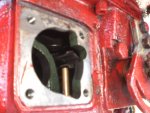
Hi Cryan. I may have made some progress but wanted to ask your opinion before going further. I've taken a look at the thing which controls the injection pump slider. It looks open, like flower petals, and not very precise at all.
1. I wonder WHAT connects the governor and the slider and what that should look like. The schematic drawings on the internet workshop manual don't show that. But if a pin - or whatever controls the slider - has broken - and is now in the sump - then that might account for the slider slipping, out of control, to maximum.
2. There is a plate in front of the injection pump, which can be removed. Would you agree that its removal is a sensible next step?
Many thanks. Injec pump rack control.jpg
 
Do you have the illustrated Parts Manual for the engine? That shows the linkage between governor and injector pump.

If you haven't got it I can copy the relevant page and email it to you but I can't do it today.
 
I'm not sure what connects them exactly but it looks like there should be a round knob on the slider which would be operated by the governor. The flower thing you describe may be a cam which the knob is moved by but I can't really see from your photo and as you say, the online manual doesn't show it. I would call Bukh back and ask to speak to one of the technicians as he could perhaps talk you through it or at least send you more detailed drawings. If you have removed the fuel pump you might need to check the timing when re-installing it.

Or, as parsifal above says, check the parts manual. Parts manuals are often more helpful when assembling things than the service manual as the have exploded diagrams.
 
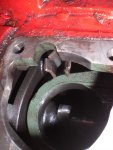
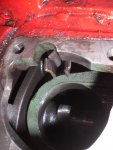
Thanks again Cryan. I've taken a better picture and had a close look myself. I'm now pretty sure that the 'funnel' piece which connects o the slider knob is NOT broken. Even though it is 'cut' and wider at the top than the very straight bottom half, each side is identical and symmetrical - and things which break, don't break that way. SO I think the funnel thing guides the knob down into place so that one cannot make a mistake when fitting the pump.
I've also today had the inspection plate on the end of the block off and had a poke around with my fingers. I can see and feel that the 'funnel' thing is attached to a bracket, which pivots on a rod which is held in place by the big bolt near the governor. I've felt the governor spring and it seemed fine. I've 'flicked' the bracket and - after twanging - it returns to idle position. SO my guess is that the governor is working OK. That leaves grit up the injection pump as the most likely cause. A stuck-open pump will cause runaway. I'm taking Parsifal up on his offer, and I hope the manual will show me what I've been feeling and seeing today.Slider locator control.jpg
 
Hi Parsifal. No I don't have an illustrated parts manual and would be very grateful for a copy of the page. See also my latest reply to Cryan. Many thanks indeed.Slider locator control.jpg
my email is johnmayerauthor@gmail.com - it's looking like grit in the pump is the likely cause. But we'll see. I've been quoted £40 inc VAT for a clean of the pump and £6.50 for a bench test per injector. So I see no harm in having that done - only a month off in the peak fishing season here.
 
Yes, in that photo the funnel type item does look like it would take the slider knob.
Whilst it is possible for debris to hold a slider full open it would still need to be operated to that point by the governor. Also debris tends to stop the slider from opening at all due to the fact they spend more time fully closed than fully open. If your sure the governor is in good order and the weights are not stuck then I would be inclined to test run everything before stripping the pump down, just to see if you have sorted the problem by unsticking the weights?


On some older engines I've worked on it is not uncommon for fuel pump sliders to stick and most require a squirt of wd40 and a bit of movement in and out. I honestly can't remember one sticking fully open and causing overspeed?
 
Last edited:
Hmm, that's good advice again. I have nothing to lose by test running the engine. The slider seems to be absolutely fine by comparison with a spare injection pump I have. The slider starts and stops in the same position on both and I have to say, the governor mechanism felt like it was working as it should when I poked my fingers in and flicked the lever and spring etc. I suppose, if all the mechanical parts feel right and it does run away again, then the pump is the likely candidate. You may have just saved me a month's fishing and the cost of a pro pump shop telling me there's nothing wrong with my pump. I'm going to try it!
By the way, do you know if there is something inside the pump which controls the amount of fuel going to the injectors, or it that the slider's job?
Many thanks again.
 
The slider has teeth which engage a gear inside the pump. The gear is attached to the throttle which will either be a simple hole or a helix groove which covers the return orifice of the pump. As you place a horizontal motion onto the slider it moves the gear which transfers that motion to a rotation which will open up or close in and restrict the the fuel return hole thus controlling the amount of fuel able to flow through it from the pump. Basically when on full open the two holes align and allow full flow of fuel as they move apart the fuel flow is restricted until it's stopped completely.

http://m.youtube.com/watch?v=w9jMvJZwRuE
 
Last edited:
Thanks. the video was a clear illustration of how an injection pump works. Now I understand how the inside of the pump works. But I can't understand why would grit in the diesel would cause the engine to rise to runaway speed. Surely if grit got through into the pump, it is far more likely to stop the pump altogether. I can envisage a scenario where grit in the pump might cause a momentary 'kick' in speed, but the governor spring ought to be able to handle that. Or am I wrong?
Your expertise and help is very much appreciated. Many thanks.
I'm going to try to re-assmeble the diesel system this morning and see if the engine runs away - I do hope not.
 
Hi Parsifal. No I don't have an illustrated parts manual and would be very grateful for a copy of the page. See also my latest reply to Cryan. Many thanks indeed.View attachment 34895
my email is XXXXX

- it's looking like grit in the pump is the likely cause. But we'll see. I've been quoted £40 inc VAT for a clean of the pump and £6.50 for a bench test per injector. So I see no harm in having that done - only a month off in the peak fishing season here.

I've emailed the pictures. I reckon the BUKH Parts manual is worth having. I bought mine before I had a computer and it cost £25 (I think) but paid for itself when I stripped and rebuilt the engine many years ago. Maybe you can download it from somewhere. Unfortunately, BUKH (UK) Ltd haven't got into the computer age yet (although they are first class in every other way)!

That seems a pretty good price for the pump and injector work. Last time I had the pump overhauled and tested by a BOSCH specialist it cost about £75.
 
Last edited by a moderator:
Thanks. the video was a clear illustration of how an injection pump works. Now I understand how the inside of the pump works. But I can't understand why would grit in the diesel would cause the engine to rise to runaway speed. Surely if grit got through into the pump, it is far more likely to stop the pump altogether. I can envisage a scenario where grit in the pump might cause a momentary 'kick' in speed, but the governor spring ought to be able to handle that. Or am I wrong?
Your expertise and help is very much appreciated. Many thanks.
I'm going to try to re-assmeble the diesel system this morning and see if the engine runs away - I do hope not.


As I said I suppose it is theoretically possible for debris to jam the pump full open but it would still need the governor to push it that far first. I can't remember ever coming accross an example though. But lots of times I've seen the opposite where debris has prevented the pump from increasing power.
The tollerances on a fuel injection pump are tiny and require cleanroom conditions to rebuild them so don't be tempted to take it apart unless you have access to a very clean environment.
 
Top