
You are using an out of date browser. It may not display this or other websites correctly.
You should upgrade or use an alternative browser.
You should upgrade or use an alternative browser.
Building Liberty Ships.
- Thread starter Wansworth
- Start date
Blue Seas
Well-Known Member
The Liberty ships program was considered to be a massive success but it was not without its problems. Some poor design together with unsatisfactory welding techniques and poor (Admiralty 'A' type) steel led to square (rather than radiused) hatch corners, sulphation at the grain boundaries and uncontrolled cracking of the sheet steel after having entered the brittleness transition zone due to high latitudes cold weather.
Sadly it led to some loss of ships / life sometimes within 24 hours of launch. The cure for the weld cracking was often 'stop crack' strips which were rivetted in place!
Still, a tremendous achievement who's effects are still felt in shipbuilding today.
Sadly it led to some loss of ships / life sometimes within 24 hours of launch. The cure for the weld cracking was often 'stop crack' strips which were rivetted in place!
Still, a tremendous achievement who's effects are still felt in shipbuilding today.

SimonX
Well-Known Member
A surviving Liberty Ship, Jeremiah O’Brian, is berthed at fisherman’s wharf in San Francisco. A fascinating museum that covers what is in the video and more. The last unaltered Liberty ship - museum ship- SS Jeremiah O Brien -

jbweston
Well-Known Member
When visiting San Francisco I made a point of visiting. She's one of those technological artifacts that commemorates a huge historical achievement. Not just speedy standardised shipbuilding, but the whole complex achievement of the supply of the UK and Russia by means of transatlantic merchant convoys manned by brave seamen supported by innovative naval and air protection.A surviving Liberty Ship, Jeremiah O’Brian, is berthed at fisherman’s wharf in San Francisco. A fascinating museum that covers what is in the video and more. The last unaltered Liberty ship - museum ship- SS Jeremiah O Brien -
My great uncle Bill worked as a young architect for the Air Ministry during the war constructing airfields in Benbecula and Iceland and other places to extend the range of air cover for convoys.

Concerto
Well-Known Member
Sorry for a thread drift, but my father flew out of Benbecula in the latter part of WWII. He was a pilot navigator in a Leylight Wellington bomber in Coastal Command. They flew at night with the large Leylight search light scanning the waves to try and find surfaced U-Boats. They ranged out to Iceland, but never spotted any. If they had, they would have dropped depth charges.My great uncle Bill worked as a young architect for the Air Ministry during the war constructing airfields in Benbecula and Iceland and other places to extend the range of air cover for convoys.

capnsensible
Well-Known Member
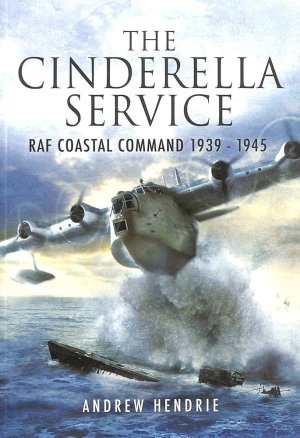
Coincidentally, I've just read a book about the wartime coastal command.Sorry for a thread drift, but my father flew out of Benbecula in the latter part of WWII. He was a pilot navigator in a Leylight Wellington bomber in Coastal Command. They flew at night with the large Leylight search light scanning the waves to try and find surfaced U-Boats. They ranged out to Iceland, but never spotted any. If they had, they would have dropped depth charges.
Aircraft like Wellingtons had early marks of radar as well as observers spotting surfaced u boats. On sighting, the aircraft would position itself for an attack run and switch on the Leigh Light in the final approach to illuminate the target for fine tuning the bomb drop calculation. Often very successful but at some cost to the Command Squadrons.
Part of the war I hadn't previously thought about. There is a good case to suggest that if more modern bombers had been diverted to cover the Atlantic much earlier, the the losses amongst allied shipping would have been far less including, of course, Liberty ships.
You might find this of interest as it describes your father's job very well.
capnsensible
Well-Known Member
wrr
Well-Known Member
What I found even more impressive was her being sailed by veterans from San Francisco to Southampton to mark the 50th anniversary of D day in 1994. Although there were no U boats to threaten her on this return voyage, the veteran crew faced enough engineering challenges to deter much younger seamen!
Freebee
Well-Known Member
In flight refuelling was invented before ww2 if it had been taken up by the navy and airforce it could have changed the whole pattern of ww2, allowing far ranging sea patrols and given the reach to bomb targets that could not be reached by unrefuelled aircraft
Concerto
Well-Known Member
My father's log book recorded several problems with hydraulics leaking, running very low on fuel, wind drift greater than predicted, plus fog at Benbecula on their return making their return very difficult. During the winter months they would fly for 10 to 12 hours. Not sure if inflight refuelling would have help with fatigue.
jbweston
Well-Known Member
My great uncle Bill had an interesting career. He was the youngest child of a pub landlord in a terraced street in Burton-on-Trent. Not a money spinning occupation. His father must have been progressive for the time (1910s and 20s) because he set his daughter (my grandma) up with the lease of corner shop so she had her own business rather than working in a factory or going into service, and somehow got Bill articled to the Borough Architect so without any college education he was able to qualify as a chartered architect. Bill worked on designing Gaumont cinemas in the 1930s as so many new ones were being built. Then airfields during the war, all over the Western Approaches.
Bill enjoyed working for the Air Ministry on the airfields. He had responsibility and was on site not in an office. He enjoyed working with the US Army engineers who thought he was a useful guy to know because they weren't allowed alcohol in their mess but Bill as Brit (and presumably well in with RAF Transport) could produce beer and whisky whenever he was invited to party or card game. He loved a party or card game.
He had fond memories of building Benbecula in particular. Last time I looked it was still an active airfield.
Bill enjoyed working for the Air Ministry on the airfields. He had responsibility and was on site not in an office. He enjoyed working with the US Army engineers who thought he was a useful guy to know because they weren't allowed alcohol in their mess but Bill as Brit (and presumably well in with RAF Transport) could produce beer and whisky whenever he was invited to party or card game. He loved a party or card game.
He had fond memories of building Benbecula in particular. Last time I looked it was still an active airfield.
Concerto
Well-Known Member
My father never mentioned any Americans at the airfield, so they must have moved on by the time he arrived.
About 20 years ago he visited Benbecula and went to the airfield. Took special permission to enter and he was taken to the officer's mess to be "entertained" as a former member of the RAF. He lent them his log book and an aerial photograph of the airfield to be copied for their small museum. The site still has the airstrip but most of the work is as a early warning radar station.
About 20 years ago he visited Benbecula and went to the airfield. Took special permission to enter and he was taken to the officer's mess to be "entertained" as a former member of the RAF. He lent them his log book and an aerial photograph of the airfield to be copied for their small museum. The site still has the airstrip but most of the work is as a early warning radar station.
capnsensible
Well-Known Member
Also a firing range for weapon tests.

Bajansailor
Well-Known Member
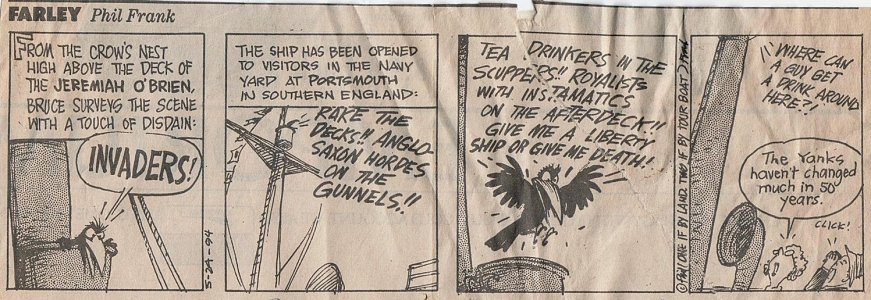
This cartoon (from the San Francisco Chronicle) about the Jeremiah's visit to Portsmouth was sent to me by a friend in San Francisco many years ago 
'Anglo Saxon hordes on the gunnels!' (sic)
'Royalists with Instamatics (remember these?) on the after deck!'
I think that Bruce was probably a Republican back then.
The Wiki description notes that Bruce is a 'right wing raven' who lives with Farley.
Farley (comic strip) - Wikipedia
'Anglo Saxon hordes on the gunnels!' (sic)
'Royalists with Instamatics (remember these?) on the after deck!'
I think that Bruce was probably a Republican back then.
The Wiki description notes that Bruce is a 'right wing raven' who lives with Farley.
Farley (comic strip) - Wikipedia
Neeves
Well-Known Member
To put a chill on the thread.
My father flew Hudsons in 407 squadron. They bombed and shot up a flak ship off the Dutch coast, went back to check for damage to the ship and were shot down, Dec 1940. They took to the dinghy inflated and attached to the rear door and spent three nights in the North Sea. Picked up by another flak ship and then POW for the rest of the war.
None of the pilots in 407 squadron on the day he was shot down survived the war. If you did 20 sorties you were on borrowed time, my father did 21.
He was 20 years old at the time.
Jonathan
My father flew Hudsons in 407 squadron. They bombed and shot up a flak ship off the Dutch coast, went back to check for damage to the ship and were shot down, Dec 1940. They took to the dinghy inflated and attached to the rear door and spent three nights in the North Sea. Picked up by another flak ship and then POW for the rest of the war.
None of the pilots in 407 squadron on the day he was shot down survived the war. If you did 20 sorties you were on borrowed time, my father did 21.
He was 20 years old at the time.
Jonathan
Wansworth
Well-Known Member
That’s something to think aboutTo put a chill on the thread.
My father flew Hudsons in 407 squadron. They bombed and shot up a flak ship off the Dutch coast, went back to check for damage to the ship and were shot down, Dec 1940. They took to the dinghy inflated and attached to the rear door and spent three nights in the North Sea. Picked up by another flak ship and then POW for the rest of the war.
None of the pilots in 407 squadron on the day he was shot down survived the war. If you did 20 sorties you were on borrowed time, my father did 21.
He was 20 years old at the time.
Jonathan
SimonX
Well-Known Member
My granddad’s brother was a aircraftman servicing Sunderlands and Catalinas out of RAF Castle Archdale on Lough Erne, Northern Ireland in the war. I remember going there as a boy. The place had been converted to a holiday park but there were still relics such as huge concrete blocks used to moor the planes.
capnsensible
Well-Known Member
This cartoon (from the San Francisco Chronicle) about the Jeremiah's visit to Portsmouth was sent to me by a friend in San Francisco many years ago
'Anglo Saxon hordes on the gunnels!' (sic)
'Royalists with Instamatics (remember these?) on the after deck!'
I think that Bruce was probably a Republican back then.
The Wiki description notes that Bruce is a 'right wing raven' who lives with Farley.
Farley (comic strip) - Wikipedia
View attachment 200617
Neeves
Well-Known Member
Liberty Ships, etc etc
I read recently, that the UK only paid off the financial debt to America in 2006, no free lunches, for their financial support during WWII.
The price of winning the benefits of which percolated world wide (but not to the UK)
No wonder the US were close to us - they had to make sure we had the cash - to meet our contractual obligations to them
Jonathan
I read recently, that the UK only paid off the financial debt to America in 2006, no free lunches, for their financial support during WWII.
The price of winning the benefits of which percolated world wide (but not to the UK)
No wonder the US were close to us - they had to make sure we had the cash - to meet our contractual obligations to them
Jonathan
The Q
Well-Known Member
That must have been an awful posting then....Sorry for a thread drift, but my father flew out of Benbecula in the latter part of WWII. He was a pilot navigator in a Leylight Wellington bomber in Coastal Command. They flew at night with the large Leylight search light scanning the waves to try and find surfaced U-Boats. They ranged out to Iceland, but never spotted any. If they had, they would have dropped depth charges.
I've lived there twice, first time in 1971-75 when dad as civilian was posted there.
On one flight in a viscount in about 72 it took 3 attempts to land, we finished on the grass at the end of the runway.
Second time 83-85 when some comedian in the RAF posted me there on radar. I'm very glad I wasn't posted back in the 1940s to Borve Castle the original RDF (radar) site on Benbecula. A very windswept site in wooden huts..
They only got colour TV and bbc2, itv and ch 4 in about 1980...
All that military accomodation by the airport just being finished when we arrived in 1971 was knocked down last year.
Only the married quarters, which have been sold off, remain.
Last edited:
Other threads that may be of interest
- Replies
- 0
- Views
- 70

- Replies
- 0
- Views
- 64
