
Building a rudder - materials advice?

Foolish Muse

Well-Known Member
Joined
27 Dec 2012
Messages
375
Visit site
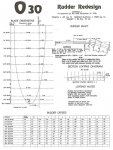
The Olson 30 has a second class legal rudder "eliptical" that is longer than the older style, and as such is known for better downwind handling. I'm looking at building one myself.
rudder-ellip-specs (2).jpg

You can see that the dimensions are all noted on the plans. I'm quite good at working with wood and with a big band saw it would be simple to cut the horizontal framework pieces precisely. My thought is to build the horizontal framework out of 1" hardwood; and the rudder shaft out of a solid hardwood dowel. I would heat the wood then coat in epoxy to have it sucked into the wood as it cools. Then I would fill in the large gaps in the framework with Styrofoam, and then cover it all with fibreglass and gelcoat.

Has anyone done this kind of construction before? Would a 2" hardwood rudder shaft be as strong as a fibreglass shaft? If I used dowels to connect the horizontal framework to the rudder shaft, would that be good enough to overcome twisting? Should the forward edge of the rudder be reinforced with a few layers of fibreglass or with a wooden insert? Any thoughts?
 
I wouldn't do it myself, as there are variables that have to be dealt with, and unless you're an engineer with the ability to calculate the stresses involved against the quality of the material that you're working with, then it's guess work on a primary piece of essential kit. I'm not a woodworker, so how would one be able to calculate the sheer force on an individual piece of wood? Dealing with fibreglass for example, would allow for far more consistency of calculation. On the other hand, if others have done it successfully, then it's possibly quite safely feasible, after all, rudders have been built out of wood for quite a while!
 
Would fibreglass be stronger?

Potentially, yes.
But before you assimilate that, you should be aware that GRP (which is what I presume you mean by 'fibreglass') describes a general type of composite construction. It is no more specific than 'wood'. If you're not aware of that, I'd respectfully suggest you're not yet equipped to make it.

Not trying to discourage you. You'll find lots of helpful info on line (including, as someone mentioned, calculations of mechanical properties).
 
You'll find lots of helpful info on line (including, as someone mentioned, calculations of mechanical properties).

I spent some time trying to find this information before I posted here. It's not quite so simple to find a comparison between the bending/breaking strength of a 2" piece of Hickory compared to a 2" Stainless pipe with 1/4" walls. The "Modulus of Rupture". I"m not a materials engineer after all, which is why I asked for advice here.
 
Surely it would be much simpler to modify the existing rudder with SS shaft etc to the newer shape. Just clean up the GRP of the old one and epoxy foam then glass and resin to get the right shape and size. If you have to carve away some of the old rudder then that can be done then repair with more epoxy. It sounds like you want a class legal rudder. However if that is not a concern then make the bottom ellipse biassed to more area at the front of the bottom for more balance so lighter helm.
I added more depth and area at the front to my trailer sailor rudder and it does make it more manageable on a shy spinnacker run. ie easier to stop the round up. good luck olewill
 
Surely it would be much simpler to modify the existing rudder

You'd think so, but when I completely screw up the build, or I simply throw up my arms in frustration, then I'd be left with neither rudder and be stuck on shore. And that would be the worst of all possible outcomes.
 
Post #2 was just your usual jibe / nonsense / post scoring. No actual input. As was post #5.
So my good fellow, the OP is suggesting he will make a spade rudder & stock entirely from wood & glassfibre.
I doubted the suitability of the material for the stock.
The OP hasnt said what class of boat either,although asked
In your wisdom ,what would you suggest he do.


As a matter of interest iyo, whats the best position for a midships cleat
http://www.ybw.com/forums/showthread.php?468638-Where-should-I-position-a-Midships-cleat


How much do you pay for marina electricity
http://www.ybw.com/forums/showthread.php?468696-Electricity-Cost
 
Last edited:
The 2" tube is a 17" sleeve that is plug welded to a 1.5" solid rod core at the region where it passes through the top with 5" inside the blade and 12" projecting above the top and into the top bearing ...
 
Youngs Modulus of Elasticity is a measure of stiffness: Hickory is 15GPa compared to some GRP materials that can be as high as 70 GPa (or much lower). The higher the number the more stiff the material, so the wood dowel could be around 4.5 times more flexible than GRP. Practically, assuming that Hickory was strong enough, you would have a rubber rudder shaft compared to the GRP shaft.

https://www.youtube.com/watch?v=QFlEIybC7rU
 
Top