Broken off Engine Zinc Anodes

Fire99

Well-Known Member
Joined
11 Oct 2001
Messages
3,978
Location
Bangor NI
Visit site
Hi gang,

My Caterpillar engines have two zinc anodes which have snapped off just below the cap level inside the heat exchanger and oil cooler.
Any tips on what to do?
Should I attempt to drill them out? Push then in (as per a US forum suggestion) or put the brass caps back on without another anode attached and replace the anodes when the stuck parts have worn away?

Any suggestions are appreciated..

Cheers
 
Any pics .Generic will do ?
Theres a whole raft of internet info on CAT cooler failures due to reduced / inadequate/ none existent/ neglected intercooler anodes .
So much so CAT have relegated them to throw away parts and lifed them for 7 yrs .From 2005 ish onwards .

The earlier ones were better I understand.You haven’t said age or make ?

The biggie is the charge air coolers going bang and water ingress into a cylinder, = needs a rebuild or re power .
 
Last edited:
Any pics .Generic will do ?
Theres a whole raft of internet info on CAT cooler failures due to reduced / inadequate/ none existent/ neglected intercooler anodes .
So much so CAT have relegated them to throw away parts and lifed them for 7 yrs .From 2005 ish onwards .

The earlier ones were better I understand.You haven’t said age or make ?

The biggie is the charge air coolers going bang and water ingress into a cylinder, = needs a rebuild or re power .

Mine are 3126B engines. The one in question had a new heat exchanger core a year ago and a rebuild. I'm just replacing the anodes but one on the underside of the exchanger and one on the oil cooler has snapped off just below the line where the brass cap screws in..
 
Open up a paperclip or use a flat-ended rod of similar or slightly larger diameter, put a large blob of superglue on the end and offer it up to the anode without pushing it in any more if possible, wait for the glue to set and pull it out.
 
Open up a paperclip or use a flat-ended rod of similar or slightly larger diameter, put a large blob of superglue on the end and offer it up to the anode without pushing it in any more if possible, wait for the glue to set and pull it out.
Clever thinking.. I like your thoughts.. I'll give that a try..
 
When I bought my Corvette I found a couple of broken off anode ends inside each cooler, but on that design once the cap was removed getting these out was simple, so just laziness on the part of prior persons (I won't call them engineers) changing the anodes.

But once they are broken off and covered is zinc corrosion deposits the core metal no longer forms part of an anodic protection circuit, so the corrosion of the remaining zinc seizes, so the old bits will never go away and any protection from those bits has ended.

Another method that might get the remnant out is to tape a piece of narrow tubing to the crevice nozzle of the boats vacuum cleaner and use this to grab the end of the remnant by suction (also works for retrieving side light bulbs on Fiat 500's - don't ask me how I know this !)
 
.....But once they are broken off and covered in zinc corrosion deposits the core metal no longer forms part of an anodic protection circuit, so the corrosion of the remaining zinc seizes, so the old bits will never go away and any protection from those bits has ended....

I had a friend with a similar problem with his Cat3126 anodes, he carefully drilled one out successfully on his AZI-42, not good to have swarf swilling around but it did work for him.

I have the same engines and am due to check my anodes again when next out in June.

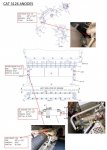
Pondering on superheat6k comments: if the end of the broken anode could be seen/reached, I just wonder if a file could be used to clean the end, and a dim taken then extend a metal stud from the plug to press/connect to it, just to re-make the circuit, until eventually (hopefully) the anode finally dissolves? Soo many anodes on a Cat 3126, see my image below:


CAT_3126_ANODES.jpg
 
Thanks folks for the replies. One has been solved (as such) in that I removed the heat exchanger end cap to find that a plastic repair had been made to the end cap seemingly with the anode in situ and had glued in the anode. So I'm actually replacing the end cap with a new Cat one (obviously made out of pure gold due to the price) and a new anode will go in.

The oil cooler one I'll be tackling today at some point and see just how friendly the anode has become to its surroundings. I'll report back. :cool:

edit - It wasn't my original plan but I appear to be slowly becoming a Cat engine mechanic.. And judging by what I've seen from other 'marine engineer's ' handy work, I may end up doing a better job. :oops:
 
Actually, I found the Cats quite straightforward for most maintenance. I didn’t tackle valve clearances as this requires special tools.
I'm fairly mechanical (had to regrind in 20 valves and a top-end rebuild on a motorcycle) and like where possible to know how my engines work and how to repair as much as possible myself. Partly down to cost (CAT mechanics can charge a fortune!) and partly that I want confidence in my own boat and how to fix it when I'm on a trip.
 
I have a spare set of plugs which I use with RL. Leave it circulating over night whilst you fit new anodes to spare plugs.

I know its a pain, because there are so many, but definitely worth doing every 3-5 years I reckon.
 
I have a spare set of plugs which I use with RL. Leave it circulating over night whilst you fit new anodes to spare plugs.

I know its a pain, because there are so many, but definitely worth doing every 3-5 years I reckon.
That seems a good move to me.. RL seems to have pretty decent results....
 
Top