Brazing S/S bolts to strip (to secure liferaft chocks)

Babylon

Well-Known Member
Joined
7 Jan 2008
Messages
4,401
Location
Solent
Visit site
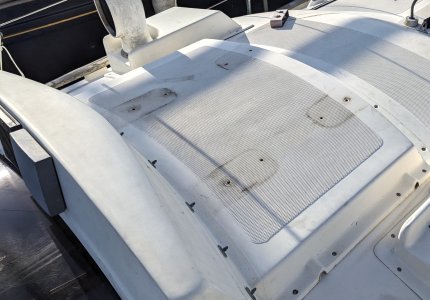
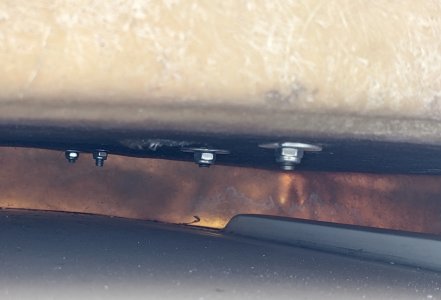
My old plastic life-raft chocks, which are mounted on the housing for the sliding-hatch just forward of the coaming, disintegrated after 10 years in the sun. I have a replacement set to mount, but am completely flummoxed as to how I originally got the the loc-nuts in place in the deep and tight cavity (accessed by removing the sliding acrylic hatch and peering forward with very little height clearance)? I might have unscrewed and removed the entire housing, but in any event I don't want to do that now, or in the future. Yesterday I managed to undo the old M6 machine-screws by lashing an open-ended spanner to a sail-batten to stop the nuts spinning while a friend operated the hefty screwdriver from above, but there's almost no way to hold the nuts back in place when replacing them.

My best idea for a solution is to permanently fix an 'undercarriage' each side of inverted M6 screws, using two strips of 3mm thick S/S as a carrier into which I'd carefully mark-up and bore holes to take the screws, the ends of which will then penetrate upwards through the housing and the chocks to secure from above with nuts. Each inverted undercarriage would be Sikaflexed in place before nipping up the nuts, so future chock replacement should be much easier without worrying about the innards at all.

So the question is: how does one braze S/S machine-screws to S/S strip? What kit would one need (to borrow)? As an alternative, would epoxy onto suitably keyed surfaces work?
PXL_20230625_175411600.jpg
PXL_20230625_094044603.jpg
 
Last edited:
Make the assembly and take it your local SS fabricator to weld - job done forever! I'd do it if you were ever near J27 M5!
Thanks for the kind offer. I guess the yard would know local people... it's bang next door a hoofing great scrapyard after all!

I would weld s/s screws to s/s strip

You could also tap the strip and screw the bolts into the scrip

I have doen this with hatch covers on a waste tank
I thought of tapping into the strip, then epoxying just under the bolt heads and manking the thread immediately above where the bolts protrude... but welding probably the tidier and more secure option.
 
If you have an old Arc welder you could make a capture weld with a few stainless rods yourself.
All I ever use now is me old Oxford oil cooled.......lovely!
 
Thanks for the kind offer. I guess the yard would know local people... it's bang next door a hoofing great scrapyard after all!


I thought of tapping into the strip, then epoxying just under the bolt heads and manking the thread immediately above where the bolts protrude... but welding probably the tidier and more secure option.

Just use some Loctite on the thread of the screws

I do it this way so that if the protruding thread strips the setscrew can be replaced easy
 
Just use some Loctite on the thread of the screws

I do it this way so that if the protruding thread strips the setscrew can be replaced easy

Good idea thanks. Tapping and thread-locking is in fact my easiest option as I already have a M6 tap set and can do the whole job (marking, boring and tapping) aboard the boat in one go. However accurately I try do all this, I'll probably have to relieve the existing snug holes in the GRP to account for cumulative error, but anyway nothing has to be watertight as its all above the coachroof itself.

Also, I wouldn't worry if I have to drop the whole assembly to replace a screw in future, as the aft-most end can be held for re-positioning, say with mole-grips lashed to a stiff extension, from the opening.
 
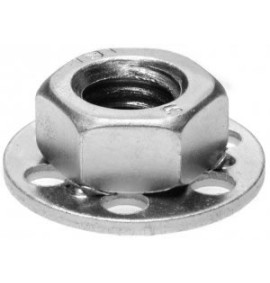
Its easy peesy.....get a ring spanner ( a flat one like that on a combination spanner), put a piece of tape over one side of the ring so you can drop the nut in and it wont fall through. Tape the spanner to what ever to get the length / penetration you need. Drop screw in from the top and align nut and start turning screw. If the torque becomes to much to cope with once the nut is engaged then replace spanner with piece of flat bar with suitable notch cut out in the end to hold the nut like a normal spanner. If you want washers on then tape them in place on the spanner too !
 
Bond in bighead fasteners with goop; get them in position with a spanner ziptied to a batten, hold the fastener in the spanner with blutack. A glamorous assistant fits a screw in from above and does it up enough to squidge the goop, probably just finger tight. The screw ought to be greased to reduce the risk of goop spread related unpleasantness.
1687807058070.png
 
Glue the nut to a metal bar with cyno. Tighten up- The nut should dig into the GRP to stop it turning. When fastened twist the bar & break the glue joint.
Useful idea, but (i) I'd prefer a penny-washer to spread the load which will however prevent the nut digging its own housing into the GRP, and (ii) I'd still wish to bond the underparts to the roof so they don't fall off when I withdraw the screws for chock replacement.

Bond in bighead fasteners with goop; get them in position with a spanner ziptied to a batten, hold the fastener in the spanner with blutack. A glamorous assistant fits a screw in from above and does it up enough to squidge the goop, probably just finger tight. The screw ought to be greased to reduce the risk of goop spread related unpleasantness.
View attachment 158848
Great product, and excellent suggestion for getting these in place. (Might have trouble finding a glamorous assistant though... will Keith from the boat next door in the boatyard do?)
 
Some interesting ideas, but why not just take the garage/hatch cover off ? Surely it must be quicker than trying to get nuts and washers on in a very restricted space?
 
Useful idea, but (i) I'd prefer a penny-washer to spread the load which will however prevent the nut digging its own housing into the GRP, and (ii) I'd still wish to bond the underparts to the roof so they don't fall off when I withdraw the screws for chock replacement.
In that case use a rivet nut with a penny washer dropped over the shoulder before fitting. If the hole in the GRP is a bit tight it will draw up into the hole as the bolt is tightened . Then it will not drop out when you release the bolt later on. You will achieve your aim of having the washer & having a fixed nut.
But bearing in mind that the last chocks lasted 10 years, will it really matter if you have to repeat the operation every 10 years.
 
Some interesting ideas, but why not just take the garage/hatch cover off ? Surely it must be quicker than trying to get nuts and washers on in a very restricted space?

Getting the cover off is doable but a major operation, which I wouldn't want to repeat (or subject a future owner to) when the new plastic chocks themselves eventually disintegrate; the old ones only lasted 6 years before they degraded and starting breaking! (*) I want a solution that is resilient, gets everything in place now and is easily repeatable.

My lead solution remains two S/S strips (each 450mm x 20mm x 3mm) tapped for bolts pointing upwards through slightly enlarged holes for easy gripping/alignment/insertion. That way the whole subassembly can be dropped and remounted any number of times.

Note (*): Plastic chocks aren't actually fit for purpose given their short and flimsy lifespans, but are all that seems commercially available. GRP or teak ones would be much better and last indefinitely, but I don't fancy a whole craft project. The alternative is an expensive S/S cradle but that would raise the liferaft higher still and require new fixings through the roof. Hence my wish for an "easily repeatable" solution.
 
Last edited:
In that case use a rivet nut with a penny washer dropped over the shoulder before fitting. If the hole in the GRP is a bit tight it will draw up into the hole as the bolt is tightened . Then it will not drop out when you release the bolt later on. You will achieve your aim of having the washer & having a fixed nut.
But bearing in mind that the last chocks lasted 10 years, will it really matter if you have to repeat the operation every 10 years.
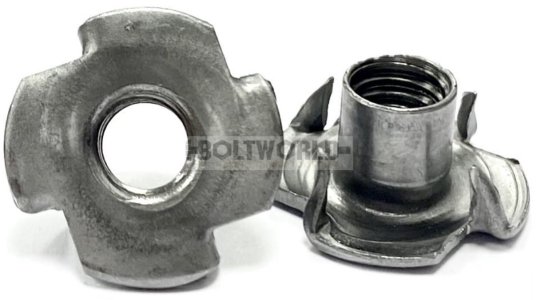
Good steer, thanks! Looking up rivet nuts got me to thinking about S/S TEE-NUTS which are actually ideal for the job and permanent! All I have to do is enlarge the existing holes with enough clearance for easy insertion from below, and draw them up one time only. They'll self-bite and I'll add a dollop of Sikaflex for good measure so they stay put.

The plastic doesn't actually last ten years. As per my post above, I've now checked when I fitted them (2015) and when bits started falling off (say 2021) so that's only six or so years.

TEE-NUT.jpg
 
I would suggest that to set them, you bolt them in place first as you will need a lot of pressure to pull the tangs into the GRP. Some tangs will just fold over. You will not be able to tighten them enough through the chocks as you will damage the plastic. Then you will find that they will not have pulled up enough.
I use them on my RC model planes & even pulling them into plywood needs a fair bit of tightening of the bolts. On a model one uses epoxy. However, your suggestion of Sika in this situation would seem preferable. Even if they do not go right home they will be held in place. The Sika will help spread some load when cured
 
I've also used them on RC planes (slope-soarers etc) with nylon bolts; they hammer easily enough into ply or lite-ply but as you say GRP is another story and there's no room to swing a hammer in this case. To avoid crushing the plastic chocks, I'd have to pull them up first using a penny-washer to spread the load under the screw-head, then mount the chocks afterwards.

The other serious issue is that Tee-Nuts are quite deep (looks like 50% deeper than the screw diameter on a spare unit in my RC box) and the GRP housing is quite thin (maybe only 6mm), so this could involve hacksawing the barrel down, plus filing the tangs!?

I see that I have a choice of nightmares...! Maybe back to Plan A...?
 
Top