
Bow roller took a caning

armchairsailor

Well-Known Member
Joined
17 Sep 2009
Messages
1,144
Location
back aground in Blighty
Visit site
There was a bit of wind in my bay this weekend. Ferries were cancelled, 15 boats went onto the beaches around Victoria and one of my mooring lines broke!

Looks like I've got some FG work to do at the bow. The roller appears to have crushed the fibreglass underneath, and is now loose enough to rattle and for me to turn the screws holding it down by hand. In addition, the rubber roller itself had a huge gouge worn into it, and needs to be replaced (easy enough). At least I know why the main mooring line was worn through and I was on the secondary... :nightmare:
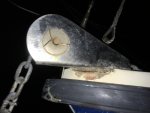
IMG_0532.jpg

Goes to show why anti-chafe is useful and to always do your checks. Not just on the lines, but on ALL points of contact.

Any advice on fixing this? I was thinking to build it back up with goopy epoxy, fill all holes and redrill for the roller. I've not inspected the attachment point underneath the foredeck yet, but maybe a little reinforcement wouldn't come amiss.
 
I think you will have to cut out all damaged material , chamferring into the surrounding sound material, and rebuild with resin and glass. Epoxy resin if you prefer.

There is loads of info on line on the techniques to use but probably the best and most comprehensive is the West System fiberglass boat repair manual.
http://www.westsystem.com/wp-content/uploads/Fiberglass-Manual-2015.pdf
The techniques will be similar whether you use epoxy or polyester resin.
 
Thanks for the link Vic. Is this a doable thing to do afloat, given a dry few days and a dock?
I'd pop into a marina with finger pontoons and poke the bow over the walkway. Your biggest problem with epoxy may be the temperature this time of year. I epoxied in new anode studs many Winters ago and I can still mark the surface with a fingernail.

Is it my imagination or has the SS bent? Or did it lift at the back?
 
I'd pop into a marina with finger pontoons and poke the bow over the walkway. Your biggest problem with epoxy may be the temperature this time of year. I epoxied in new anode studs many Winters ago and I can still mark the surface with a fingernail.

Is it my imagination or has the SS bent? Or did it lift at the back?

If the climate at the OP's location is too cold then it might be a valid reason to use a polyester resin rather than epoxy but humidity and condensation become your enemies at lower temperatures whatever resin you use.
 
Last edited:
I would think that the fitting is really on the small size for mooring through a gale.
I would consider some proper reinforcement, perhaps a triangular stainless plate extending back maybe 8" from the bow to spread the load and feed the force into the hull and deck? Probably reinforce underneath with some grp.
Repairing it back as it was would not really be enough.

Mooring on chain can be very harsh on the boat if the boat is stopping short on every wave.
You could consider adding some fairleads and mooring with twin rope strops, keeping the chain as a backup?

Whether you use epoxy or polyester is not the main point. The big issue this time of year will be getting the damage dry enough to work on.
This time of year I wouldn't epoxy anything outdoors without getting some hot air on it to dry it and speed the setting of the epoxy. It also thins the epoxy for better bonding.
 
I would be looking to replace with a fitting that has a removable pin to keep the chain in situ. There's a name for it but I can't bring it to mind just now.

Derek
 
This shows my limited knowledge: I wasn't actually using the chain - I was using two mooring lines, and because the lengths were a little short, I ran one over the bow roller rather than through the other fairlead. Now I suspect it would have been kinder on the boat to have had symmetrically set lines.

As for humidity, I hear you all - I think I'll patch up something to keep the FG semi-dry and wait for the spring to get on to this.

I definitely like the idea of a pin arrangement, as the whole setup does seems a little on the lightweight side - I miss a Samson post.
 
In complete ignorance of your mooring specification and the area in which you moor.

It appears you did not have enough dampening in your mooring system. Simply repairing what you have is not going to change the shock loads - you need to look at your mooring set up. Having a samson post would make no difference - the shock loads would still be on the bow roller - and putting those same shock loads on the fairleads - might still result in some damage. Before you get into repairing the bow roller have you looked at whatever the mooring lines are, or were, secured to - they take those same shock loads. If you need to make repairs - do it all at once.

For the mooring itself you need to introduce some form of dampening or elasticity. Having beefy mooring lines will ensure they are strong and abrasion resistant - but will have no stretch.

Jonathan
 
Victoria Canada or Victoria Australia?

His location , in his profile and displayed in the header of his posts is "Salish Sea" , the intricate network of coastal waterways that includes the southwestern portion of the Canadian province of British Columbia and the northwestern portion of the U.S. state of Washington.!

You would do well to edit your profile to read something sensible amd informative for your location!
 
His location , in his profile and displayed in the header of his posts is "Salish Sea" , the intricate network of coastal waterways that includes the southwestern portion of the Canadian province of British Columbia and the northwestern portion of the U.S. state of Washington.!

You would do well to edit your profile to read something sensible amd informative for your location!

Spoilsport! :)

You're right - Victoria, Canada - the bit that's not covered in ice at the moment. In fact, it's similar to S England I'd say. Certainly less chilly than Scotland, where I used to live.

By way of an update, I've inspected the damage and there's cracking in the gelcoat pretty much all around the roller, so I'll have to grind quite a lot back to get to undamaged material. Looks like it will be worth doing a proper job.
 
Last edited:
So, since many of these threads end on a hiatus where no real epilogue is given, here's mine.

I finally got around to doing the work in August, and it wasn't nearly as daunting as I thought it would be. I got CSM and polyester resin, since I was told it would bond better and be easier to apply a final tinted layer to make it blend in with the topsides. An angle grinder was very handy, although not without issues, given that it was easy to hit the surrounding hardware. Once the damaged fibreglass was cut out and angled, I cut the matting to the rough shape of the void, put in 3-4 layers of matting, each well wetted down before the next one was put on, and finished off with the resin mixed with a multi-purpose filler/ bulking powder. Once it had been left to cure for 24 hours, I ground it down then sanded to approximate the level of the deck as best I could and reinstalled the roller. It's a job most of us can do without too much ado - just ensure you've got everything to hand and are well prepared.
 
I would be looking to replace with a fitting that has a removable pin to keep the chain in situ. There's a name for it but I can't bring it to mind just now.

Derek

Many bow rollers have holes either side through which you can put a drop-nose pin to prevent the chain lifting or moving much while the boat is attached. You still need to consider how the chain is secured inboard on the roller. As a secure back up. We took the chain round a cleat a few years ago when we rented a summer mooring (with chain to surface). Not elegant but fairly secure.
 
Top