Bow Plank Materiel

winfarthing

Well-Known Member
Joined
24 Aug 2007
Messages
118
Location
Menai Strait, North Wales
Visit site
The bow plank on my 'project' Colvic Victor 40 is in need of renewal. Having managed to remove it and it's several component pieces, the quote for sufficient teak to renew it is about £450. I knew it wasn't going to be cheap but hadn't expected that much. I don't believe the supplier is being overly expensive, that's just the price of of a lump of teak. The question is has anyone any experience of using a cheaper hardwood, if there is one, or some other alternative? It needs to be reasonably strong as it carries the bow rollers but does not carry any rigging.
 
Have you asked for a quote for iroko? Its about the only other suitable wood, generally a bit harder than teak and not quite so nice looking, but it is durable and generally a fair bit cheaper.
 
Have you asked for a quote for iroko? Its about the only other suitable wood, generally a bit harder than teak and not quite so nice looking, but it is durable and generally a fair bit cheaper.

Thanks, will explore that option. Didn't realise Iroko would be cheaper. Is it not a little brittle in shear? Happy to be wrong and it's cheaper!
 
Not sure what you mean by bow plank but if it is simply the plank that some boats have with bow roller and often windlass on then I would expect any wood of reasonable strength would be good. Teak is not as strong as many woods but is used as it resists rot and looks good. Other woods can be treated to resist rot with epoxy or other coatings. There are some modern 'manufactured' woods such as kebony which promise similar characteristics to teak but they are probably a similar price. Beware of cheap teak which will be inferior wood. Often the quality of the wood is more important than the type.
 
I would suggest you select the plank yourself when it comes to it. Iroko can vary from complicated wild grain to close and relatively straight grain - even in the same piece of wood and sometimes you will see shakes in wider planks though that may or may not matter.
 
Purple Heart, Padouk, and Ipe are commonly used as teak substitutes here in Western North America. Padouk is probably the easiest to work though it's dust is horrible. It will turn quite black in sunlight under oil or varnish. Purple Heart has a lot of wild grain and is hard on tools, but it's very durable. Ipe is really heavy, use smaller dimensions, hard on tools as well. Any of these are far less money than teak.
 
It depends on the function of the plank. I would favour a core of marine ply and a 6mm veneer of teak top, bottom and all sides if the teak finish is what you desire. Epoxying the teak all round the ply core will prevent water ingress at the edges. I have often edged ply with hardwood to give it that extra edge of durability. That said there's some pretty ropey ply in the depths of Snark that appear to have lasted 40+ years, without such protection.
 
Not sure what you mean by bow plank but if it is simply the plank that some boats have with bow roller and often windlass on then I would expect any wood of reasonable strength would be good. Teak is not as strong as many woods but is used as it resists rot and looks good. Other woods can be treated to resist rot with epoxy or other coatings. There are some modern 'manufactured' woods such as kebony which promise similar characteristics to teak but they are probably a similar price. Beware of cheap teak which will be inferior wood. Often the quality of the wood is more important than the type.

If it's like other Colvics, it's a solid piece of wood running along the bow from the keel to the stem-head. I can appreciate that it would be a costly bit of timber - the ones I've seen must be about 4"x6", and about 6'-10' long!

I'd have thought that any hard wood that is OK for exposure to water would do - it isn't load-bearing, so strength isn't really an issue - any bit of timber that size would be strong enough unless it was balsa! Oak comes to mind, but I'm sure there are plenty of alternatives. Obviously teak or Iroko would last longer, but other woods with good salt water resistance should be fine.
 
+1 for Iroko. On my previous boat I had to berth bows-to because I had a dinghy in davits over the transom. I fitted an Iroko plank at the bows that could be used to step down to or up from the pontoon. The inner end had a windlass bolted through it while the outer end has a home-made roller so that the Bruce was self-stowing. Iroko weathers to a silky grey that is quite like weathered Teak. Yours would just need to be bigger.

CYANObowsto.jpg


CYANOwindlass.jpg
 
If it's like other Colvics, it's a solid piece of wood running along the bow from the keel to the stem-head. I can appreciate that it would be a costly bit of timber - the ones I've seen must be about 4"x6", and about 6'-10' long!

I'd have thought that any hard wood that is OK for exposure to water would do - it isn't load-bearing, so strength isn't really an issue - any bit of timber that size would be strong enough unless it was balsa! Oak comes to mind, but I'm sure there are plenty of alternatives. Obviously teak or Iroko would last longer, but other woods with good salt water resistance should be fine.

That sounds odd and I can't find pictures. What is its purpose as it sounds like it would take room in the fore cabin running like that? From the sounds of things, if it is a sizeable bit of timber, then lamination is likely to be best in most circumstances. I would agree with topcoat and it would save on teak if only the head of it requires this as a surface finish. Glued and sealed with epoxy it would likely be much stronger than solid teak and even more dimensionally stable (not that this would be a big issue with teak).
 
+1 for Iroko. On my previous boat I had to berth bows-to because I had a dinghy in davits over the transom. I fitted an Iroko plank at the bows that could be used to step down to or up from the pontoon. The inner end had a windlass bolted through it while the outer end has a home-made roller so that the Bruce was self-stowing. Iroko weathers to a silky grey that is quite like weathered Teak. Yours would just need to be bigger.

CYANObowsto.jpg


CYANOwindlass.jpg

That is the type of plank I thought it was.
 
Iroko is roughly 60% of the price of teak. As it takes no load other than anchor and mooring chains then mahogany would also do. The design I used has a saddle with a bow roller either side of the plank (laminated mahogany because that is what I had in stock) and a steel strip running underneath with a hanging knee down the bow screwed to the stem head.
 
Oak ? We might be able to help from the sawmill if you post the dimensions.

Thanks for the suggestions, all worth considering. The bow plank has the following rough dimensions.
I off 126cm x 30cm at 55mm thick. The thickness to be a planed finish, the other dimensions sawn as they will be further worked on.
1 off 30cm x 70cm at 20mm thick. Again, the thickness to be a planed finish, the other dimensions sawn as they will be further worked on.

The second one sits under the first one and is cut to the shape of the GRP moulding. It is just a bow plank and it's only purpose, as well as decorative, appears to be to take the anchor chain through the roller, well clear of the stem. This obviously requires sufficient strength to take the weight off the chain at max depth plus snatching forces.
Thanks to Sarabande - I'd be interested in the cost of an oak equivalent. I have also requested a quote for Iroko and take the point about its variable qualities.
 
That sounds odd and I can't find pictures. What is its purpose as it sounds like it would take room in the fore cabin running like that? From the sounds of things, if it is a sizeable bit of timber, then lamination is likely to be best in most circumstances. I would agree with topcoat and it would save on teak if only the head of it requires this as a surface finish. Glued and sealed with epoxy it would likely be much stronger than solid teak and even more dimensionally stable (not that this would be a big issue with teak).

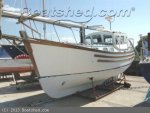
It's on the outside of the bow, and acts as a cutwater. The Colvics I've seen it on are the motor sailer, like this: autoimage-125223_BoatPic_Main.jpg - I've just checked, and the OP's boat isn't that type, so my thought isn't relevant.
 
It's on the outside of the bow, and acts as a cutwater. The Colvics I've seen it on are the motor sailer, like this: View attachment 43645 - I've just checked, and the OP's boat isn't that type, so my thought isn't relevant.

OK, I get what you mean now, I would assume that was just part of the stem post. The problem is there is often interchangable terminology for all these things as well as local variation and simply not knowing the correct terminology. It is surprising how difficult it is to describe things and, like they say, a picture is worth a thousand words. :)
 
OK, I get what you mean now, I would assume that was just part of the stem post. The problem is there is often interchangable terminology for all these things as well as local variation and simply not knowing the correct terminology. It is surprising how difficult it is to describe things and, like they say, a picture is worth a thousand words. :)

And, of course, Colvic generally provided hulls that were fitted out by others, so there is enormous variability in the fixtures and fittings, as I found when I searched for a photo showing what I meant! Boats with the same hull may or may not have the cutwater; it isn't structural, but it looks nice and potentially protects the gel-coat on the GRP hull!
 
Top