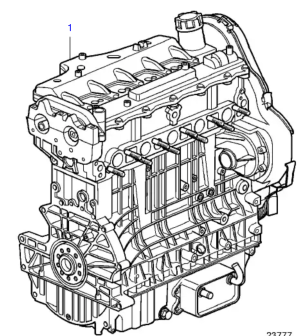
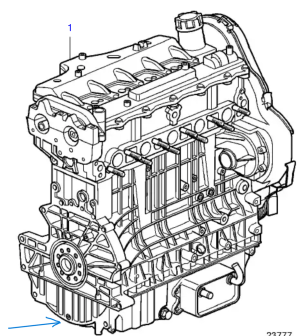
Both engines (only 150 hours) sudden oil leaks from crankshaft o-rings???

Miozio

New Member
Joined
2 Oct 2023
Messages
18
Visit site
Hello everybody.

I have a Bavaria s36 with very low hours on both Volvo Penta D3 220 engines.

Yesterday, after 1 month of not running the boat, i went for a quick full power passage along the coast. Everything was great until I returned to the marina and checked the engines. To my surprise port and starboard had some oil in the bilge.
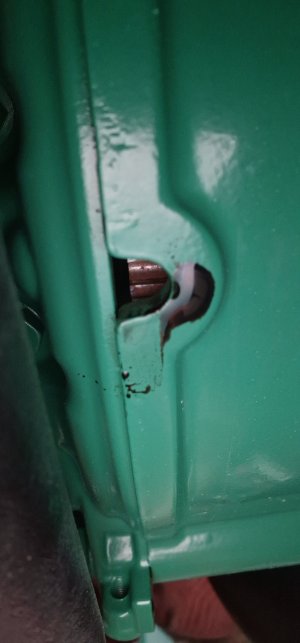
After taking a picture of right above the splash, here is what I found.

Has anybody experienced this, especially on both engines? Is this a crankshaft seal leak? The gearbox is on the left, not seen on the pic.
20230929_100732.jpg
 
Hard to tell from the picture where that trail of oil leads to the left, it could well go all the way up the side of the engine and be leaking from the top
 
That trail is from my fingers but the leak comes from that hole, not sure why it is there. Possibly to drain the leaking oil to the bilge?
 
It’s impossible to tell what we are looking at. Need a more zoomed out picture.

Very unlikely a crankshaft has o-ring. A spring lip seal is more likely. And very unlikely for such seals to fail at low hours, twice. Being stationery for a month isn’t a cause.
 
Last edited:
I agree, it is difficult, but there is a bilge right below this, can't make a zoom out. So basically, to the left of this "hole", there is a stern drive gear and further on there would be an outboard stern drive.
 
Bear in mind that a D3-220 is an R5 engine that shouldn’t be run at full power for extended periods.
I would wipe up the oil and run a bit more gently next time.
I ran them for about 20 minutes at full blast with 4000 maximum rpm with sharp turns and all that. Both engines dripped some oil, not much. Although, I haven't found anything about extended time in the manual. It only says, to avoid elevated fuel consumption, it shouldn't be run at full rpm.
 
So from underneath the bottom of the crankcase / oil pan? Or is it running/dripping down that rearward face from the crankshaft seal directly abI’ve? Either way it seems very unusual that both engines would simultaneously experience the same fault.
Looks like it was underneath the crankshaft seal
 
Oil pressure was too high for the seal and it’s blown it .
looks like engine oil as its black .Your gear box oil should be honey coloured.
As Simon mentioned , age maybe contributing.
Its a combo of many factors with the ducks aligning all at together .

1- Age

- Static lay up for extended periods they dry out which sends them on a embrittlement path .

- Over filling = inc oil pressure . Watch the oil pressure ,esp when clap cold .Watch the oil pressure gauge drop as it heats up .Can take 15-20 mind of load ,not idle marina manoeuvres.

- Revving the thing up to max or near max when it’s not throughly warmed up .watch the oil pressure gauge drop as its heats up . Have you got access to oil temp ?Not water jacket temp , it’s the oil temp I am talking about .

It’s the same with classic cars you have to get the oil warm first before letting rip .This is what I do .
With the boat diesels I don’t open them up until the oil is warmed up and pressure dropped .This often when clap cold means running pushing a bow wave to get the load up .It can take a while .

Obviously dip them first every day .

2- Curiously we are assuming with the dip thing that it’s not been gradually elevating day by day , week by week .
Where I am going with this line of thought is a leak of a oil cooler so the gross vol has increased or leak of fuel ( somehow ? ) getting into the sump .Net result will be elevated pressure akin to overfilling the sump .
But two simultaneously is unlikely.

3- Thirdly and last the actual oil .
Is it the correct Volvo spec for the engines ? There is a line of thought that some oils are detrimental so some seals and gaskets and the net result is a weeping seal or gasket .

I have experienced this ^ with classic cars btw .Oil threads on car forums are like anchor threads on here btw 🤗

In the boat I follow the manual specs .

Treatment ,
Theres a possibility that if you change the oil right now to exact spec in the manual ….you personally do it eyeball it this time and avoid extended 4000 rpm , carefully warm the oil in future it might , stress might self heal , or drop to un noticeable .
Try that first .If it still pisses it out at 3000 - 3300 rpm than you are 8hit street you are looking at new RMS rear main seals .
 
Last edited:
1- Age

- Static lay up for extended periods they dry out which sends them on a embrittlement path .

- Over filling = inc oil pressure . Watch the oil pressure ,esp when clap cold .Watch the oil pressure gauge drop as it heats up .Can take 15-20 mind of load ,not idle marina manoeuvres.

- Revving the thing up to max or near max when it’s not throughly warmed up .watch the oil pressure gauge drop as its heats up . Have you got access to oil temp ?Not water jacket temp , it’s the oil temp I am talking about .

It’s the same with classic cars you have to get the oil warm first before letting rip .This is what I do .
With the boat diesels I don’t open them up until the oil is warmed up and pressure dropped .This often when clap cold means running pushing a bow wave to get the load up .It can take a while .

Obviously dip them first every day .

2- Curiously we are assuming with the dip thing that it’s not been gradually elevating day by day , week by week .
Where I am going with this line of thought is a leak of a oil cooler so the gross vol has increased or leak of fuel ( somehow ? ) getting into the sump .Net result will be elevated pressure akin to overfilling the sump .
But two simultaneously is unlikely.

3- Thirdly and last the actual oil .
Is it the correct Volvo spec for the engines ? There is a line of thought that some oils are detrimental so some seals and gaskets and the net result is a weeping seal or gasket .

I have experienced this ^ with classic cars btw .Oil threads on car forums are like anchor threads on here btw 🤗

In the boat I follow the manual specs .

Treatment ,
Theres a possibility that if you change the oil right now to exact spec in the manual ….you personally do it eyeball it this time and avoid extended 4000 rpm , carefully warm the oil in future it might , stress might self heal , or drop to un noticeable .
Try that first .If it still pisses it out at 3000 - 3300 rpm than you are 8hit street you are looking at new RMS rear main seals .
Wow. Thank you for this. The official Volvo penta mechanic changed the oil and it looked too dark to me. He says he uses the genuine oils.

I will follow up on your suggestions regarding the oil change and monitoring.
Thanks again
 
Check whether the engines have the Volvo 5 year warranty. I don't know whether it applies to this model of engine, but there was a 5 year warranty on the D1 30 in a new boat I bought in 2015.
 
Top