
Bosch relay

Caladh

Well-Known Member
Joined
25 Oct 2009
Messages
1,540
Location
Out there again and no longer dreaming
Visit site
Bosch relay web.jpg
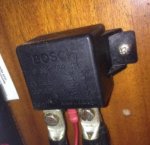
I posted a question about this relay some time ago and was advised to go and trace the wiring (!) which
I've now done. The question is what does it do? The l/h connection comes from the main on/off Engine Start
switch and the r/h connection is from the main on/off House switch. The two small wires (red+ and black-) at
the rear of the two cables you cab see go to the alternator. Is it in effect, a basic VSR ?
 
View attachment 86187
I posted a question about this relay some time ago and was advised to go and trace the wiring (!) which
I've now done. The question is what does it do? The l/h connection comes from the main on/off Engine Start
switch and the r/h connection is from the main on/off House switch. The two small wires (red+ and black-) at
the rear of the two cables you cab see go to the alternator. Is it in effect, a basic VSR ?
No, there is no voltage sensing.
As mentioned it is a basic 75A split charging relay for combining the batteries while the alternator is putting out.
The small black wire would go to alternator (or any) negative and the red to alternator D+ (AKA warning light terminal).
I have the same set up in my boat, works very well. (Although some think differently).
 
I had a similar one on a boat with a Volvo Penta MD1 with a Dyno start and VSR. I never understood how the system worked.
 
Last edited:
I wouldn't change if I were you unless you plan to add solar or wind generation. My knowledge of charging is not good enough to say whether that would be a good idea. Ask Paul Rainbow.
 
I guess the next question would be therefore, would it be a good idea to change it for a VSR ?

This is a simple relay that will close as soon as you start the engine and all batteries will be in parallel. A faukt with either battery will not open the relay. A VSR will allow all batteries to be charged but better protect you against some problems. I would replace it. You should be able to use the same cables from the switches (fit fuses as appropriate), you'll need to use the negative wire, but the positive will be redundant.
 
I would suggest OP use a digital volt meter to check domestic house battery voltage firstly when the engine is cranked. It should remain the same showing that the house battery is isolated from the engine stat battery. Then when the engine has started you should see the voltage of the house battery rise to near 14v showing it is being charged by the alternator. Thes tests would show that the relay is operating only when the alternator starts to charge. ie from the indicator light circuit or the W terminal which has an AC output often used for tacho drive. If this is the case then the system seems to work well although as said a VSR might function better in some circumstances but I would say leave it as is. The VSR will only connect charge to house battery when the engine battery has come up to full voltage usually quite quickly. I would never use a VSR for solar charging as solar charging is often of low power so not sufficient voltage to operate VSR. Use diodes or separate solar panels. ol'will
 
I would suggest OP use a digital volt meter to check domestic house battery voltage firstly when the engine is cranked. It should remain the same showing that the house battery is isolated from the engine stat battery. Then when the engine has started you should see the voltage of the house battery rise to near 14v showing it is being charged by the alternator. Thes tests would show that the relay is operating only when the alternator starts to charge. ie from the indicator light circuit or the W terminal which has an AC output often used for tacho drive. If this is the case then the system seems to work well although as said a VSR might function better in some circumstances but I would say leave it as is.

The VSR will only connect charge to house battery when the engine battery has come up to full voltage usually quite quickly.

The VSR will close when it senses the alternators output voltage, which will be pretty much as soon as the engine has started. It's a myth that it will charge the engine battery before closing.

I would never use a VSR for solar charging as solar charging is often of low power so not sufficient voltage to operate VSR. Use diodes or separate solar panels. ol'will

Huh ? A VSR works perfectly well with a solar installation. A solar panel outputs enough voltage to close the VSR and opens in the evening when the voltage drops as the panels stop charging. If the panels are so small that they couldn't raise the voltage enough to close the relay, it's doing exactly what it's supposed to do, keeping the batteries isolated when there is insufficient charging available.
 
Top