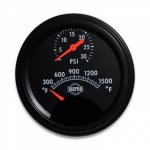
Boost gauges - why?

burgundyben

Well-Known Member
Joined
28 Nov 2002
Messages
7,484
Location
Niton Radio
Visit site
Why do some boats have boost gauges on the dash?

I get that boost is an expression of load, I also get that late season, weedy bottom, unwelcome guests, junk, etc all add weight and drag for any given speed and revs, hence increased load, but I really don't see the need for boost gauges?

Its common to see them on older Ford powered boats, I note that the Perkins Sabre Phaser based motors came with a control panel with no boost gauge (but they had the odd wastegated TC)

I can see the value of EGT perhaps and I can see that the two things are linked.

When planning my new engine install, Cummins 210hp B series in a 4.5 ton boat that is expected to just about clear 30 knots, assuming I get the props right I don't see the need.

Tacho, oil pressure, coolant temp and voltmeters is what I'm planning.
 
They help with a twin set up, to balance them, but accurate rev counters would do the same? Which we aint got cos the alternators drive them, so with belt slip, and dodgy regulators not always "together" Oh and we have OLD FORDS and they do not help. LOL
 
turbocator-gauge-large.jpgBoost is characteristic of propeller demand curve therefore if you want to equalise load on engines works well to drive engines on boost gauges and not tachometers.

However EGT gauges are far more accurate and responsive indicator of propeller load.

In U.S. combined EGT/Boost gauge (Turbocater) manufactured by ISSPRO industries is a nice and very popular instrument.

Alternatively scrub them all and display on your Raymarine display..
 
Flippin'eck! Surely you should be driving an old Ford on smell alone. Mebbe a glance at the smoke now and then if you're really fussy. ?
 
I think sometimes boulders like to put as many dials and switches on the panel as possible. Boys toys???
I have a light for the oil pressure, a light for the alternator and a temp gauge for the water.... thats it... nothing else!!! My friends similar aged boat has engine oil temp, engine oil pressure, water temp, gearbox pressure, gearbox temp, voltage and ammeters.....

Why does my wife's automatic car have a rev counter????
 
Don't get Megs started on his old Fords. He's precious about them. Coupled to the paddlewheel and it's the best innovation since sliced bread. Mind you, the bit about cheap and easy to source parts is tempting, not enough to settle for hull speeds, but tempting :p
 
View attachment 55207Boost is characteristic of propeller demand curve therefore if you want to equalise load on engines works well to drive engines on boost gauges and not tachometers.

However EGT gauges are far more accurate and responsive indicator of propeller load.

In U.S. combined EGT/Boost gauge (Turbocater) manufactured by ISSPRO industries is a nice and very popular instrument.

Alternatively scrub them all and display on your Raymarine display..

You'd drive a twin engine boat with equal boost and unequal revs?
 
EGT gauges can be a lifesaver at the end of the season when bottom has become weeded, giving donks too much tight wire even though Ben has Inconel exhaust valves things get mad hot in the combustion chamber.

Suspect Ben will want to prop his new boat to wring the engines necks so keeping eye on EGT's even more important.

You'd drive a twin engine boat with equal boost and unequal revs? Absolutely!
 
Last edited:
EGT gauges can be a lifesaver at the end of the season when bottom has become weeded, giving donks too much tight wire even though Ben has Inconel exhaust valves things get mad hot in the combustion chamber.

Suspect Ben will want to prop his new boat to wring the engines necks so keeping eye on EGT's even more important.

You'd drive a twin engine boat with equal boost and unequal revs? Absolutely!

Well you learn something everyday. So why don;t we have 4" boost gauges and 2" tachos? It would allow better matching of load?

BTW - you once said to me a 'a lightly loaded diesel is a happy diesel', I'll be keeping the props just a little on the skinny side.
 
Our Perkins have boost gauges but never been anything like sensitive/accurate enough to match engine load. Wouldn't have crossed my mind that they would be any good for this...... :)
 
Don't get Megs started on his old Fords. He's precious about them. Coupled to the paddlewheel and it's the best innovation since sliced bread. Mind you, the bit about cheap and easy to source parts is tempting, not enough to settle for hull speeds, but tempting :p

You know the way to Ramsgate??
 
Ben - Bit off thread but if you need to take any measurements for the details of your install you are welcome to look at my 6BT's.

I bought myself some boost gauges for OB but never got around to fitting them so I am looking at cutting holes in the new dash panel tomorrow as they must be better off installed than simply sitting in my workshop.

As far as Exhaust gas temperature unless you are looking at individual cylinders I see little point and at that point probably taking attention to detail a bit too far (IMHO). The Navy went berserk on EGT on the Paxman generator engines in the early 1980's and wrecked several enormous engines by trying to tweak fuelling to individual cylinders to get exhaust gases temperatures under control.
 
Ben - Bit off thread but if you need to take any measurements for the details of your install you are welcome to look at my 6BT's.

I bought myself some boost gauges for OB but never got around to fitting them so I am looking at cutting holes in the new dash panel tomorrow as they must be better off installed than simply sitting in my workshop.

As far as Exhaust gas temperature unless you are looking at individual cylinders I see little point and at that point probably taking attention to detail a bit too far (IMHO). The Navy went berserk on EGT on the Paxman generator engines in the early 1980's and wrecked several enormous engines by trying to tweak fuelling to individual cylinders to get exhaust gases temperatures under control.

Trevor,

Every ship I ever served on had individual cylinder temperature gauges and adjustment of individual unit pumps and monitoring and adjusting fueling was responsibility of the second engineer and we used to keep a genny on line for a year at a time. We did occasionally have ex Andrew engineers on board however the chief always told them that they never stood any chance of gaining any proper experience as their lot headed back to port when the milk turned sour!

Rolls Royce were always naughty with their Shewsbury built diesel engines as they had a habit of breaking the seals on a production pump and tweaking the odd engine which was pulling production tolerance on the dyno to max EGT in order to pass the engine off test. After a few years in service, pull the pump of for re-calibration without checking to see if lead seals had CAV or RR on them and you could end up with an engine as flat as a witches tit!

On a serious note may I suggest you are missing the point slightly. If it were my call I would leave boost gauges in the box however give EGT gauges more consideration as they have real value as they are fast acting enough to tell you exactly what load propellers are demanding from your engines. Your engines have a maximum turbine out temperature of 438 C, in other words after turbocharger has extracted a large chunk of heat energy from the exhaust.

My light hearted comment about Ben wringing his engines necks, even if he is propped light pulling say 80% load clean, at the beginning of the season with significant weed growth loss of say 200 rpm off the top can take you way above 450 C which means that critical bit in the cylinder are getting mad ot!.

Ben and I have a mutual acquaintance who is an airline pilot, my sea trial kit has EGT's and when we did sea trials on his boat, our pilot immediately saw the benefit of driving boat on the pyros and pilots dad, a retired pilot who was also along for the ride said that equalising EGT's on multiple piston engined airliners was normal practice, resulted in optimal engine load and fuel consumption.
 
Trevor,

Every ship I ever served on had individual cylinder temperature gauges and adjustment of individual unit pumps and monitoring and adjusting fueling was responsibility of the second engineer and we used to keep a genny on line for a year at a time. We did occasionally have ex Andrew engineers on board however the chief always told them that they never stood any chance of gaining any proper experience as their lot headed back to port when the milk turned sour!

Rolls Royce were always naughty with their Shewsbury built diesel engines as they had a habit of breaking the seals on a production pump and tweaking the odd engine which was pulling production tolerance on the dyno to max EGT in order to pass the engine off test. After a few years in service, pull the pump of for re-calibration without checking to see if lead seals had CAV or RR on them and you could end up with an engine as flat as a witches tit!

On a serious note may I suggest you are missing the point slightly. If it were my call I would leave boost gauges in the box however give EGT gauges more consideration as they have real value as they are fast acting enough to tell you exactly what load propellers are demanding from your engines. Your engines have a maximum turbine out temperature of 438 C, in other words after turbocharger has extracted a large chunk of heat energy from the exhaust.

My light hearted comment about Ben wringing his engines necks, even if he is propped light pulling say 80% load clean, at the beginning of the season with significant weed growth loss of say 200 rpm off the top can take you way above 450 C which means that critical bit in the cylinder are getting mad ot!.

Ben and I have a mutual acquaintance who is an airline pilot, my sea trial kit has EGT's and when we did sea trials on his boat, our pilot immediately saw the benefit of driving boat on the pyros and pilots dad, a retired pilot who was also along for the ride said that equalising EGT's on multiple piston engined airliners was normal practice, resulted in optimal engine load and fuel consumption.

Another question about this subject came to mind, if matching engines by load is a cleverer thing to do than matching by revs, why do some manufacturers offer an engine sync tool that matches revs?
 
Another question about this subject came to mind, if matching engines by load is a cleverer thing to do than matching by revs, why do some manufacturers offer an engine sync tool that matches revs?

I guess it's easy enough and good enough on decent new tech engines...

We had the boost vs pyro gauge discussion with LS a couple of years ago, ended up buying boost gauges on aesthetics :rolleyes:
I'd really like a dual pyro gauge on my plotter via NMEA2K but I'm not sure there is even a NMEA2K sentence for that!
The NoLand RS11 analogue to NMEA2K box I bought from Trev has no pyro option (there is a boost option though!)

cheers

V.
 
Another question about this subject came to mind, if matching engines by load is a cleverer thing to do than matching by revs, why do some manufacturers offer an engine sync tool that matches revs?

Synchronisers have been around for years, also remember that many boaters in the U.S. prefer still twin lever controls also driving a boat on one lever has appeal. Once electronic engines came along it was easy peasy.

Our Concorde pilot discovered benefit of Pyrometers when testing propellers, well known propeller supplier came up with some radical props for RB2008. During trials the needles on EGT gauges moved faster than fuel gauge on your latest four wheeled acquisition, so vessel was lifted and props ripped off before they did any damage.

MAN and Steyr probability other take input from EGT sensor as part of base engine management input.
 
Another question about this subject came to mind, if matching engines by load is a cleverer thing to do than matching by revs, why do some manufacturers offer an engine sync tool that matches revs?

As far as I can tell the main use of synchros is allowing the operator to avoid the annoying harmonics you get with two engines that are nearly but not quite synchronised, which is a first world problem if there ever was one.
 
It is worth remembering here that IF engines are perfectly matched (something Cat are the best at, when selling pairs) then driving on matched RPM will give you the right answer anyway

Also, in the real world you often cannot match the loads due to one engine driving more auxiliary load than the other. A stabilisers PTO is pretty significant; a power steering pump less so, and there might be other differences. In these circumstances it doesn't do to match loads unfortunately. You're better getting both engines up to spec then matching rpm

In the olden days when it was hard to get a perfectly matched pair of big props there was more logic in matching loads than these days when we have MRI scanners to make near-perfect pairs of big props

You also have to factor in the sometimes different reduction ratios of port and starboard gearboxes, if you are seeking perfection
 
Top