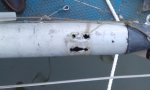
Boom repair... Patch or what?

Captain Crisp

Well-Known Member
Joined
1 Mar 2015
Messages
414
Visit site
Hi,
my Twister 28's 50yr old aluminium boom has an area where a previous fitting has been removed leaving about 5 ugly holes all in close proximity. IMG_20191221_104704_compress83.jpg
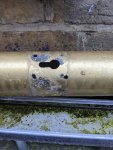
It's clearly a weak spot as well as an eyesore... What should I do?
Thanks!
Crisp
 
Start looking for a nice spruce tree?

If the section is round, you might be able to sleeve it internally, maybe inside and out?
I assume that's an old kicker fitting.
Possibly you could turn the boom end for end.
But that's just waiting to break.
 
I had a similar problem on a 40+ year old Corsair In Australia a about 4 years ago. On the mast, just above the point where it passes through the deck the mast was very heavily corroded, The boat had been neglected for many years and left afloat on a mooring. The mooring rope had been tied around the mast for extra security and most of the anodising had been worn away and there was a lot of corrosion. I repaired by carefully cleaning the damaged area and about 50 mm either side and then wrapped epoxy glass, using a woven roving, around the mast, tapering it at either side. 4 years on the repair is still sound and the boat gets plenty of use, and I'll be sailing again when I'm next in Australia early in the New Year.
If you use the same technique, then when the epoxy glass has cured, refit the SS kicking strap fitting, using it as a template to cut the keyhole slot , and carefully open up the slot for the mainsail bolt rope, assuming the main uses a bolt rope. I'd use monel pop rivets to fit the plate.
I think it's better to make the repair with a continuous wrap of glass roving, you'll be able to pull it tight after the first wrap or so, and get a better glass to resin ration. It'll also be much easier to do than trying to make plate to patch the damaged area, and be as least as strong.
You could also paint the boom to "hide" the repair and smarten up the boom.
 
It has done well to last as long as it has. I had the same type of roller reefing boom, fitted in 1967, and it broke in two at the kicking strap fitting in 2005.

It happened off the coast of Brittany, en route for L'Abervrac'h.

It was impossible to find a replacement length of the same aluminium section and my insurer paid for a nice new Sparcraft boom with slab-reefing. It cost £472.
 
I would be inclined to find someone who is a competent welder of aluminium and have a conversation with them about filling and then patching the area, it'll probably not look pretty but it will regain some strength. Beyond that I would look for a repalcement especially if intending to do more than coastal hopping.
 
Unfortunately, I can't wrap all around as the mainsail foot is held inside a slot along the top of the boom...

I think you could patch that to get another season or two. It would need to be plated three times the length of the damage and wrap halfway around the boom. Fix with a good number of monel rivets in a staggered pattern. Don't try to pick up existing holes but tidy up with a round file.

As the others have suggested, it is probably only putting off the inevitable. On the scale of boaty expenditure £472 for a new boom sounds fair value
 
Pepe Boatyard, Hayling Island (now called the Aluminium Boat Company, I think) might be able to give you advice and perhaps carry out a repair if you are near there.

ABC Ltd - Home

I had my aluminium mast foot sleeved by a welder located at Chichester Marina some years ago and they did a very good job at a reasonable price. Unfortunately I can't remember the name of the firm but the job was arranged through Holman Rigging.
 
I had a similar problem with a 38 year old spinnaker pole. A fitting pulled out and I just replaced the spinnaker pole as it was deemed too weakened. Looking at the photo of the OP's boom, I feel it will break easily at the point shown. Bite the bullet and order a new boom. I used Z Spars and found them very good to deal with.
 

Attachments

  • Spinnaker pole damage.jpg
    Spinnaker pole damage.jpg
    532.6 KB · Views: 9
Unfortunately, I can't wrap all around as the mainsail foot is held inside a slot along the top of the boom...
I understand that, but if you read my post:

Quote "If you use the same technique, then when the epoxy glass has cured, refit the SS kicking strap fitting, using it as a template to cut the keyhole slot , and carefully open up the slot for the mainsail bolt rope, assuming the main uses a bolt rope. I'd use monel pop rivets to fit the plate." End Quote.

You can easily cut a slot for the main sail bolt rope, you could use a dremmel, or a hacksaw blade, and fair it off with a file and/or sandpaper.

The reason I think an epoxy glass repair would work are as follows:
If you use a SS plate, it will be difficult to bend to shape, it'll need to be at least 2mm thick to be an effective repair, and you'll need to electrically isolate the SS from the aluminium.
If you weld an aluminium plate on top, you'll need to careful that you don't introduce weak points at the welds, the boom will be a tailored alloy for spar making, some on the forum will probably know what it's likely to be, it may even be heat treated, or may also mechanically worked for additional strength. The weld will introduce an undefined alloy at a high load point on the boom. You'll also have to paint or anodise the repair to protect the new aluminium plate, and then there's the issue of getting the boom to the welder or the welder to the boom.

An epoxy glass repair can be done on the boat on a fine day, and if done carefully, will be at least as strong as the alternatives. Think about flying in a modern aluminium, epoxy carbon fibre, commercial jet aircraft.
 
It can be repaired. Welding repair will be difficult and unreliable. The best way is to sleeve it using rivets; there are riggers and others out there who do this type of jobs. It will cost almost half the price of a new boom.
 
I understand that, but if you read my post:

Quote "If you use the same technique, then when the epoxy glass has cured, refit the SS kicking strap fitting, using it as a template to cut the keyhole slot , and carefully open up the slot for the mainsail bolt rope, assuming the main uses a bolt rope. I'd use monel pop rivets to fit the plate." End Quote.

You can easily cut a slot for the main sail bolt rope, you could use a dremmel, or a hacksaw blade, and fair it off with a file and/or sandpaper.

The reason I think an epoxy glass repair would work are as follows:
If you use a SS plate, it will be difficult to bend to shape, it'll need to be at least 2mm thick to be an effective repair, and you'll need to electrically isolate the SS from the aluminium.
If you weld an aluminium plate on top, you'll need to careful that you don't introduce weak points at the welds, the boom will be a tailored alloy for spar making, some on the forum will probably know what it's likely to be, it may even be heat treated, or may also mechanically worked for additional strength. The weld will introduce an undefined alloy at a high load point on the boom. You'll also have to paint or anodise the repair to protect the new aluminium plate, and then there's the issue of getting the boom to the welder or the welder to the boom.

An epoxy glass repair can be done on the boat on a fine day, and if done carefully, will be at least as strong as the alternatives. Think about flying in a modern aluminium, epoxy carbon fibre, commercial jet aircraft.
Oops... apologies for not reading properly! Sounds like a good plan.
Many thanks,
Crisp
 
A different solution is to measure the tube diameter and thickness and replace the tube, keeping the existing end fittings. I know the mainsail has a bolt rope but a loose footed sail usually makes a better shape and its not too difficult to make the existing sail loose footed. Any sail maker can advise on that. Mill finished tube is reasonably priced as shown by this example 3in OD x 10swg Wall Tube | Aluminium | metals4U Such tube can be primed and painted with a special metals primer used first.
 
Last edited:
Rivet a 2 ft length of aluminium "T" section along the underside. Work the flat of the "T" to fit the round of the boom & then fit the vang to the leg of the "T". If you cannot fit the flat of the "T" to the curvature of the boom insert 2 filler pieces of strips of aluminium . You could splay them a bit with an angle grinder to make the fit even better. The centre of the flat does not actually have to touch the boom so long as the outer edges do & the rivets get a good grip. Splay the leg of the "T" each end to avoid sharp corners.
 
Yes, you can. The sail will probably set just fine loose footed. I've converted two boat from attached foot to loose foot. I like it better.
I think that's what finished off my boom! :(

I had previously had a mainsail with the foot in the groove, which distributed the load along the boom, but a couple of weeks before the break occurred I had fitted a brand-new loose-footed sail.

The force of the sail pulling up at the boom end and the kicker pulling down was too much for the boom, which was corroded under the kicking-strap fitting.

We were running with a strong wind aft, the kicker taut and the sheet paid right out.
 
I'd be careful with repairs.
Breaking the boom could well rip the sail.
Possibly a secondhand boom or even an old mast from a bigger boat can be cut down.
Some people have made DIY carbon fibre booms.
 
Hi,
my Twister 28's 50yr old aluminium boom has an area where a previous fitting has been removed leaving about 5 ugly holes all in close proximity. View attachment 82706

It's clearly a weak spot as well as an eyesore... What should I do?
Thanks!
Crisp

If that hole has been in place for some time and you have sailed with the boom like that its clearly strong enough.

I would fit a aluminium patch over the the top with a layer of glass / epoxy underneath.

Make the patch as long a possible and around as much as possible.

My Mast is about a old as your boom and is made up of 3 sections sleeve and riveted together.
 
Top