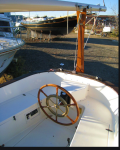
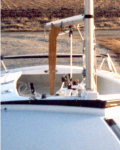
Boom gallows

Well said!

It’s infuriating when you ask for advice on how to do something you want to do and people, no doubt with the best of intentions, tell you you shouldn't be thinking of doing it at all!
Read the original question which was in two parts. If only the second part was asked I doubt anybody would have suggested boom gallows as an appropriate solution. So the alternate suggestions are very appropriate, particularly after more information was provided.

How many smallish fractionally rigged boats with light alloy spars have you seen with a boom gallows? If a scissors boom crutch was effective, but awkward to handle then a single boom crutch in brackets such as I used for many years on a boat with a long heavy wooden boom would be an option. However, once I fitted a stackpack, lazy jacks, single line reefing and took all lines back to the cockpit, that became redundant too.
 
Another idea that might interest you is to use a single rigid crutch that slots into oneor more sockets fixed to the cockpit coaming or cabin bulkhead:
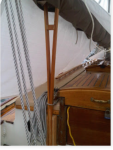
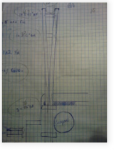
View attachment 117196View attachment 117197

Boom Crutch Beauty

View attachment 117198

View attachment 117199
Miscellaneous Rigging | .................... American Y-Flyer Sailing Assn., Inc. .................
Exactly As I suggested 9but crossed with yours). This was very useful when all the lines were at the mast and the main was roller reefing with a Turner reefing gear. Lower the boom into the crutch at the back of the cockpit, reef and raise. Remove the crutch. Problem was tricky to lower into single crutch in a rolly sea, so really more useful when in port.

As I said redundant once I updated mainsail handling so everything done from the cockpit. Better to identify the constraints you are experiencing and search for solution rather than start with one possible solution and try to make that fit your constraints.
 
Read the original question which was in two parts. If only the second part was asked I doubt anybody would have suggested boom gallows as an appropriate solution. So the alternate suggestions are very appropriate, particularly after more information was provided.

How many smallish fractionally rigged boats with light alloy spars have you seen with a boom gallows? If a scissors boom crutch was effective, but awkward to handle then a single boom crutch in brackets such as I used for many years on a boat with a long heavy wooden boom would be an option. However, once I fitted a stackpack, lazy jacks, single line reefing and took all lines back to the cockpit, that became redundant too.
.

As usual, I am not really interested in entering into arguments with you, but only in trying to help Madrigal find information about fitting something he feels will help make his sailing easier.

Having gathered as much information about the advantages of boom gallows, I have concluded that one would be a useful, and low cost, addition to my boat. My first source of information was Eric Hiscock who, in his "Cruising Under Sail" strongly advocates the fitting of boom gallows to cruising yachts. The weight of a wooden boom is not a factor he mentions ("Wanderer V "had aluminium spars and boom gallows ). The factors that convinced him, and anything that convinced him goes a long way to convincing me, are the convenience and safety of having the boom held immovably when one is moving about on the coach roof whilst taking down a reef or stowing the mainsail.

In addition, in my case, sturdy boom gallows sited near the cabin bulkhead (with the legs on the coachroof or bolted to the coachroof sides) would provide a safe handhold when clambering in and out of the cockpit to go forward in bad weather. Hiscock also points out that the boom gallows supports can provide a good anchoring point for the after end of lifelines, which I would prefer having as far inboard as practicable. Also, an added minor bonus, the gallows would provide a good place to attach a sunshade to when in port.

Further research online, especially on USA websites and forums, and questioning owners of French yachts with boom gallows encountered at various rallies I have attended, further convinced me that in fitting a boom gallows I would gain something useful and lose nothing of any significance.

My next move was to start a thread on this forum [ Boom gallows: design, construction and method of use ] and the response, from people whose opinions I have every reason to respect, was again very encouraging.

So, I am a convert, and happy to share any information I have gathered from those having practical experience with anyone interested; without trying to tell them what they should, or shouldn't, do.
 
Last edited:
It's a really good point about wear, and chafe as well, they just aren't happening when the boom's sitting in its notch. Also the C of G is lowered, or more accurately, the boom is not swinging from the masthead which encourages roll or list.
That's quite some set-up you have made, very impressive.

We have a Challenger 35 fibreglass sloop - I built a boom gallows for her using a (too) tall S/S gantry which had been used for supporting a very high dodger over the companionway and aft end of the coachroof.
I had two S/S plates welded on to the top of the gantry to which I bolted on a timber beam with three half circles cut out for sitting the boom in.
This gantry also serves to support the forward end of a home made fibreglass bimini awning over the cockpit - the aft end is supported on a S/S tubular bar that is clamped between the two backstays.
The bimini has a 50 mm upstand all around the perimeter, to give it rigidity, and also to allow it to act as a rain water collector.
And I also laminated on two fibreglass angles, which apart from stiffening up the structure, are an attachment for securing the solar panel to.
So, even on a relatively 'modern' boat, our gantry is invaluable.
Whenever the mainsail is not in use, the boom is resting in one of the semicircular cut-outs in the timber beam - this reduces the wear on the shackle pins in the mainsheet (even if a side lashing is used to help to stop the boom from trying to swing slightly as the boat rolls).
I will attach a couple of photos below for reference.

View attachment 117156


View attachment 117157
 
Last edited:
Claud Worth in 'Yacht Cruising', 1938, in the chapter about Bad Weather, describes in detail securing the boom in the gallows, before reefing Tern III, and on reflection I remember have also used the gallows to put a reef in, and also to safely sort out various kerfuffles without a swinging boom knocking me out again.
(Worth is was writing about reefing a sizeable gaff cutter, in heavy weather, running before the wind which is often considered tricky to say the least!)
On more reflection, having a sturdy, no-nonsense gallows available has been a godsend, almost in the same league as the ability to solidly heave-to;
I stand by my previous 3-legged dog comment :)
 
Last edited:
The boom gallows I made (see earlier post) were also telescopic so it was below the boom with full main. In raised position it made for a secure boom when stowing the main and tying reef points and was under the boom when using the reefed main. It also secured the boom when using it as the ridge pole for a cockpit tent. In addition it provided secure hand hold with small grab rail when going around the spray hood.
Going back to the OP I see no reason not to fit a boom gallows, probably at the forward end of the cockpit. Telescopic legs would allow it to be lowered when sailing. The whole structure could be made from s.s. tube, or with a wood beam. ( I have seen both).
 
I used to own (designed,built) a 50' cutter that I sailed half way around the world. Before leaving, I built a boom gallows behind the centre cockpit.

It had three notches to control the the 6.5m boom and we used it for storing the boom in port and also for fixing it when reefing or handing sail. The times we forgot to settle the boom into it's place, the squawking of the main sheet, mounted above my berth, would drive me nuts.

Additionally, it provided a convenient hand hold on the very wide, open aft deck in rough weather or for hauling oneself out of the deep cockpit and the timber cross piece was the rear support for the bimini.

It featured provisions for the crew to hook in their life lines.

Lastly, it was a good, attractive place to hang the ship's bell.

In conclusion, it contributed significantly to the safety of the crew and the operation of the ship. Not only was it functional, aesthetically it suited and enhanced the look of the boat.

I f popularity were a measure of all things, then it should also be noted that gantries, festooned with gadget of all sorts and mounted at the blunt end of boats are also popular. Aesthetically most are atrocities and technically they do not feature well on the stability curve.
 
Does anyone have a permanent boom gallows, and if so, do you find it useful, and are there any problems with it? They used to be common on traditional boats. As a single-hander, I struggle to fit my scissor crutch when changing to the trysail or sailing under headsail alone in a seaway. It would be nice not to have the boom swinging from side to side as it does even with the main sheet taught, and it would ease the tension that the topping lift puts on the upper part of the mast with the fractional rig.
Not my boat but have almost identical. So yes I do, yes - massively useful and no, no downside really. Can't think of one, just useful. One of those things like mast steps which came with the boat and would have been a bit of a pain to fit afterwards, but single handed just great, boom rock solid when it's down plus topping lift free for other duties like pick up the middle of an awning, which gets ties of to the...... boom gallows :)
One of those things i would put the effort in to fitting if ever changing boats for full time cruising. Weekends with crew maybe not so worth it.

t7aj5Ol.jpg
 
The boom gallows ………… made for a secure boom when stowing the main and tying reef points.

Which again raises the wider aspects and why not a solution for most people these days as
- when stowing our mainsail we just drop it into the stack pack - no need to touch the boom until zip cover up in harbour; and
- all reefing done from the cockpit, and no reef points fitted on the sail to be tied.
 
Which again raises the wider aspects and why not a solution for most people these days as
- when stowing our mainsail we just drop it into the stack pack - no need to touch the boom until zip cover up in harbour; and
- all reefing done from the cockpit, and no reef points fitted on the sail to be tied.
"Yer pays yer money, and yer takes yer choice"
 
Not my boat but have almost identical. So yes I do, yes - massively useful and no, no downside really. Can't think of one, just useful. One of those things like mast steps which came with the boat and would have been a bit of a pain to fit afterwards, but single handed just great, boom rock solid when it's down plus topping lift free for other duties like pick up the middle of an awning, which gets ties of to the...... boom gallows :)
One of those things i would put the effort in to fitting if ever changing boats for full time cruising. Weekends with crew maybe not so worth it.

t7aj5Ol.jpg
Proper boat. Ebbtide?
 
Not my boat but have almost identical. So yes I do, yes - massively useful and no, no downside really. Can't think of one, just useful. One of those things like mast steps which came with the boat and would have been a bit of a pain to fit afterwards, but single handed just great, boom rock solid when it's down plus topping lift free for other duties like pick up the middle of an awning, which gets ties of to the...... boom gallows :)
One of those things i would put the effort in to fitting if ever changing boats for full time cruising. Weekends with crew maybe not so worth it.

t7aj5Ol.jpg
Thanks to everyone for their comments and suggestions. You have all given me ideas to ponder, Laminar Flow’s comment about the ship’s bell being perhaps the most original!:)
 
@GHA very proper!

A question re your bulwark / toerail - is the timber attached to S/S brackets welded on to the deck?
Pic isn't actually my boat but one of the countless changes in a major ongoing refit was to weld on stainless tabs for the toerail to connect to, slightly raised off the deck. and weld on plates to attach the stantions, Actually, weld on everything which was bolted before :)
But again, for a cruising boat wouldn't be keen on not having a boom gallows, especially single handed.
 
Which again raises the wider aspects and why not a solution for most people these days . . . . .
Indeed, what you say is (from observation) true and the system on my current and last boats. However, if you go back to the OP a specific question was asked. It seems that the generally used set up does not suit the OP and his needs.

The thing I like about cruising is that there is no one "right" answer, we can all set up our boats and sail them in the way that suits us.
 
They were quite popular at one time, but with the advent of alloy spars and manmade canvas, they aren't really necessary. My Dad's first boat, a converted lifeboat, was gaff-rigged with heavy wooden spars and canvas sails. The whole lot was very heavy, and gallows made sense for that; you certainly wouldn't have wanted that lot hanging from a topping lift! ISTR (( I was only about 9-10 at the time) that it was a folding crutch rather than fixed gallows, but it fulfilled the same purpose. So, I can see the point on a more traditional gaff rig, but on a modern alloy bermudan rig, I don't see the point. I have two independent ways of supporting the boom - the topping lift, and a rod-kicker.
But
I believe that in severe conditions with boom held in place perhaps lashed in place can prevent the boom sweeping from side.
 
Top