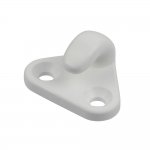
Boom cover - clips, zips, velcro or circus tent lacing?

The whole air circulation thing has often made me wonder whether it wouldn't be better to rig a boom tent , fastened to the guardrails or handrails, although that would increase the windage and would be inconvenient when motoring. Perhaps a shortie version hooked to the handrails?

Rob.
 
Meaning that the lazy jacks have to be pulled all the way forward to lie against the mast? Where they bang and frap in the wind? We prefer to leave them where they are, which a cover over the boom with clips below will allow.

Because my mast suffers from vortex shedding http://en.wikipedia.org/wiki/Vortex_shedding I wrap the pole lift round the mast which has the effect of frapping the lazy jacks as well as stopping the vibration. Another way is to pull the lazyjacks aft and loop them round a clip at the boom end.

Anything rather than those awful looking stack packs; flapping like Old Mother Riley's drawers in the breeze.
 
Sounds more like a stack pack?

and the difference from a sail cover with lazy jacks is ?? Is this not a cover by another name?

Anything rather than those awful looking stack packs; flapping like Old Mother Riley's drawers in the breeze.

We have a continous cover which zips around the front of the mast - no flapping or tangle of lazy jacks and ready for dropping at a moments notice
 
and the difference from a sail cover with lazy jacks is ??

I assume Vyv's lazyjacks come out the bottom of his traditional-style sail cover.

Is this not a cover by another name?

It's a kind of cover, but most of this thread is about the traditional over-boom cover that does up along the underneath. That's what the OP is having made.

Pete
 
I assume Vyv's lazyjacks come out the bottom of his traditional-style sail cover.


It's a kind of cover, but most of this thread is about the traditional over-boom cover that does up along the underneath. That's what the OP is having made.

Pete

Well it covers my sail.I thought he was open to suggestions having said

I'm thinking of getting a new boom cover, and can choose any fastening system.

The next boat to us has just replaced their traditional cover with one that sits in the groove and over zips - they have traditional battens
 
Beware the damage that can be caused to sails where a longitudinal zip is used on the cover. Care when closing and/or a fabric flap behind the zip will avoid small abrasions.
 
Boom covers are a nightmare, I know what I want can draw it but no one will make it! They reply with there dimension sheets and want to make to there dimensions, tighter and in heavier cloth than I want.

I want lighter cloth because its easier to handle, rolls up and stuffs in locker easier. Its simple loose fitting design not made to measure to exact dimensions so air can get round it with simple buckles to secure. It also means I can use it as sail bag to move sail around, I know what I want but no one will make it for me :confused:.

I knocked the sewing machine out of time making my last boom cover and I think I am going to have to pay to get it fixed so I can make my next :ambivalence:
 
The next boat to us has just replaced their traditional cover with one that sits in the groove and over zips - they have traditional battens

So what happens when they're out sailing? Do the two halves just dangle down each side of the boom?

Pete
 
Assuming that the OP wants a simple removable sail cover that is joined under neath and around the front of the mast then zip maybe for the front but definitely not a zip for the underneath long part. I have the snap together plastic clips for both the under part and the front of the mast. They are OK. The hook and loop of bungee would also be fine.
For onesea a sail cover is definitely an easy project on a domestic sewing machine. I don't think overloading the machine will wreck it as you imply. Probably just wear or age caused failure. good luck olewill
 
For onesea a sail cover is definitely an easy project on a domestic sewing machine. I don't think overloading the machine will wreck it as you imply. Probably just wear or age caused failure.

I did it last time!
There is one spot where to do a decent job I need to get through several layers of cloth. That I kept to the end just in case, it was not good for the machine it was then when I sewed on the hooks that really buggered it. Its not wrecked its out of time (more so than my knowledge can fix), and requires a service. At 60 quid for the service and a high likely hood of doing it again on this one made me think towards buying one.

The other problem I am having is finding the right type and weight cloth, the last samples I got where a little too light. But the standard cloths are heavier than I want, then I am being difficult in that I want burgundy in color and this is more restrictive than I thought!

The old one has not got to many holes so its not that high priority a job.
 
At 60 quid for the service

For that money you ought to be able to buy a cast-iron machine from decades past (mine has chrome and tail fins) that will punch through a reasonable weight of cloth. The key term on eBay is "semi-industrial" - apparently there's no such thing really, a machine is either industrial or domestic, but it's become a codename for the heavier breed of domestic machine.

You aren't trying to use a blunt needle, I take it?

Pete
 
Our mainsail is made in heavy Vectran, bulky and resistant to flaking. Consequently we have a quite large sail cover. We also have lazy jacks, so a zip is ruled out The current cover has the fastest fixing method we could think of within these limits, hooks and loops. It is OK but still somewhat slow to remove and replace, so we have bitten the bullet and bought a stack pack, currently sitting on the lounge floor waiting to be taken out to Greece. Hope it works out, although we still have some doubts.

Interesting, my main is in dyneema reinforced Vectran, has lazy-jacks and is fully battened and my zipped boom cover (well a stack-pack) seems to work OK and has done for 15 years.
I do have reservations about zips, which, in the Med only seem to last about 8-10 years - I'd definitely try Velcro (after all, if it doesn't work you can replace it with a zip).
Perhaps the modern term of Stack Pack is one I should use - but I've called it a boom cover (and so have the sailmakers) for the last 22 years.
 
Meaning that the lazy jacks have to be pulled all the way forward to lie against the mast? Where they bang and frap in the wind? We prefer to leave them where they are, which a cover over the boom with clips below will allow.
Not at all.
The lazy-jacks go down to the batten on the cover/stackpack. There is then a flap on the inside of the batten, on the top, with the male and female parts of the zip on that. Made for me in 2002 by a South African sailmaker in Perpignan. As an added sophistication you can have the free flap retained by little velcro tabs within the cover/stackpack when the sail is set.
Paul Lees has just made me a replacement.
 
Last edited:
in boom furling seems to solve some of the issues but wonder about mildew and staining.
i did once hear of a sail cover type thing but cant quite remember what it was called. oh yes, i think it might have been a "sail bag".
on my little ship it is quicker and easier to remove the sail than to put a sail cover on. on some of your monster masts i imagine it's a nightmare.
 
Not at all.
The lazy-jacks go down to the batten on the cover/stackpack. There is then a flap on the inside of the batten, on the top, with the male and female parts of the zip on that. Made for me in 2002 by a South African sailmaker in Perpignan. As an added sophistication you can have the free flap retained by little velcro tabs within the cover/stackpack when the sail is set.
Paul Lees has just made me a replacement.

Yes, but if I understand you correctly your cover remains on the boom permanently, which allows the lazy-jacks to remain there also. I (and the OP) am talking about a totally separate cover that stows in a locker when I am sailing. I cannot think of a way that a zip below the boom could be used with this unless the lazy-jacks are pulled either forward or aft to emerge from the cover.
 
Top