Boat vibrating when free spinning

There was an article in one of the yottie comics several years ago, Should I get a spinny or an asymmetric? The conclusion was, neither. Spend the money on a folding/feathering prop instead. It may not give you quite as much extra speed downwind as the sails, but it will do it on all points of sail.
 
To be fair I think a lot of cruising sailors will motor rather than use a kite anyway so probably a good conclusion. Partly the additional effort and partly most would think there’s not enough wind if the genny flaps.
 
From a purely mechanical perspective you can have the 130S saildrive in reverse gear when sailing. It's a big no-no with a 120S or others with a cone clutch as it can cause the cone clutch to spin and wear prematurely. The 130S has a plate clutch and will be fine locked in gear - though as others have said it's going to add drag.

Regarding the vibration, it is going to be from a rotating element, most likely the prop. The loads and harmonics are different when free spinning and being driven, which is why it may only show up under a specific circumstance.
 
With all due respect, I'm not sure what makes you think that my life time experience is limited to fat, little motorsailers?

I have done many tens of thousands of ocean cruising and racing miles, in a variety of different boat with various keel and rig variants.

I have also been involved in the design, construction, modification, restauration and surveying of yachts in a variety of materials, for both fun and profit.

I am also very much interested in the physics and mathematics of yachts and sailing.

There is a slight, if off-chance, that I may have some basic awareness around the advantages, hydrodynamics, mathematics and limitations of fixed, folding and feathering propellers.

The only thing I know about the OP's boat is that it has a saildrive. These things have been around for near on 60 years, a span which should cover a broad variety of different boats. Unlike everyone else, I am apparently not clairvoyant as to his boat's specifics.
I did point out that the greatest benefits are to be had in light airs and on specifically light boats. The speed benefits diminish significantly at higher, relative speeds and for obvious, physical reasons.

The OP's manual apparently says that he can let the transmission mill. That is not a given for every type of gearbox. This is important, since it immediately reduces prop drag by some 40% without any additional expense.

On your average boat and at a relative speed of 0.9 ( sqr root DWL x 0.9) the speed loss, versus no prop at all, is about 8% in this situation.
With a feathering prop, speed loss would be just 4% and with a folder a mere 1%.

Firstly, a relative speed of 0.9 is an important benchmark, because up to this point form resistance remains quite modest, whereas after it rises exponentially and more so on heavier boats. Rather unsurprisingly, 0.9 tends to be the well-established average speed for sailing yachts. Beyond this speed, prop resistance become increasingly less significant compared to overall resistance.

To put this into some context: For a 28' waterline boat a relative speed of 0.9 calculates to 4.76 kn.

With a fixed & locked 3-blade you would lose about 0.6 kn.
Letting it spin reduces your loss to about 0.38 kn.
With a feathering prop you're down to 0.2 kn loss.
and with a folder, it would practically not be measurable (0.0476 kn)

Consequently, the speed gain for the OP, switching to a feathering model over letting the old prop mill, amounts to 0.2 kn. Locking the prop causes precisely the disadvantage Flaming illustrated, over losing the prop entirely, at least.

The 1 kn gain often claimed by the purveyors of various props doesn't seem overly realistic, at least not on the basis of physics.

The French did a practical test with various props on actual boats sparring over a sailed distance and some feathering types seemed to offer only a marginal advantage in terms of speed.

Re spinnaker versus folding/feathering prop. We have found the speed gain from the chute to be in the order of at least 2-2.5 kn in light going, increasing speed from 3 kn to 5 - 5.5 kn easily. Beats a feathering prop hands down, I would say, even by the margins of over excitable marketing claims for specialty props.
 
To put this into some context: For a 28' waterline boat a relative speed of 0.9 calculates to 4.76 kn.

With a fixed & locked 3-blade you would lose about 0.6 kn.
Letting it spin reduces your loss to about 0.38 kn.
With a feathering prop you're down to 0.2 kn loss.
and with a folder, it would practically not be measurable (0.0476 kn)
0.38 knots loss from a speed of just under 5 knots is massive.

If I could do one thing to improve my speed by 0.38 of a knot..... I mean, I spend thousands on sails that give me a much smaller advantage than that....
 
With all due respect, I'm not sure what makes you think that my life time experience is limited to fat, little motorsailers?

I have done many tens of thousands of ocean cruising and racing miles, in a variety of different boat with various keel and rig variants.

I have also been involved in the design, construction, modification, restauration and surveying of yachts in a variety of materials, for both fun and profit.

I am also very much interested in the physics and mathematics of yachts and sailing.

There is a slight, if off-chance, that I may have some basic awareness around the advantages, hydrodynamics, mathematics and limitations of fixed, folding and feathering propellers.

The only thing I know about the OP's boat is that it has a saildrive. These things have been around for near on 60 years, a span which should cover a broad variety of different boats. Unlike everyone else, I am apparently not clairvoyant as to his boat's specifics.
I did point out that the greatest benefits are to be had in light airs and on specifically light boats. The speed benefits diminish significantly at higher, relative speeds and for obvious, physical reasons.

The OP's manual apparently says that he can let the transmission mill. That is not a given for every type of gearbox. This is important, since it immediately reduces prop drag by some 40% without any additional expense.

On your average boat and at a relative speed of 0.9 ( sqr root DWL x 0.9) the speed loss, versus no prop at all, is about 8% in this situation.
With a feathering prop, speed loss would be just 4% and with a folder a mere 1%.

Firstly, a relative speed of 0.9 is an important benchmark, because up to this point form resistance remains quite modest, whereas after it rises exponentially and more so on heavier boats. Rather unsurprisingly, 0.9 tends to be the well-established average speed for sailing yachts. Beyond this speed, prop resistance become increasingly less significant compared to overall resistance.

To put this into some context: For a 28' waterline boat a relative speed of 0.9 calculates to 4.76 kn.

With a fixed & locked 3-blade you would lose about 0.6 kn.
Letting it spin reduces your loss to about 0.38 kn.
With a feathering prop you're down to 0.2 kn loss.
and with a folder, it would practically not be measurable (0.0476 kn)

Consequently, the speed gain for the OP, switching to a feathering model over letting the old prop mill, amounts to 0.2 kn. Locking the prop causes precisely the disadvantage Flaming illustrated, over losing the prop entirely, at least.

The 1 kn gain often claimed by the purveyors of various props doesn't seem overly realistic, at least not on the basis of physics.

The French did a practical test with various props on actual boats sparring over a sailed distance and some feathering types seemed to offer only a marginal advantage in terms of speed.

Re spinnaker versus folding/feathering prop. We have found the speed gain from the chute to be in the order of at least 2-2.5 kn in light going, increasing speed from 3 kn to 5 - 5.5 kn easily. Beats a feathering prop hands down, I would say, even by the margins of over excitable marketing claims for specialty props.
Suggest you read post#19 again. The OP asked a question about vibrations when under sail with a spinning prop. I suggested a solution giving the benefits of changing to a folding or feathering prop which include solving the vibration problem better than locking in reverse which will increase drag and slow the boat down.

As for your strange "calculation" I refer you again to the graph in the YM article which clearly shows that there is virtually no drag from a feathering propeller (or a folding one either) so using your figures the loss in speed with a locked prop is 0.6 knots, a spinning propeller just under 0.4 knots and a folder/featherer zero. Note also that unlike the locked or spinning fixed prop drag from a folder/featherer is constant irrespective of speed.

This is what owners experience - speed increases in the range of 0.3-0.5 knots at all speed ranges. Clearly the %age improvement is greater at lower speeds. With your claimed average on your boat of 6.43 knots, if you fitted a feathering prop you could expect this to increase to between 6.73 and 6.93. Look at it another way as I suggested earlier, a saving on a typical 60 mile cross channel of around 1 hour or an increase of between 7 and 12 miles on a daily run.
 
Is there any vibration in the rudder?

I once owned a yacht where a spinning prop caused enough disturbed water flow over the rudder to cause vibration throughout the boat. Under power or with a locked prop, there was no problem.
 
Aha! So you admit that there’s ALWAYS a drag of zero with these contraptions!! 😉
Not admitting anything - just stating the facts supported by the data in the YM test which came from the Wolfson Institute and SSP Maritime consulting using Volvo saildrives - the subject of this thread.
 
Is there any vibration in the rudder?

I once owned a yacht where a spinning prop caused enough disturbed water flow over the rudder to cause vibration throughout the boat. Under power or with a locked prop, there was no problem.
Yes that is common as reported in post#14 on a Dufour. I have had 2 boats with saildrives. The first had a fixed prop for most of its life but only suffered from the vibrations with the prop spinning at 5.5 knots or above under sail. Solved by locking in reverse and suffering the 0.4 knot or so loss in speed through the water. Later fitted with a Flexofold 2 blade which eliminated that loss. That boat had a vertical rudder stock and I am told by others that the turbulence is more common on rudders where the stock is swept back. My second boat had a rudder like that, but it had a Flexofold from new and no effect on the rudder.
 
Yes that is common as reported in post#14 on a Dufour. I have had 2 boats with saildrives. The first had a fixed prop for most of its life but only suffered from the vibrations with the prop spinning at 5.5 knots or above under sail.
The potential problem is created by the turbulent water flow over the rudder created by the spinning prop. This can occur with a shaft drive, or a sail drive. Typically a sail drive propeller is situated further from the rudder than a shaft drive, minimising the effects.

The problem I reported in post #28 was with a shaft drive sailboat.

Nevertheless this is only one possibility for the reported symptoms.
 
As for your strange "calculation" I refer you again to the graph in the YM article which clearly shows that there is virtually no drag from a feathering propeller (or a folding one either) so using your figures the loss in speed with a locked prop is 0.6 knots, a spinning propeller just under 0.4 knots and a folder/featherer zero. Note also that unlike the locked or spinning fixed prop drag from a folder/featherer is constant irrespective of speed.
I would suggest it's time for some research.

The YM test you seem so fond of referring to was widely criticized as having been rather amateurish, done in a tidal estuary/harbour, which makes valid data collection rather dodgy.

For some indication of how a proper prop test and analysis should look like I suggest the ones published by Voile magazine.

While my French is not great, it is sufficient enough to read & understand technical articles on sailing and props.
My German, however, is excellent and my data and calculations are based on a test done by the German magazine, Die Yacht.

This testing was done in an institute's tank and thus allows for a repeatable process in a controlled environment. Certainly, a more scientific approach than the one taken by YM.
They were also able to establish (towing) resistance values for all the props tested.
Assuredly, there is no such thing as zero resistance.

For more information, graphs and analysis of the above, I recommend the book: Motorsegler, by Hans Donat and published by Klasing & Co.
It's in German, but I'm sure you'll manage.

As previously stated, a practical test conducted by Voile was able to confirm the above.


0.38 knots loss from a speed of just under 5 knots is massive.

If I could do one thing to improve my speed by 0.38 of a knot..... I mean, I spend thousands on sails that give me a much smaller advantage than that....
Now that we have established that there is no such thing a zero resistance when dragging something through the water at a number of knots, the actual point is that the difference between a free milling prop and a feathering one (not a folder) is less than 0.2 kn and not to mention, the better part of 2000 pounds Sterling.

Your other assessment is indeed correct. Making a boat go faster diminishes the adverse effect of prop drag, which is inversely proportional to overall resistance.
 
Now that we have established that there is no such thing a zero resistance when dragging something through the water at a number of knots, the actual point is that the difference between a free milling prop and a feathering one (not a folder) is less than 0.2 kn and not to mention, the better part of 2000 pounds Sterling.
I'm not quibbling your numbers.

But your assertion that 0.4 of a knot is a small difference..... It isn't, it's a huge gain. If I was 0.4 knots faster than the rest of the fleet I'd win every race. If the boat speed is 6 knots, then it's circa 6.5% speed improvement.

To put that in context, in rating terms it would be 65 points. That's absolutely massive. I get grumpy when we have to race boats that are 40 points different...

Or in other words, by your numbers, fitting a folding prop to a boat that currently has a fixed prop is actually more than the equivalent speed advantage of turning my JPK1010 into the next model up, the 1080. It's also more than turning a J97 into a J109.

If your point is that feathering props aren't really worth it, and people should generally get a folder for the 0.4 knot boost, then 100% agreed.

I think you missed the point of my other comment... The amount I, and anyone else who races semi seriously, spend on new sails over the time we own the boat in search of considerably less speed boost than 0.4 knots is far in excess of what a folding prop costs. Sure that's not necessarily directly relevant to cruisers, but it makes the point about quite what a huge advantage they bring.

For sure there will be people for whom this doesn't matter at all. But downplaying the advantage as "only 0.4" or "only 0.2" is really missing the point of quite how big a difference that actually is when you're talking about such a slow moving form of transport!
 
I would suggest it's time for some research.

The YM test you seem so fond of referring to was widely criticized as having been rather amateurish, done in a tidal estuary/harbour, which makes valid data collection rather dodgy.

For some indication of how a proper prop test and analysis should look like I suggest the ones published by Voile magazine.

While my French is not great, it is sufficient enough to read & understand technical articles on sailing and props.
My German, however, is excellent and my data and calculations are based on a test done by the German magazine, Die Yacht.

This testing was done in an institute's tank and thus allows for a repeatable process in a controlled environment. Certainly, a more scientific approach than the one taken by YM.
They were also able to establish (towing) resistance values for all the props tested.
Assuredly, there is no such thing as zero resistance.

For more information, graphs and analysis of the above, I recommend the book: Motorsegler, by Hans Donat and published by Klasing & Co.
It's in German, but I'm sure you'll manage.

As previously stated, a practical test conducted by Voile was able to confirm the above.


Now that we have established that there is no such thing a zero resistance when dragging something through the water at a number of knots, the actual point is that the difference between a free milling prop and a feathering one (not a folder) is less than 0.2 kn and not to mention, the better part of 2000 pounds Sterling.

Your other assessment is indeed correct. Making a boat go faster diminishes the adverse effect of prop drag, which is inversely proportional to overall resistance.
Please can we concentrate on the OPs question rather than wandering off into other areas that may or may not have any direct relevance.

The OP has a saildrive in his boat and experiences vibrations when under sail from the spinning propeller. According to the data I referred to earlier in the YM test (which only deals with drag of propellers and performance under motor rather than speed under sail) allowing the prop to spin typically adds about 20% to the hull and drive drag in the speed range of 4-6 knots. Locking the prop adds 50%. Fitting a folding or feathering propeller to the saildrive does not add any measurable drag.

The important point when changing to a folding or feathering propeller is the change in drag of the boat overall and not the difference in drag of the propeller in isolation. Other factors such as the type of stern gear location of the propeller and the drag of the propeller in relation to the hull form - for example it is a lower proportion on my GH31 than on flaming's JPK.

That is why the impact on boat speed is variable according to the type of boat. However, it is there and real whether measured by sophisticated real time instruments, rating penalties or logs of passage times, and for many it is considered significant enough to justify the cost.

You may not consider it worthwhile on your type of boat because it does not have the characteristics that maximise the benefits, although if you did fit one you would gain in other ways than a "small" increase in boat speed.
 
If your point is that feathering props aren't really worth it, and people should generally get a folder for the 0.4 knot boost, then 100% agreed.
Finally. Yes, correct. The problem here is that, firstly, not every boat has the room to swing a folder and, secondly, folders are less efficient than both feathering and fixed props under power and definitely in reverse, if maneuvering happens to be an issue.

Prop marketing often claims speed gains in the order of 0.8 kn to 1 kn and which are then often taken for gospel by the general public. Not only are such claims pure fiction, they completely ignore factors of overall resistance and relative resistance at relative speeds.

I completely understand that in the highly competitive world of racing every tenth of a knot counts. Of course it does.
For a cruiser, performance under power is a consideration. The Voile tests pay special attention to this, as well as to the effects a prop might have on fuel consumption versus distance traveled. Having an engine seems to offer a variety of benefits besides the downsides.

Sailboat props are nearly always a dodgy compromise between motoring efficiency and drag under sail. Motorsailers on the other hand, tend to be a dodgy compromise between sailing efficiency and motoring per se.

Back to the trenches ...

By all accounts, the OP's setup seems to suffer from an imbalanced prop. This can be because the prop is actually imbalanced or due to a hydrodynamic effect, such as can be caused by certain hull appendages, including the foot of the sail drive itself or not sufficient hull to prop clearances.
Minimum clearance data can be found in the literature or online.

It might be worthwhile to have the prop tested/balanced. It is possible to get away with a slightly smaller prop by pitching it up. A smaller prop would increase the clearance margins and obviously reduce the eccentric forces. Trying a prop with a different geometry may offer the desired results as well. A prop shop might be able to provide a "loaner" before committing.

At a cost, you can of course simply chose a prop that has no (exposed) blades at all while under sail.
 
Finally. Yes, correct. The problem here is that, firstly, not every boat has the room to swing a folder and, secondly, folders are less efficient than both feathering and fixed props under power and definitely in reverse, if maneuvering happens to be an issue.

Prop marketing often claims speed gains in the order of 0.8 kn to 1 kn and which are then often taken for gospel by the general public. Not only are such claims pure fiction, they completely ignore factors of overall resistance and relative resistance at relative speeds.

I completely understand that in the highly competitive world of racing every tenth of a knot counts. Of course it does.
For a cruiser, performance under power is a consideration. The Voile tests pay special attention to this, as well as to the effects a prop might have on fuel consumption versus distance traveled. Having an engine seems to offer a variety of benefits besides the downsides.

Sailboat props are nearly always a dodgy compromise between motoring efficiency and drag under sail. Motorsailers on the other hand, tend to be a dodgy compromise between sailing efficiency and motoring per se.

Back to the trenches ...

By all accounts, the OP's setup seems to suffer from an imbalanced prop. This can be because the prop is actually imbalanced or due to a hydrodynamic effect, such as can be caused by certain hull appendages, including the foot of the sail drive itself or not sufficient hull to prop clearances.
Minimum clearance data can be found in the literature or online.

It might be worthwhile to have the prop tested/balanced. It is possible to get away with a slightly smaller prop by pitching it up. A smaller prop would increase the clearance margins and obviously reduce the eccentric forces. Trying a prop with a different geometry may offer the desired results as well. A prop shop might be able to provide a "loaner" before committing.

At a cost, you can of course simply chose a prop that has no (exposed) blades at all while under sail.
Your first sentence is simply untrue on all accounts except that you cannot fit a folding propeller on many , particularly older style boats. the YM tests clearly show that the better propellers of both types are equal or superior to fixed blade propellers in terms of thrust in both forwards and reverse. Propellers per se have minimal impact on fuel consumption - that is directly proportional to power demanded. There is an exception perhaps with variable pitch propellers such as Bruntons Autoprop which adjusts pitch to speed and conditions so that the engine is always fully loaded and working at the optimum point on the power curve which also is the point of lowest specific fuel consumption. This is particularly useful on larger engined boats and when motorsailling.

Sailboat propellers are not a compromise. They are sized in exactly the same way as a shaft drive to provide maximum speed in the maximum rpm range.

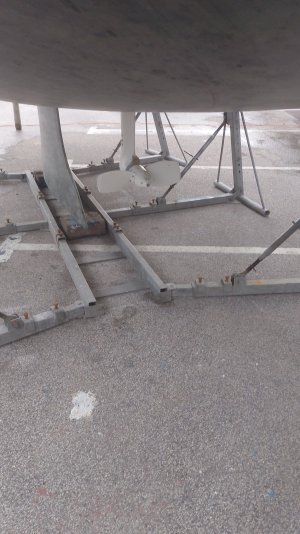
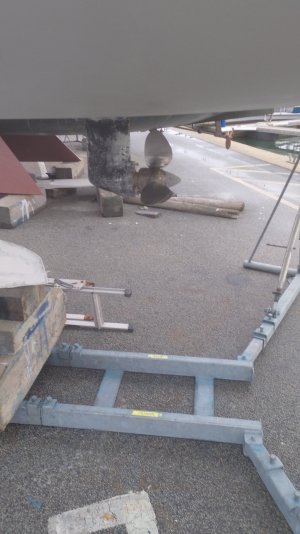
The vibrations on fixed blade saildrive propellers is nothing to do with tip clearance as the photographs show, nor are there any other obstructions that might affect the propeller. The standard leg length takes propellers up to 19" diameter and the longer one 21", all with more than enough tip clearance. 3 blade are generally worse than 2 blade and of course any imbalance may make it worse. Imbalance usually comes from a damaged blade or a breakdown in the hub cushioning, both of which are easily spotted.

It seems you know little about saildrives or folding and feathering propellers in general given the amount of misinformation in your posts on the subject - nor seemingly any practical experience of owning one. Maybe the photos below will help. The first 3 are saildrives. The first is a standard 2 blade 15" in a Bavaria 32 which shows only the blades exposed outside the drive; the second is a Pogo with a 15" 2 blade folding propeller in the folded position which illustrates no change in the drag when under sail; third is a Dehler 29 with a 15" Featherstream 3 blade. As you can see (contrary to your earlier claim) the hub is no larger than the housing and when the blades are feathered there is no additional drag. This is exactly the findings in the YM test I directed you to earlier, which I guess you have not looked at because they do not match your preconceptions.

Maybe now we can turn to boats like yours and mine where I have over 20 years experience in working with feathering propellers. My first experience was trying to get the best out of the Yanmar 1GM in my 3 tonne displacement Eventide. Hopelessly underpowered and at best might get 5.5 knots but realistically 5 knots at 3300rpm. The reduction ratio in forward was 3.2:1 BUT in reverse was 2.2:1. The propeller was 14"fixed with a pitch that enabled the engine to get to its maximum of 3600. Inevitably though the faster shaft speed in reverse meant the engine was overloaded and had difficulty in getting sufficient revs for meaningful power. The prop was in a tight aperture behind a wide deadwood which partly masked the blades. There was enough tip clearance though after I had modified the deadwood and rudder for a 15" prop. So we made a feathering 3 blade with 3 " less pitch in reverse that marginally improved forward speed, particularly in heavier conditions and transformed reverse into usable instead of scary - and of course improved speed under sail.

Fast forward 15 years or so and I swapped that boat for its larger sister the GH31. this is now fitted with a Beta 30 and a PRM 2.5:1 reduction in both forward and reverse. For the same reason as with the Eventide I wanted to get the largest blade size and area so Darglow made the propeller with the smaller hub and the 17" blades from the larger size. To fit this hub onto the 30mm shaft it is turned down to 25mm at the end (the small hub only goes up to 1"). It is pitched at 10" in forwards and 9" in reverse to avoid the higher loads when engaging reverse and trickling along at low speeds. The boat achieves 7.5 knots at 3300 pm just as predicted and performs well in reverse with little prop walk. The last photo shows the stern gear in its current form. As you see the hub is small contrary to your claim. overall performance under motor is better than a fixed propeller and the reduction in drag under sail is noticeable. I have no experience of the boat with its old fixed prop and engine under sail to make any firm statement about what difference in speed and as the sails are all new as well it would be difficult to attribute any improvement to specific changes.

I am recounting all this to show how far out you are in your understanding of the properties and benefits of folding and feathering propellers. In my earlier life when I was more involved I spoke to many customers who had changed to these better propellers with similar positive outcomes. People don't spend that kind of money if the product does not deliver what it claims.
 

Attachments

  • IMG_20251106_133922.jpg
    IMG_20251106_133922.jpg
    524.1 KB · Views: 3
  • IMG_20251106_133817.jpg
    IMG_20251106_133817.jpg
    584.7 KB · Views: 4
  • IMG_20251106_133746.jpg
    IMG_20251106_133746.jpg
    399.9 KB · Views: 4
  • IMG_20250715_180159.jpg
    IMG_20250715_180159.jpg
    565.4 KB · Views: 4
Well, at this point I'll just have to assume that a major part of the literature in any language, all the programs used to establish resistance values, the Voile tests and the work done by the engineers in the German tank testing institute was concocted by a bunch of idiots and the billions invested by the commercial industry to improve the critical fuel economy of ships by optimizing propeller shapes has been wasted.

Thank you for showing me what a saildrive looks like. Gosh, I wouldn't have known!

The interesting part of the OP's situation is that while he has a problem with prop vibration, thousands of others with the same set-up do not.
 
Well, at this point I'll just have to assume that a major part of the literature in any language, all the programs used to establish resistance values, the Voile tests and the work done by the engineers in the German tank testing institute was concocted by a bunch of idiots and the billions invested by the commercial industry to improve the critical fuel economy of ships by optimizing propeller shapes has been wasted.

Thank you for showing me what a saildrive looks like. Gosh, I wouldn't have known!

The interesting part of the OP's situation is that while he has a problem with prop vibration, thousands of others with the same set-up do not.
Once again you are avoiding the issue by waffling on about resistance on big ships and the effect of propeller shapes on fuel economy of such ships. You made a number of claims about feathering and folding propellers that are simply not true. You seem to have no direct experience of the products, ignore anything that does not agree with you views. even when it comes from reputable sources independent of the manufacturers. The problem of vibration of spinning propellers on saildrives is well known - my first Bavaria suffered from it - as did Flaming's Dufour - so 3 out of 3 owners on this thread alone. That is one of the reasons why owners fit mostly folding propellers. I showed you photographs to illustrate how wrong you are in what you say about them. I took those photos today in the club yard and the Bavaria was the only saildrive boat that did not have a folding or feathering propeller. Clearly a waste of time for somebody with such a closed mind. Maybe you need to get out more and see what actually happens in the real world where intelligent and experienced people weigh up what is on offer and decide whether the benefits the product offers justifies the expenditure. Pretty sure few of them would spend any time looking at research papers on resistance and propeller shapes of big ships.
 
Having been outed by Tranona as a complete inconnu on propellers and probably everything else boaty, I decided to got back to the source.

It turns out that the German claims as to resistance reduction by letting the prop mill were waaay to conservative. Surprising that, who would have thought that Germans engineers would be so conservative, really?
According to "Principles of Yacht Design", written by a couple of Swedes this time and arguably the contemporary bible of yacht design, the reduction in drag by letting the prop mill is to the order of 75%.
For anyone further interested, they offer pertinent mathematical formulas to calculate prop drag at any desired speed. To note: the constant for a fixed blade locked prop is 1.2 for one left to spin it's 0.3, i.e. 25%

The book is available in English, in case anyone not able to understand Swedish or German needs to verify the above.

To put that into context, if your fixed & locked prop were to reduce your boat speed by 0.6 kn (as per my previous, "strange calculation"), then letting the prop spin would only reduce your speed by a mere 0.15 kn. To be sure and as the book clearly states, this is in relationship to not having any prop at all.

It certainly demonstrates the desirability of letting the prop spin freely. No doubt, it also further puts into the question the financial aspect of the matter, at least for the non racer. Of course this information was published by a couple of Swedes; clearly high on Aquavit.

Over time and on numerous occasions, I have repeatedly pointed out certain non resistance related benefits of folding/feathering props, notably their contribution to improving weatherhelm and steering control. So much to my "fixed" mind.

On prop efficiency and fuel consumption: Some people seem to have a hard time thinking outside of the box. Yachts are simply another form of water craft and only differentiate themselves from the rest by the fact that they are quite useless for most things other than sheer pleasure. Beyond that they share the same physics and yes, means of propulsion. Not every advancement in propeller design was done for Golden Hinds or even your average power yacht, but much of what was done elsewhere has found it's way into the realm of the less useful.
Fuel efficiency may not be a top priority to the average sailor, however, Voile magazine sure made a point about it in it's prop test, listing range per litre at various RPM and litres per hour averages for each particular prop. As you see, my statements are not as far-fetched as you like to make out.
Bruton came out ahead in this evaluation, alas it also has among the highest tow resistance. But, hey, Voile did a test on that too ...
 
Top