boat speed

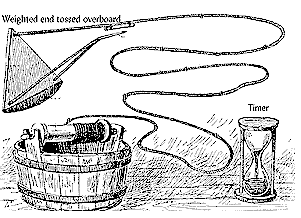
I think i will try the chip log, as i seems to mean not spending much money
Also is it possible to use braided on braide as i happen to have a lot of thin stuff hanging around. How does the peg attach as well?

Sorry, i don't seem to be able to post a picture of my boat as i need the URL which i don't know
thanks jack
 
Last edited:
I think i will try the chip log, as i seems to mean not spending much money

Sorry, i don't seem to be able to post a picture of my boat as i need the URL which i don't know
thanks jack

Right click will often give you the option to copy the URL if its already on a website. If it happens to be a suitable file type eg jpg or gif you may then be able to use the "insert image" icon
insertimage.gif
to put the pic into a post

If its not on a website the use the "attachment" facility or the forum albums ( but albums i think may have to await moderation). Or create a Photobucket account and use that
 
Last edited:
ae400b.gif


Not that good a pic, but maybe you get the idea? It's quite a palaver to deploy & recover, do you have a spare chinaman on board to do it for you?

The dutchman's log concept of counting as a bit of foam or seaweed goes past, or throw a sweetie paper over is easier to use.

Why is it so important? Don't you have a GPS app on your phone?
 
VicS,

I've never heard of a pitot tube on boats, but of course it's standard on almost all aircraft; as water is much denser and more forceful on a sensor than air, I suppose there's reason to think it would work on lower, boat type speeds.

The containerships and fruitships I worked on, all had pitôt tube speed log installations.

The pitôt tube was about 8 to 10 feet long (depending on the ship type) and had to penetrate the tank spaces below the engine room.

I had to change a few over the years, that got bent on obstructions when the Nav. department on the bridge forgot to lift them in shallow waters. They were raised and lowered by either pneumatic or motor chain drive.

They had to be forced out the bottom of the outer tube by forcing the new pitôt tube in from the top. A bit hairy, but there were two gate valves on the outer tube.

Sal Log ? Quite right about it beind a bit hairy, Hit a obstuction off Karg island took 12 hours to drive it out, always remember that on, also the R/o greased the rubber cone drive, that took some degreasing to get the accuracy back. OH what lovely days. :D :D
 
I seem to remember someone was selling a version of the chip log which continously trailed and used the pressure on the chip to extend a spring, which in turn gave a speed reading.

Can't find it for the life of me now... But it should be possible to bodge up something similar?
 
Pitot tubes are a simple and reliable form of measuring air velocity, we use them all the time when designing air flow systems for pharmaceutical and medical research labs, connected to say a Magnehelic differential pressure gauge or pressure sensor, they are very accurate.

Simply put (ignoring hydrostatic pressure) they work on two pressure tapings, one to a forward facing tube which measures the total pressure and one to the side of the tube that only measures static pressure, the difference in pressure of course between the two tubes must be the velocity (or dynamic) pressure, a function of kinetic energy: mass (in this instance the density of air in kg/m3) times velocity (m/s) squared over two. The mass of air is say 1.2kg/m3 so the resulting unit is kg/m3 x m/s x m/s, two of the m’s cancel out leaving kg/ms^2 which is a pascal.

The problem is that for air we need a relatively small pressure gauge/range to connect the two tapings to, due to its low density. For instance a 5 knots air speed would result in a pressure of (1.2 x 2.5722^2)/2 say 4 pascals and at 25 knots (1.2 x 12.861^2)/2 = say 99 pascals, (the sort of pressure your mouth would exert sucking water up a straw about 10mm!

Now with water it’s a different argument, with say a density of 1,000kg/m3 the pressure gauge would have to accurately cope with a range at 5 knots 3,308 pascals and at 25 knots 82,702 pascals, which is quite a large range (or if you prefer 0.48-12 psi).

I suppose then you would have to ensure the forward facing tube did not get fouled!

I know paddle wheels are a PITA too!
 
Top