Boat speed under sail, what should I expect?

http://www.ybw.com/forums/showthread.php?362370-How-big-is-your-tender&p=4218868#post4218868


In fairness Seajet actually says "prolonged squalls of F11" with the the first part of that phrase overlooked by subsequent posters, but that's obviously how legends start...

Laika,

thanks, at least you can read !

However they say ' there's no such thing as bad publicity ', so maybe the attempted snideness by some here is the reason there's currently a waiting list for late model A22's ! :)
 
Yes, you're trying to compress rather than compressing. I still don't agree you're trying to climb the bow wave though. Imagine you've put a trolley jack at the front of your car and raised it up but then try and drive it along (assuming the trolly jacks has wheels). The front of the car may be raised but it's not trying to go uphill. If the wave was stationary then yes you'd be trying to climb up it but it actually moves with the boat so there's no energy expended trying to overcome the force of gravity by making the boat go upwards - all that energy is used in moving the water.

Fluids have viscosity, so while they flow, they do so with some resistance - this is seen as the water builds up under the bow creating an instantaneous ramp; stop pushing, and the ramp disappears. With the vessel inclined, the direction of the thrust is also inclined - broken into vectors, you have horizontal component propelling the boat forward, along with a vertical component. The vertical component is climb - the reason you don't take off is that the ramp is falling away - like walking up a descending escalator. But if you put enough power into the climb component, you ride up the "ramp" before it has the time to fall away. Anyone who's been in a speedboat knows that when you start off the bow points up and you push a bloody great wall of water in front, until you literally climb up over the bow-wave (you can actually feel yourself rise) and the nose drops over the crest of the hill you made, and then you're on plane.
 
Fluids have viscosity, so while they flow, they do so with some resistance - this is seen as the water builds up under the bow creating an instantaneous ramp; stop pushing, and the ramp disappears. With the vessel inclined, the direction of the thrust is also inclined - broken into vectors, you have horizontal component propelling the boat forward, along with a vertical component. The vertical component is climb - the reason you don't take off is that the ramp is falling away - like walking up a descending escalator. But if you put enough power into the climb component, you ride up the "ramp" before it has the time to fall away. Anyone who's been in a speedboat knows that when you start off the bow points up and you push a bloody great wall of water in front, until you literally climb up over the bow-wave (you can actually feel yourself rise) and the nose drops over the crest of the hill you made, and then you're on plane.
1/ Bow
2/ Surfing
 
I'm afraid that argument fails.

Let's considers what would happen we suddenly stop pushing your car along - it will stay on top of the trolley jack as the jack is resisting the downward gravitational force of the car.

If we did this with a boat the bow wave would disappear, the gravitational force of the bow of the yacht dispersing the water. Compression is irrelevant as we are not in a constrained volume e.g. there is nothing to resist the force moving the water.

The wave disappears because the boat is no longer displacing the water. Yes, there's a component of water displaced when the view drops but the d stem will rise too.
 
Fluids have viscosity, so while they flow, they do so with some resistance - this is seen as the water builds up under the bow creating an instantaneous ramp; stop pushing, and the ramp disappears. With the vessel inclined, the direction of the thrust is also inclined - broken into vectors, you have horizontal component propelling the boat forward, along with a vertical component. The vertical component is climb - the reason you don't take off is that the ramp is falling away - like walking up a descending escalator. But if you put enough power into the climb component, you ride up the "ramp" before it has the time to fall away. Anyone who's been in a speedboat knows that when you start off the bow points up and you push a bloody great wall of water in front, until you literally climb up over the bow-wave (you can actually feel yourself rise) and the nose drops over the crest of the hill you made, and then you're on plane.

You are talking of acceleration, which Is a slightly different situation. I'm referring to a steady state as we are taking of maximum hull speeds.

The vertical component of thrust is there but it would be there regardless of the "wall of water". It's there because the bow of the boat has risen due to the bow wave that has appeared underneath it as a result of the boat's forward motion displacing water.
 
best to think about the centre of gravity rather than the trim of the boat. When in displacement mode the CofG descends as the boat sinks into the trough of the wave, the trim changes initially bow down but then bow up as speed increases. When the boat exceeds "hull speed" the CofG starts to rise again and by the time you are planing the CofG is above it's original height. The boat is no longer displacing water the dynamic energy is now lifting the hull above it's static water line height. Think of an energy vector pointing ahead but rotating downwards as speed increase above hull speed.
 
best to think about the centre of gravity rather than the trim of the boat. When in displacement mode the CofG descends as the boat sinks into the trough of the wave, the trim changes initially bow down but then bow up as speed increases. When the boat exceeds "hull speed" the CofG starts to rise again and by the time you are planing the CofG is above it's original height. The boat is no longer displacing water the dynamic energy is now lifting the hull above it's static water line height. Think of an energy vector pointing ahead but rotating downwards as speed increase above hull speed.

That's a great way of thinking about it as CoG is much easier to visualise than acceleration.
 
You are talking of acceleration, which Is a slightly different situation. I'm referring to a steady state as we are taking of maximum hull speeds.

Only in the speedboat example. It makes absolutely no difference - maximum hull speed is not an actual limit; even without planing, you can exceed the hull speed - you just need to apply more thrust. As an object goes faster through the water, the wavelength increases, the stern falls deeper into the trough causing more bow-up pitch, thus increasing the ratio of thrust devoted to pushing the boat up, to that pushing the boat forward. You can see that for a boat to get beyond "hull speed" the power requirements raise exponentially. Most of what we call 'displacement' boats simply don't have the power available to go much beyond hull speed.

The reality is that most boats will exceed their "hull speed." In the strictest sense, hull speed is where the wavelength of the bow-wave is equal in length to the LWL, so the boat is equally supported front and back, the waterline is horizontal and 100% of the thrust is going into propelling the vessel forward, rather than upwards.

The vertical component of thrust is there but it would be there regardless of the "wall of water". It's there because the bow of the boat has risen due to the bow wave that has appeared underneath it as a result of the boat's forward motion displacing water.
The wall of water I referred to is the bow wave. Surely you've been out in a small runabout - something that has a theoretical hull speed of maybe 4 kts; so once you're past the speed of a fast walk, you're plowing along going perpetually uphill. And depending on boat design/engine size, you could maintain that regime for a range of speed from hull speed up to 10 or 12 kts or whatever speed that particular boat either maxes out or is able to get on plane. If you putter along below the hull speed, the boat stays horizontal (disregarding the loading issues of small boats) and there is no vertical thrust component.
 
Barnac1e said:
From my earlier sailing days - a picture of my 27ft Trapper running at 7 knots before a strong sirocco in the Adriatic, which is what I would expect as a maximum speed. I know the main is furled but all of the big furling genoa is out and pulling hard.
Point is, unless the 27 ft boat has some sort of planing hull, anything above this sort of speed is very rare in a displacement 27 footer.
The T27 is a fine boat & will out sail a 500 on all points of sail
Your post perplexed me but as we were basically thread drifting I left it. Then the light dawned and, like a dog with a bone, have come back to it.

My boat ("27ft Trapper") was a Trapper 500 (27ft 4in). With "T27" I think you may have been thinking of the Trapper 28, later designated as the Trapper 400. Anstey Yachts introduced both into the UK under licence from C&C in Canada, copies of the C&C 27 and the C&C Viking respectively. Common confusion reigned by Trapper Yachts, (morphed from Anstey Yachts) incorrectly labelling the LOAs of the 500 and 501 (identical hull mould as the 500) as 28ft in their advertising literature. The Trapper 28 was indeed 28ft 2in.

As you correctly point out, the Trapper 28 was a faster and better sailer than the 500/501 range with its lower freeboard and longer LWL. Small and cramped cabin though ... all boats are compromises.
 
Your post perplexed me but as we were basically thread drifting I left it. Then the light dawned and, like a dog with a bone, have come back to it.

My boat ("27ft Trapper") was a Trapper 500 (27ft 4in). With "T27" I think you may have been thinking of the Trapper 28, later designated as the Trapper 400. Anstey Yachts introduced both into the UK under licence from C&C in Canada, copies of the C&C 27 and the C&C Viking respectively. Common confusion reigned by Trapper Yachts, (morphed from Anstey Yachts) incorrectly labelling the LOAs of the 500 and 501 (identical hull mould as the 500) as 28ft in their advertising literature. The Trapper 28 was indeed 28ft 2in.

As you correctly point out, the Trapper 28 was a faster and better sailer than the 500/501 range with its lower freeboard and longer LWL. Small and cramped cabin though ... all boats are compromises.
Yes the 28. the 500 had a chopped of transom & a deeper sheer line
 
Yes the 28. the 500 had a chopped of transom & a deeper sheer line
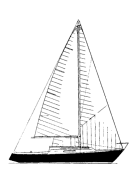
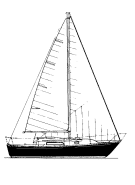
The (Trapper/C&C Viking) 28 came first and sailed beautifully but with very limited accomodation, no standing headroom, for example. The later C&C27 Mk I/Trapper 500) had a different design brief to correct the cruising potential with higher topsides and cabin with greater beam; the aft overhang was also dispensed with. Really two different yachts by the same designer, George Cuthbertson.

t-vik28.gif
_____
t-cc27.gif
 
C of g with reference to sea level!

Very well then, but I'm still trying to wrap my head around how that makes it easier to visualize. I also disagree that you descend into the trough in displacement mode. I guess depending on the fineness of the bow and stern with relation to the midships, the boat might descend marginally as hull speed is approached. Up until that point, the wave train could have several peaks and troughs along the length of the hull, which would tend to cancel out each other.
 
I sometimes sail in company with a French friend for several weeks at a time. Yoanne insists that his 30 footer consistently sails at 7-8 knots whilst I know I am averaging 5-6 knots. What I do not understand is how I always arrive well ahead of him at the next anchorage!
 
I regularly sail at greater than 10kts, my car did 400 mls and it still indicated half full tank therefore it did 105.87 mpg and my glass is half full (can someone fill it up)!
 
Top