Boat heater that also generates 30 watts of power £300(ish). Would you buy one?

No you misunderstand; A stove will put out around 1000watts of heat. Let's conservatively assume half is lost to exhaust. So you get 500watts of heat in the boat.

Additionally 20 of those watts is converted into electricity which you can use to run lights, netbooks, charge batteries etc.

My apologies. I miss read your post.
 
In answer to your original question - probably not. It doesn't rise high enough on my list of priorities and is likely to be too bulky for my small boat, both in operation and when stored away. In that sense, it might be better to incorporate a dedicated burner in its base so it can be mounted low down and away from the companionway lest all te heat goes out the door. By that time you're effectively looking at an existing heater technology. If the electrical generation can be incorporated within the heater matrix, perhaps it has a chance. I would see the likely output, both heat and power, to be a minor addition to other sources rather than addressing the full scale of the problem. In winter in the yard I run a mains fan heater at 2kW (maximum draw on the supply) and it makes the boat bearable so long as you keep your coat, hat and scarf on!

Rob.
 
In answer to your original question - probably not. It doesn't rise high enough on my list of priorities and is likely to be too bulky for my small boat, both in operation and when stored away.

Fair enough. Size seems to be important to people. Maybe it would be better to aim at a cheaper compact 10w @ 12v unit like this: http://www.thermonamic.com/pro_view.asp?id=826

In that sense, it might be better to incorporate a dedicated burner in its base so it can be mounted low down and away from the companionway lest all te heat goes out the door.

Well the idea is the exhaust from the stove is forced out of a duct with a fan, so you can keep the companionway closed and the dry heat in. Like this: http://www.pan2000.se/english/sida2.html

I imagine on small boats it could be usefully paired with a Origo http://www.amazon.co.uk/gp/product/B002BW0D16?*Version*=1&*entries*=0 You might choose to move it to the floor when in 'heating' mode I suppose. I'd be worried I'd kick it over, but each to their own.

I guess you could also put one of those flat camping gas stoves, but I wouldn't personally use one on a boat.
 
Last edited:
I wonder if the wattage could power a dehumidifier and heat-recovering ventilator, to allow continuous burning of LPG below decks without introducing toxic gases and moisture?

Then we could just use naked gas flames for cabin-heating, rather than carefully ducting away the exhaust.

Seriously though, I think it's a clever little thing...but how is it so inefficient? 30 watts recovered, from 500 watts effective output? Surely that could be improved?
 
Actually I was thinking that on a small boat such additional hamper would be best built into some dead space with a dedicated burner, low down so as to get the heat down low. Of course, you'd need another fan to blow the air over the matrix fins and across the cabin sole. You see how it is turning into a Propex? perhaps that,s the answer - use the generator ob the exhaust of a Propex so it runs independant of the ship's 12V supply. Our neighbours used to start their car with a match...!

Rob.
 
good point

I wonder if some-one could come up with a sort of device that used simple physics to enhance the convective airflow from a few tealights without using electricity

D

If anyone could do that they'd sell it for a fortune on eBay. At least a tenner.
 
Last edited:
Peltier generators rely on a temp differential. The cool side should be watercooled. There is plenty of it about! Then it could be made much smaller and would be more efficient too.
 
good point

I wonder if some-one could come up with a sort of device that used simple physics to enhance the convective airflow from a few tealights without using electricity

D

Take something along the lines of a post horn with the wide end down & the narrow end pointing up, sort of 20-30 degree 'ish angle, route the tapered tubes through the flower pots sides & you might find a thermo-convection powered flow develops.
 
intgrigueing idea

Take something along the lines of a post horn with the wide end down & the narrow end pointing up, sort of 20-30 degree 'ish angle, route the tapered tubes through the flower pots sides & you might find a thermo-convection powered flow develops.

could you possibly draw what you have in mind?

or even make a prototype of some sort?

D
 
I expect this is preposterous, but so are most of my ideas...

...couldn't an LPG flame be used to power a small steam-engine, which could turn magnets within a wire coil (or whatever the hell a dynamo consists of) producing electricity?

Assuming the builder wasn't obsessed with reliving Reverend Awdry's stories, wouldn't a steam-engine be agreeably quieter than traditional generators?
 
I expect this is preposterous, but so are most of my ideas...

...couldn't an LPG flame be used to power a small steam-engine, which could turn magnets within a wire coil (or whatever the hell a dynamo consists of) producing electricity?

Assuming the builder wasn't obsessed with reliving Reverend Awdry's stories, wouldn't a steam-engine be agreeably quieter than traditional generators?

If you are heading that way, use a Stirling cycle hot-air engine.
 
I really like the idea - I think if you could produce a fairly dry heat source (fumes and moisture vented out) using something like an alcohol stove and generate a small usable current, it might have it's place in the market. For boats though I think the UK market would be quite limited to the minimalist end - 1-2 berths - small area to heat, low power usage (few LED lights, low power tablet/smart phone, minimal nav equipment, small outboard auxiliary, bucket) and people who sleep aboard like this are either unwilling or unable to splash the cash. Other potential markets might include micro-caravans and mini/self-converted camper vans and maybe even dinghy cruisers, but again, low-financial-outlay niche markets. I reckon that most people who spend, say, £8K+ on a boat want a bit of home comfort, be it generator, heater, fridge, telly, flushable loo...
But don't let this put you off!
 
If you are heading that way, use a Stirling cycle hot-air engine.

Love the idea, can't pretend I understand it yet. When I have time, I'll read-up on it.

...the answer is a generator running on diesel as quiet as possible...

Hmm...I haven't found one which is genuinely quiet, other than the beautifully enclosed Paguro and Northern Lights 1500rpm designs...but it's likely I'll spend less on a whole yacht, than they cost. They're heavy, too!
 
Love the idea, can't pretend I understand it yet. When I have time, I'll read-up on it.

Stirling cycle engine use air (or another gas) as the working fluid, rather than water/steam. In theory they can be the most efficient type (near a Carnot cyce, which is theoretically the best possible) but in practice not so because they use external combustion, which means a lot of heat never makes it into the working fluid. If you'e using heat from a stove, though, that doesn't really matter. At one time, about 100 years ago, you could buy small Stirling cycle desk fans ... many offices had town gas supplies before they had electricity supplies.
 
Sounds great. Where can I get one? Does...anybody actually manufacture them?

I don't know what happened to Whispergen, I'm sure that was a Stirling engined generator for combined heat and power, for houses or boats?

My objection would just be that bottled gas is generally very expensive for heating.
My Impala had a gas powered heater in it, cheap to buy, but on little camping gas bottles, a bit of a joke.
Different if you can use cheaply refilled bigger bottles.

I recall seeing a Russian oil lamp from the 30s (IIRC), using a thermopile (array of bi-metal thermocouples) to power an old-style valve wireless.
 
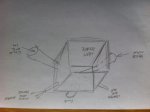
sketch of thermal powered blower

could you possibly draw what you have in mind?

or even make a prototype of some sort?

D

It's not my idea, I've stolen it from an avant-garde skandi stove designer.

You might consider a form of balanced flue whereby the exhaust is cooled by pre-heating the inlet air thus reducing the wasted heat vented to the atmosphere?
I don't think four tea-lights would prove adequate as a heat source. How much water do tea-candles produce in the atmosphere as they burn?
Less than LPG (can't be much more surely), less than a human sitting quietly, dunno; any chemists out there?

If using LPG or coke or paraffin (or diesel) I suppose that you would want a fanned flue but that could be powered by a peltier power-pak as sam_uk's original suggestion.
If you build one, would you try to extend the inlets so that the heater is where the people sit & the inlet is at the bottom of the boat? I think that might further encourage a circulation of warm(ed) air.

Next time a physics or materials science or domestic science student turns up here it might make an interesting (& useful project).

have a ponder on the sketch below (or attached)
 

Attachments

  • IMG_0144.jpg
    IMG_0144.jpg
    103.2 KB · Views: 1
Top