Boat electrics help

wanzap1

Well-Known Member
Joined
18 Sep 2018
Messages
87
Visit site
Hi All,

As part of my boat overhaul I am upgrading and servicing the electrics. It's something which I would like to tackle myself as it will help me have a thorough understanding of how my electrics operate.

I have been researching on the tinterweb but would really love someone experienced to provide me with a schematic.

One area which I struggle with is how I wire the solar charge, shore power and engine power to the batteries and the main circuit. The boat charges off an outboard. I understand the premis but its the details of fuses / breakers, isolation switches, monitors etc which I want to get right.

Any pointers to resources would be much appreciated. I don't mind paying for services of getting a diagram detailled up - I can provide full details of what I require.

Many thanks
 
Last edited:
Servicing the electrics will almost certainly involve replacement of wire itself as corrosion over time damages the copper and tin coating. I would suggest in the true baoty spirit that you start with pen and paper and begin with the essentials that you have . Engine power to the batteries with an isolation switch. Then if you want 2 battery system then 2 isolation switches plus a paralleling switch for emergency start. Solar is supplied to the battery or batteries to the battery before the isolation switch.
What I am getting at is that you design the electrics to what you want understanding why you do it that way. ie just start and ask on here if you get confused. ol'will
 
A word of advice based upon (bad) experience.

Learn by looking at your existing installation and only disturb it if you have a problem and are replacing it. Old installations become used to their locations and once they have been installed for several years or been subject to engine vibration for a few years, can become fragile.

You won't see the broken core of the cable but it can make a lovely intermittent fault...
 
Great stuff.

The electrics fitted are in reasonable condition but I wish to add a second battery, solar charging, some new instruments, USB ports and lighting which will mean a new switch panel. And also I wish to add engine charging as I'm changing the out boat to one with charging capability.

I think I'll do as advised, trace out existing then draw up how I think it might work then ask for comment. Many thanks.
 
Great stuff.

The electrics fitted are in reasonable condition but I wish to add a second battery, solar charging, some new instruments, USB ports and lighting which will mean a new switch panel. And also I wish to add engine charging as I'm changing the out boat to one with charging capability.

I think I'll do as advised, trace out existing then draw up how I think it might work then ask for comment. Many thanks.
Are you merely increasing the battery capacity ? ... in which case a second battery of the same type can be simply connected in parallel

Or will your outboard have electric stating without rope stating available , in which case are you considering a dedicated engine start battery ?

Solar charging in excess of 10 watts will require a controller. Pulse width modulated ( PWM) for modest amounts. MPPT ( Maximum power point tracking) perhaps for larger arrays.
PWM controllers are available with two outputs for two separate battery banks. MPPT controllers usually have only one output although I have seen one with basic output for an engine stat battery as well as the fully regulated output for the main battery bank.

Dont rely too heavily on battery charging from an outboard. Its small compared with the output from proper alternator on an inboard engine and generally you'll avoid running an outboard longer than necessary. (Assuming we are talking about a proper boat with sails )
 
Hi,

The outboard does not have electric start - manual only. Alternator is rated at 60W 12V.

The battery bank will be both leisure.

Solar power will be based on what I think offers value for money, but I would like 50W.

Will use shore power mostly for charging - Hence I am sizing the battery bank to allow for a weekend away.
 
If engine does not have electric start or even of manual start was an option then no need for dual battery system. However if you want more battery power you just pallel more batteries. You might like to fit individual switches or be able to remove terminals to allow for checking performance of individual batteries. It makes everything much simpler. ol'will
 
Servicing the electrics will almost certainly involve replacement of wire itself as corrosion over time damages the copper and tin coating. I would suggest in the true baoty spirit that you start with pen and paper and begin with the essentials that you have . Engine power to the batteries with an isolation switch. Then if you want 2 battery system then 2 isolation switches plus a paralleling switch for emergency start. Solar is supplied to the battery or batteries to the battery before the isolation switch.
What I am getting at is that you design the electrics to what you want understanding why you do it that way. ie just start and ask on here if you get confused. ol'will
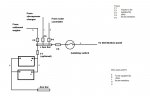
How about something like this

wiring diagram.jpg
 
A word of advice based upon (bad) experience.

Learn by looking at your existing installation and only disturb it if you have a problem and are replacing it. Old installations become used to their locations and once they have been installed for several years or been subject to engine vibration for a few years, can become fragile.

You won't see the broken core of the cable but it can make a lovely intermittent fault...

I would agree with this. My boat has lots of wires and just disappear into the GRP and appear somewhere else. I would just concentrate on making sure there are appropriate fuses to protect from wires overloading and setting ablaze. You can do lots of things to improve safety like ensuring the main battery connections have main fuses, the battery clamped down, all wires properly fixed and secured to avoid short circuits and then move onto other sections. It is a big job so good luck with it.
 
Vic, I would be inclined to put switches in b,c and d or maybe a rotary switch, and then use one common fuse.

I wouldn't. You don't want charging being accidentally being turned off from any source, for one thing. A rotary switch would mean you were limited to a single charging source, if the engine was running and the Sun was shining, you'd want both.
 
How about something like this

View attachment 89871

F5 is a duplicate of F1, there's no engine starting, so the cable from the batteries to the isolator don't need to be that heavy . I'd fit F1 and run the cable straight to the isolator. Fit c and d straight to the batteries or the battery terminal of the isolator, whichever is more convenient. If b was connected to the load side of the isolator it completely isolates the engine when the switch is off.
 
F5 is a duplicate of F1, there's no engine starting, so the cable from the batteries to the isolator don't need to be that heavy . I'd fit F1 and run the cable straight to the isolator. Fit c and d straight to the batteries or the battery terminal of the isolator, whichever is more convenient. If b was connected to the load side of the isolator it completely isolates the engine when the switch is off.
Thoughts on where to connect the engine were:
Via the isolator allows isolation of the engine but introduces the possibility of the engine being disconnected while running
Direct to the battery avoids the possibility of damaging the rectifier by disconnecting the battery while the engine is punning but does not allow isolation of the engine
A bad experience powering the electrics directly from a non regulated outboard output causing damage to the circuitry of an Autohelm

A 100 amp,. or more, battery isolator is not needed therefore a decent 2 pole switch could be used as the battery isolator with one pole isolating the engine
 
Thoughts on where to connect the engine were:
Via the isolator allows isolation of the engine but introduces the possibility of the engine being disconnected while running
Direct to the battery avoids the possibility of damaging the rectifier by disconnecting the battery while the engine is punning but does not allow isolation of the engine

I had the same thoughts. IMO, being able to isolate the engine is important and the risk of turning the charging off mid charge is the same as with most boats, so i'd go that way. Matter of choice though.

A bad experience powering the electrics directly from a non regulated outboard output causing damage to the circuitry of an Autohelm

A 100 amp,. or more, battery isolator is not needed therefore a decent 2 pole switch could be used as the battery isolator with one pole isolating the engine

I don't think it makes a difference if the charging circuit is connected to the battery, the switch output or anywhere in between, in terms of the quality of the regulation.

Yes, the switch only needs to be rated for the loads and charging current, looking at the list of equipment, a good quality Carling Contura should so the job. But, the OP will need to add up all of his loads and make sure they don't exceed the switch rating.
 
I had the same thoughts. IMO, being able to isolate the engine is important and the risk of turning the charging off mid charge is the same as with most boats, so i'd go that way. Matter of choice though.

I don't think it makes a difference if the charging circuit is connected to the battery, the switch output or anywhere in between, in terms of the quality of the regulation.

I was going to suggest that the outboard should/ could be connected via a deck socket Mine is using a now obsolete "Driplug". That enables the engine to be disconnected if necessary. These days I would use a Bulgin Buccaneer plug .

My trouble was caused by the volts from the unregulated outboard charging circuit being so high that it burnt out the voltage regulation circuit in the Autohelm. It was such an unusual fault that Nautech managed to contact me at work to warn me that there must be something wrong with my boat's electrical system, but I knew what I had done. If the battery had been connected the volts would not have risen so high. I'd forgotten to connect the battery ( using what I will describe as quick release battery connectors) in my haste to leave the mooring.

Anyway I posted my diagram to promote some discussion
 
A rotary switch would mean you were limited to a single charging source, if the engine was running and the Sun was shining, you'd want both.
Could you get a charge from two sources at the same time without some fancy sensing electronics?
If the OB is providing a charge, won't the solar reg sense the 'high' voltage and go into some form of voltage maintenance / trickle charge mode which will provide very little in the way of amps?
 
Could you get a charge from two sources at the same time without some fancy sensing electronics?
If the OB is providing a charge, won't the solar reg sense the 'high' voltage and go into some form of voltage maintenance / trickle charge mode which will provide very little in the way of amps?
You dont normally add any fancy sensing electronics or multiway selector switching , when you have solar, inboard engine alternator and shorepower. If the engine alternator , or the shorepower, gets the volts up high enough the solar regulator will merely reduce its output.

A selector switch will at best serve no useful purpose and at worst could lead to the engine charging being disconnected while the engine is running with dire consequences for the rectifier.
 
I was going to suggest that the outboard should/ could be connected via a deck socket Mine is using a now obsolete "Driplug". That enables the engine to be disconnected if necessary. These days I would use a Bulgin Buccaneer plug .

My trouble was caused by the volts from the unregulated outboard charging circuit being so high that it burnt out the voltage regulation circuit in the Autohelm. It was such an unusual fault that Nautech managed to contact me at work to warn me that there must be something wrong with my boat's electrical system, but I knew what I had done. If the battery had been connected the volts would not have risen so high. I'd forgotten to connect the battery ( using what I will describe as quick release battery connectors) in my haste to leave the mooring.

Anyway I posted my diagram to promote some discussion

It worked then :)

Good point ref the deck socket, it really needs something or it'll be a pain if/when it needs to be removed. Depending on the engine it could even be a connector under the cowl.
 
Top