Boat dogs

PabloPicasso

Well-Known Member
Joined
12 Feb 2010
Messages
2,937
Visit site
What are good dogs to have aboard? Are there breeds that do better or like life aboard? I'm guessing smaller dogs are easier to lift on and off. I may have to capitulate to the kids and get a pet. But if we get a dog and we can retake him or her aboard with us it would help.

How do people manage with the necessary when under way?
 
We have two dogs, who were not chosen with sailing in mind. Fortunately both of them enjoy the cruising lifestyle and have learned to adapt to life aboard. One is a retriever/collie and the other a whippety lurcher sort of thing. If I was choosing a breed for sailing I would definitely go for something smaller!!

We have failed to toilet train them regarding the boat. They simply refuse to go, at all, when they are onboard. We tried longer and longer passages, and I even set them an example, so to speak, on the foredeck. Eventually we did a 28hr passage and they still didn't produce so much as a drop.

Best thing we have done is to teach the command 'move'. Meaning, get the feck out of my way. Very versatile!
 
We have a labradoodle and a papillon so large & little. Both are great in harbour but not so keen on being underway, but as long as they have somewhere comfortable they just settle down.

Both will do their business on deck. An astroturf doormat dragged through fresh wee puddles at home might help, and get used to telling them to wee and pooh when walking and telling them how good they are when they do it, then asking them aboard becomes normal.

We do have the advantage of not heeling over, not sure how I would have got on on my sailing boats with the dogs.

One tip to avoid grief from other owners is not to let your dogs pooh splash over your rafted neighbours brand new fenders when cleaning down - don't ask me how I know this.
 
I dont have a dog

Only a boat cat


DSCF0778.jpg


Sometime the parrot comes along too


DSCF0779.jpg
 
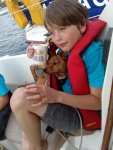
We've got a Jack Russle x Chihuahua. Had him from 9 months old and he loves the boat, sleeps on it, sails with us, watches the regatta fireworks on the boat with us and is small enough not to get in the way. He's a fantastic little guard dog and VERY protective of my three children, not scared of anything and goes quite happily on the foredeck.
They are great pets and I would recommend one. Oh, and he's not a yappy little dog that barks at everything like some do.
CAM00389.jpg
 
Last edited:
My dog on boat experience is very limited, and I intend to keep it that way. My wife and I were once asked to deliver a large old yacht on quite a long coastal trip. For reasons that are unimportant, we had to take the owner's dog with us.
The dog wasn't happy onboard, and was miserable when the boat was heeled over. Unknown to us as non dog owners, the amount of food that we had been strictly told to give to the brute, was only about half of its usual rations.
However, whatever the inconvenience, and whatever the weather, the poor animal had to be taken ashore in the dinghy, twice each day, to be emptied.
Dogs on boats? Never again!
 
We have two Patterdale Terriers. We are currently in Lanzarote and are sailing across the Atlantic with them. they are great on the boat. They sleep in the cockpit when we are on passage. They eventually go to the loo on the deck. They are very agile and will happily run around the deck when under passage with their life jackets on. They can jump of our very high deck into the dinghy and jump on/off the pontoon in the marina. Easy and enjoyable dogs to have onboard but they are well trained as well
 
Answering the OP.

My experience of my own dogs on my own boat is limited to about 3 over a period of about 5 years, on two boats.
First, any dog brought up to boat-life appears to be happy - small or large, dogs introduced to boats late in life will occasionally acclimatise, big ones finding it far more difficult.
Looking at dogs on others boats - there are an enormous variety but the ones who appear the most popular and the least discommoded by that life are Jack Russells (and being a crossbreed that covers an enormous genetic pool).
Larger dogs also need more exercising...
 
We currently sail with two Jack Russells on one of which is happy on the boat and the other not very. Previously we sailed with another Jack Russell for 16 years , once ensconced in a quarter berth with a doggy lee cloth in her basket was quite happy. Only problem was endless dinghy trips ashore which were generally fine, but often a complete pain in bad weather or when one is tired . Nothing will persuade any of them to go to the toilet onboard in a designated spot or otherwise.
 
We have two Patterdale Terriers. We are currently in Lanzarote and are sailing across the Atlantic with them. they are great on the boat. They sleep in the cockpit when we are on passage. They eventually go to the loo on the deck. They are very agile and will happily run around the deck when under passage with their life jackets on. They can jump of our very high deck into the dinghy and jump on/off the pontoon in the marina. Easy and enjoyable dogs to have onboard but they are well trained as well

Second the Pstterdale, Rupert can climb out of the dinghy up the vertical boarding ladder, loves to stand out on the flat bowsprit and is easily trained, down side is he likes his own company too much. Nimrod the Daschhound however is adorable and great company but a lunatic about nearby boats and does bark quite a lot. Nice combo though.
 
We have sailed with dog(s) since 1990. Started with a golden retriever puppy who took to it at once, but the then senior dog (middle aged landlubber Old English Sheepdog) didn't like it much. This was in a Newbridge Navigator then a Leisure 23, so only coastal sailing up to about 8 hour trips. Replacement OES also not too keen, but sadly died young ashore. Second replacement OES really took to it as we moved up via Sundream 28 to SO 36.2. After we lost the GR, the OES came with us on six trips to Scilly, longest passage 15 hours. Before she finally slipped her moorings she trained our current scruffy labradoodle who also loves boating. Unless restrained she will do a Kate Winslet at the bow when under sail!

None of our dogs have fouled the deck. They seem to treat the boat as they would our home. We have a cockpit tent where they sleep, so no struggles with the companionway, scratches on the cockpit sole or fur shed (our GR did sleep below, and a failed bilge pump in bad weather off the Scillies was finally traced to a wad of ginger hair jamming the impeller and the NRV).

Having a sugar scoop makes getting ashore easier, obviating the need to take the dog across a neighbouring boat when rafted. If you have a more traditional boat, a smaller dog makes sense. Otherwise, we would suggest getting the dog you want and taking it to sea as young as possible. In port, a dog can be security system, conversational icebreaker, conversation stopper or rafter repellent by turns. We have found all the boaters we have rafted on to be happy next to our friendly and well behaved dogs.
 
Last edited:
How about one of these|

The Schipperke was bred in Flanders by a canal boat captain named Renssens. It was descended from a 40-pound (18 kg) black sheepdog, known as the Leauvenaar, which is the same sheep-herding stock that the black Belgian Sheepdog descended from. The Schipperke was bred smaller and smaller and eventually became a different breed entirely. The dogs became a favorite choice to guard canal barges in Belgium. The breed was used for herding livestock, hunting game or simply guarding his domain. In Flemish the word "schip" means boat, hence where they got their name "Schipperke." They earned the nickname "Little Captain" and "Little Skipper" because the dogs were the "ratters," a very important function on a canal barge, and also usually the captain's dog. The breed became very popular in Belgian households by the late 1800s. It first appeared at a dog show in 1880. From that point on it was exported throughout the world. Schipperkes do very well on boats and people often get this breed to come along with them on boating and fishing trips. It makes a great guard dog when the boat anchors for the night, alerting of anything out of the ordinary and the dog thoroughly enjoys its trip. The Schipperke was recognized by the AKC in 1904.
 
How about one of these|

The Schipperke was bred in Flanders by a canal boat captain named Renssens. It was descended from a 40-pound (18 kg) black sheepdog, known as the Leauvenaar, which is the same sheep-herding stock that the black Belgian Sheepdog descended from. The Schipperke was bred smaller and smaller and eventually became a different breed entirely. The dogs became a favorite choice to guard canal barges in Belgium. The breed was used for herding livestock, hunting game or simply guarding his domain. In Flemish the word "schip" means boat, hence where they got their name "Schipperke." They earned the nickname "Little Captain" and "Little Skipper" because the dogs were the "ratters," a very important function on a canal barge, and also usually the captain's dog. The breed became very popular in Belgian households by the late 1800s. It first appeared at a dog show in 1880. From that point on it was exported throughout the world. Schipperkes do very well on boats and people often get this breed to come along with them on boating and fishing trips. It makes a great guard dog when the boat anchors for the night, alerting of anything out of the ordinary and the dog thoroughly enjoys its trip. The Schipperke was recognized by the AKC in 1904.

Met one, extraordinarily good at corralling toddler granchildren. Never rough with them, always attentive and far better than their (Toddlers') teenage sister.
 
>We are currently in Lanzarote and are sailing across the Atlantic with them. they are great on the boat. They sleep in the cockpit when we are on passage. They eventually go to the loo on the deck. They are very agile and will happily run around the deck when under passage with their life jackets on. They can jump of our very high deck into the dinghy and jump on/off the pontoon in the marina. Easy and enjoyable dogs to have onboard but they are well trained as well

We know a number boats who had a dog with no problems, all of them had a life jacket and tether clipped on, on passage, so they couldn't go overboard - which is a big risk if they are allowed on deck and can jump on and off a pontoon. One American boat we know had a cat that looked like a tiger, it jumped over board in the Atlantic when it saw a Dorado alongside, they couldn't get it back.
 
If you must have a dog may I suggest something that does not yap all the time someone walks past the pontoon

A lady went to the vet to collect her dog after treatment
The vet said " open your mouth & say aaargh"
"Why?" she said


" Your dog just died"
 
Top