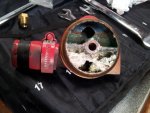
Blocked heat exchanger

It's unlikely to be salt ... as in sea salt. It is more likely to be fur like you get in kettles. Any acid will get rid of it ..... but the safest would be either vinegar or phosphoric.
 
Is it a beta?

I have the same problem with a Beta 25 and will be attempting to fix it on Saturday with a bucket, some supermarket descaler, spanners and a hammer (and some brick acid on standby).
 
I did this on mine last year & found a small electrical screwdriver was exactly the same size as the holes, sat in the cockpit with a bowl of water poking through all the holes & washed the bits out as you go.
 
I have the same problem with a Beta 25 and will be attempting to fix it on Saturday with a bucket, some supermarket descaler, spanners and a hammer (and some brick acid on standby).

Yes if its a carbonate deposit vinegar being such a weak acid will take a long while to clean it out.

A sulphamic acid based descaler, such as Fernox DS-3, will be much more effective. Sulphamic acid is just about the strongest of the so-called weak acids.

Check what your brick cleaner contains. Some are hydrochloric acid based and will be useful as last resort. Some though are not HCl based and will probably not be as effective.
 
Yes if its a carbonate deposit vinegar being such a weak acid will take a long while to clean it out.

A sulphamic acid based descaler, such as Fernox DS-3, will be much more effective. Sulphamic acid is just about the strongest of the so-called weak acids.

Check what your brick cleaner contains. Some are hydrochloric acid based and will be useful as last resort. Some though are not HCl based and will probably not be as effective.

I'd second Vic's suggestion (I use it regularly and not on just the heat-exchanger), steer clear of brick-cleaner, if you value the heat exchanger.
 
I did this on my Beta 25 a few years back. Just poke through with a suitable rod, I found a welding rod with the flux scraped off to be just the right size , then wash through. Rod now in my onboard toolbox.
 
The guy who serviced my engines yesterday put a camera in through the anode hole to see how far she was blocking up (less than 5% at present, both exchangers were removed and cleaned out last year).

The pictures showed "limescale-like stuff" and very little anode droppings at the bottom, and a layer of salt forming at the top. So, could be either and/or both.

In future, I will use Rydlime every 2-3 years to avoid it getting blocked in the first place.
 
I'd second Vic's suggestion (I use it regularly and not on just the heat-exchanger), steer clear of brick-cleaner, if you value the heat exchanger.

AGREE Charles.

I would never use hydrochloric acid on any heat exchanger as it reacts with aluminum, copper/nickel and brass.
 
AGREE Charles.

I would never use hydrochloric acid on any heat exchanger as it reacts with aluminum, copper/nickel and brass.

No, it does react with aluminium, although slowly, and it doesn't react with either copper-nickel or with brass. When I was investigating methods of determining the difference between brass, bronze and DZR I exposed all of them to hydrochloric acid for periods up to about half an hour. None reacted in any way, not even a stain.

This photo shows a trial I tried recently. It is a stainless steel antenna fitting totally encrusted in a typical marine calcified deposit in an aluminium masthead bracket. I dripped hydrochloric acid at about 10% concentration onto it. The deposit fizzed nicely and after ten minutes or so was completely removed. Neither the aluminium or stainless steel appeared to have been attacked at all.
IMG_0740_zps4d5a2e38.jpg
 
vyv_cox
Registered User

You have obviously experimented so you know what you can get away with. BUT

Chemical Reaction of HCl on aluminum - Wiki Answers
wiki.answers.com › ... › Elements and Compounds › Acids & Bases‎
Aluminum and Hydrochloric acid react violently. For instance if you have ever seen a Drain-o bomb using a plastic bottle, the combination of the 20% HCl ...


Brass Cleaning Acid?
Cleaning brass is sometimes done using muriatic acid. Brass cleaning acid should be used with care and caution. The muriatic acid used to clean brass is a dilute hydrochloric acid. It is a dangerous and powerful acid. The brass cleaning acid works by reacting with the metal oxide and dissolving the oxide into solution. Brass should only be dipped into the acid for a very short time of only a minute because the acid can also dissolve the metal.

http://www.ask.com/question/brass-cleaning-acid

Nickel is dissolved by hydrochloric acid as that is how miners extract the nickel from the ore. (they call it acid leaching)
 
Thanks for the advice. Job done and it definitely needed it. Ended up using a combination of supermarket descaler and a few bamboo bbq skewers which happened to be exactly the right size!

20140405_130749.jpg20140405_130420.jpg
 
Top