Blanking a Seacock

Agree it's unnecessary - but will cover my psychological hatred of an open hole, even if it's got a bronze cone behind it. I've taken Blakes seacocks apart before... Some irrational part of my mind just keeps saying "what if that thin bit of cone corrodes.. am I really sure these are old bronze and not new dzr ones....".

Then they won't corrode. How long have they been in the boat? If they are bronze it is over 30 years, so if nothing has happened up to now, why should they suddenly go wrong?
 
Agree it's unnecessary - but will cover my psychological hatred of an open hole, even if it's got a bronze cone behind it. I've taken Blakes seacocks apart before... Some irrational part of my mind just keeps saying "what if that thin bit of cone corrodes.. am I really sure these are old bronze and not new dzr ones....".

In order to avoid holes and unsightly or dubious plugs - buy a 1 1/2" to 3/4" hose reducer (e.g Vetus, other makes available), and use this to join the non-seacock end of the 1 1/2" outlet hose to the 3/4" inlet hose. You then have a completely sealed hose (all double clamped, of course) to deal with the exceedingly unlikely event either of your closed, clamped, handle-less Blakes seacocks failed.
 
To settle the argument, and satisfy your insurance company, service the seacocks and set them to closed etc. Then attach (2 jubilee clips) a couple of inches of pipe that has been stoppered with two jubilee clips over the pipe covering the wooden/plastic stopper.

Ugly? Probably.

Insurable? Yes but confirm with your insurer if you don't know for sure (email them a picture: their response will be in writing which you can print & keep with the rest of your boat's paperwork).

Peace of Mind? Yes, a full belt and braces approach.

Any more worries? Just do the job properly; remove the seacock and GRP the hole shut.
 
I've been pondering the same problem for some time:
... a ¾" sea cock, and a skin fitting (that was replaced with a cheap one) in the bottom of the bilge! ... Does anyone make a stopper or bung that can be used for this purpose, preferably made in the same stuff they make plastic skin fittings from?

I recently contacted Gougeon Brothers (West System) as follows:

I have read your document at http://www.westsystem.com/ss/repairing-machined-holes-in-fiberglass/
I have a 1" drilled hole at the bottom of my hull, currently occupied by an uunused 3/4" through-hull (skin fitting).
The GRP is about 1" thick at this point, cutting a 12:1 taper will result in a huge area.
Please can you advise the best solution.


Reply:

Ideally, you would grind a bevel from both sides - in and out. This allows you to reduce the bevel to 8:1 so the effective thickness of the laminate becomes 1/2" making the bevel 4" dia. from the edge of the hole on both sides. I wouldn't recommend you go any less on the bevel since this area is a high risk area where failure could be catastrophic.
Bruce Niederer | Senior Tech Advisor
Gougeon Brothers, Inc
 
Last edited:
I've been pondering the same problem for some time:


I recently contacted Gougeon Brothers (West System) as follows:
I have read your document at http://www.westsystem.com/ss/repairing-machined-holes-in-fiberglass/
I have a 1" drilled hole at the bottom of my hull, currently occupied by an uunused 3/4" through-hull (skin fitting).
The GRP is about 1" thick at this point, cutting a 12:1 taper will result in a huge area.
Please can you advise the best solution.


Reply:
Ideally, you would grind a bevel from both sides - in and out. This allows you to reduce the bevel to 8:1 so the effective thickness of the laminate becomes 1/2" making the bevel 4" dia. from the edge of the hole on both sides. I wouldn't recommend you go any less on the bevel since this area is a high risk area where failure could be catastrophic.
Bruce Niederer | Senior Tech Advisor
Gougeon Brothers, Inc
Surely it would only be "catastrophic" if whatever you bunged the 1" hole with fell out. Suppose you were to abrade the sides of the existing hole back to expose clean, dry laminate and bevel the edges, inside and out, by, say 1/4" and then fill this hole with thickened epoxy, you would have a sort of epoxy bobbin there. If, through inadequate cleaning, it did not bond pefectly to the hull, it would not fall out but just weep slightly. A nuisance certainly, but hardly a catastrophe.

You could, if you wished, back up the repair on the inside with a few layers of glass cloth laminate.

I carried out such a repair on my boat more than 10 years ago with complete success. The hole originally had a B&G transducer in it which I think was more than 1" in diameter
 
Agree, nothing difficult about blocking off a hole where there was a Blakes seacock. Use the 3 bolt holes to bolt a pad bedded in epoxy on the inside and then make good the hole outside by countersinking the fastening head and grinding away an area around the hole to laminate up to level. No need for gel coat if you use epoxy, just prime and antifoul.
 
This thread has been interesting. Who would have thought that the suggestion of putting on of these on a seacock would be so controversial?

blue.jpg


It may not be difficult to patch some holes if I remove the old valves, but I think a blakes seacock beats my GRP engineering and in any case it's half a day I can't spend on something else, like sailing. And I might want that loo back.

The idea of locking down the valve with the handle removed is exactly the right thing to do for me, thanks Tranona and parsifal for the suggestion. Sticking one of those boots over the top of each hose connector with a pipe clip definitely beats a weird length of pipe hanging around with a reducer joining the two seacocks as has also been suggested and it will act as an (unnecessary) safety backup. But for a couple of quid and 2 mins why not do it anyway? Better to have two things keeping the boat afloat than 1, where it isn't uneconomic in time and money. And it makes a nice visual fix the insurance company can have a photo of, especially combined with the handle being removed.

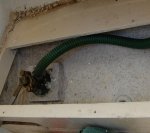
In any case, it's going to beat this (hidden under a cover and where the hose just ends):

DSC_1046.jpg
 
Last edited:
Top