Bilge water sensors (again)

Lomax

Well-Known Member
Joined
22 Sep 2016
Messages
375
Visit site
How frustrating it is that there doesn't seem to be a reliable way to detect the presence/absence of water in a boat's bilge! I have read countless threads here and elsewhere about the pros and cons of different types and brands, but haven't been able to identify a product that will:

  1. Always turn the connected bilge pump on when water is present
  2. Always turn the connected bilge pump off when no water is present
I need to be able to leave my boat for weeks at a time in complete confidence that if water gets in it will be detected - not 90% of the time, or even 99% of the time, but 100% of the time (provided the house bank holds a charge etc). I also need to know that the detecting device will switch the pump off once water is no longer present 100% of the time. Why is this so difficult?
 
This is what you want:

https://www.ultratef-gel.com/ultra-pump-switches/

Expensive and hard to get (you might need to order from the U.S.), but this is what is used on superyachts and many commercial vessels. They are bulletproof, and you'll understand why when you see one.
Thanks. Looks very similar to the Aqualarm Smart Bilge Switch. Magnetic float in tube with hall effect sensor. These also fail; if the tube is submerged in oily/dirty water the float can become stuck. I've stopped looking at bilge switches and am now looking at the ultrasonic type commonly used in the process industry. They seem to be based on a fool proof principle: the difference in propagation of sound waves in a liquid and in a gas. By sending out ultrasonic pulses at regular intervals, and measuring their amplitude and speed at a second location, it is possible to tell with 100% certainty whether the sending and receiving elements are submerged in a liquid or not - regardless of the nature of that liquid and any fouling of the elements. Air and other gases are "springy" and will attenuate and slow down the sound waves, whereas a liquid will always provide a stronger signal at a higher speed. Provided the elements are far enough apart (say a few centimetres at least) this should work in anything from porridge to pure alcohol.
 
Last edited:
Here's one example:

http://www.fluidswitch.com/fl50-ultrasonic-liquid-level-sensor.php

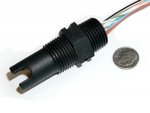
SMD Fluid Controls’ FL50 ultrasonic gap sensor is made with durable nylon or polypropylene for unmatched chemical resistance across a wide range of industrial applications, including with hydraulic fluids, oils, and slurries.

Ultrasonic level sensors work by emitting high frequency sound waves and detecting changes in the waves as they bounce back to the sensor, making them capable of both point level and continuous sensing applications.

http://www.smdsensors.com/Products/FL50-Ultrasonic-Liquid-Level-Detector/

waterleveldetector_300_tilt.jpg
 

The same company do a stainless steel magnetic mechanical float switch that I have used in my 3 diesel tanks, 2 water thanks and black water tank without a single problem. These I use to indicate when the tank is nearly full to prevent overfilling.

The same company do an ultrasonic clamp-on flow sensor that claims to measure from 0 to 10l/min. If it can truly measure down to very low flows it may be useful for measuring diesel flow on small marine diesel engines. Ir will need some extra electronics to tale the inflow and outflow to calculate the engine fuel consumption.

Do you have any connection with Strain measurement devices to obtain more technical details and pricing.

http://www.smdsensors.com/products/redirector.asp?documentID=44&whereFrom=Product_View
 
Take a lead put of other safety critical systems. Fit more than one. Fit a monitoring device to report metrics. Yes this complex. It is a trade off in an imperfect world.
 
I don't get all the worrying about imperfect reliability of bilge pump switches.

On a wooden boat that you KNOW leaks a bit, or a GRP one with a slight leak from a stern gland or a keel-stepped mast that lets a bit in through the mast, fit two switches in parallel, and test them both occasionally. The chance of both not working is vanishingly small. On boats like these you have to go aboard regularly anyway, you can't leave them three or six months unused or unattended.

If both switches are 99% reliable do you get 99.99% reliability. Not sure, but certainly much much better.

On most modern boats that near-as-dammit don't leak, any sudden significant leak is going to flatten your batteries anyway.....
 
For the past 40 years, I have had boats kept on unattended swinging moorings, 120 miles from home. First wooden, now GRP. I have never had, or felt the need for an automatic bilge pump. As the previous poster said, if the boat develops a significant leak, the pump would flatten the batteries. Far better to make sure that is simply not going to leak.

I do recall one unfortunate incident, when wintering in a canal, when a fuel tank in a neighbouring boat split a seam, and the automatic pump automatically pumped about 200 gallons of diesel into the canal. Not very clever!
 
A fellow club member many years ago cruised to London in his twin engine motor boat. One engine stopped on the way up the river. Turned out that the tank had emptied into the bilge and the automatic pump had obligingly transferred a couple of hundred litres of diesel to the river !!!
He was not happy.
Luckily being a twin he could at least carry on.
 
How frustrating it is that there doesn't seem to be a reliable way to detect the presence/absence of water in a boat's bilge! I have read countless threads here and elsewhere about the pros and cons of different types and brands, but haven't been able to identify a product that will:

  1. Always turn the connected bilge pump on when water is present
  2. Always turn the connected bilge pump off when no water is present
I need to be able to leave my boat for weeks at a time in complete confidence that if water gets in it will be detected - not 90% of the time, or even 99% of the time, but 100% of the time (provided the house bank holds a charge etc). I also need to know that the detecting device will switch the pump off once water is no longer present 100% of the time. Why is this so difficult?

Look at the Whale Bilge IC - http://www.whalepumps.com/marine/product.aspx?Category_ID=10008&Product_ID=10003&FriendlyID=Bilge-IC

The same technology is used in the Whale Gulper IC shower drain system, I have one on my boat and it works flawlessly.
 
I don't get all the worrying about imperfect reliability of bilge pump switches.

On a wooden boat that you KNOW leaks a bit, or a GRP one with a slight leak from a stern gland or a keel-stepped mast that lets a bit in through the mast, fit two switches in parallel, and test them both occasionally. The chance of both not working is vanishingly small. On boats like these you have to go aboard regularly anyway, you can't leave them three or six months unused or unattended.

If both switches are 99% reliable do you get 99.99% reliability. Not sure, but certainly much much better.

On most modern boats that near-as-dammit don't leak, any sudden significant leak is going to flatten your batteries anyway.....

My thoughts too - we normally leave both our boats in the water for almost 6 months (once was 9) completely unattended and with no emergency bilge pump system at all. In both case there is always water swilling around under the floorboards when we get there. I have fitted a dehumidifier to one which has helped a lot. In both cases the water is fresh - one from a complex water system where I couldn't find the leak, but think I finally have after the accumulator exploded showing multiple holes and rust underneath.

In the event of a seacock going then no bilge pump short of a full fire service one would help at all. With 30 years of owning boats and 45 years of sailing them an auto bilge pump has not yet emerged in the top 10 things I need to do next.
 
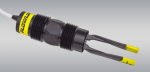
Vibrating prong level switch as used in my industry and many others. There are a number of different suppliers of similar equipment. We expect them to work day in day out for years in conditions of pressure and temperature and with corrosive liquids that make your bilges look like very benign!

Of course they do come at a cost.

Yeah, stumbled upon those while researching the ultrasonic sensors. Basically a tuning fork that gets detuned by being in contact with a substance - works equally well for hydrochloric acid and cement. Interesting!

LZ12.jpg

The ultrasonic ones I've looked at are not that expensive; can be had for ~£150-250, which puts them close to the same range as the Water Witch, not to mention the "Ultra Tef" "Ultra Switch", especially if you were planning to "double up" your switches. There is one major downside though: switching capability is in the hundreds of milliamps, rather than the 10-15A typically needed, and they do not tend to have a deadband timer built in, so you need to provide an external relay with this functionality yourself.

Take a lead put of other safety critical systems. Fit more than one. Fit a monitoring device to report metrics. Yes this complex. It is a trade off in an imperfect world.

Oh I'm eventually going to have three Gulper 320s, since my boat is divided up into three (more or less) watertight sections. But I'm going to start with the engine room one, since I know I had a slow leak somewhere in there before she came up on land for repairs. Considering the size and age of my hull (45x9" riveted steel from the 1920s) I do not expect her to ever be 100% water tight. Monitoring, logging and reporting will be through Domoticz, with SMS and email alert functionality.

I don't get all the worrying about imperfect reliability of bilge pump switches.

On a wooden boat that you KNOW leaks a bit, or a GRP one with a slight leak from a stern gland or a keel-stepped mast that lets a bit in through the mast, fit two switches in parallel, and test them both occasionally. The chance of both not working is vanishingly small. On boats like these you have to go aboard regularly anyway, you can't leave them three or six months unused or unattended.

If both switches are 99% reliable do you get 99.99% reliability. Not sure, but certainly much much better.

On most modern boats that near-as-dammit don't leak, any sudden significant leak is going to flatten your batteries anyway.....

If you go on Amazon (for example) and read some of the reviews for the Water Witch and other supposedly "perfect" (and expensive) bilge switches you'll see that 10-20% of reviews give a singe star - usually because the switches worked fine for months and then suddenly failed without warning. If the switches "fail open", you may not know about it until there's a very wet problem - if they "fail closed" you'll know about it because your battery bank has been drained, possibly the pump destroyed, possibly the boat filled with water. I am not keen on either scenario, and installing dual switches won't save you from the "failed closed" scenario anyway.

Do you have any connection with Strain measurement devices to obtain more technical details and pricing.

I do not, but I've looked a little at prices. Not cheap, but not insanely expensive either - especially when compared to the option of installing two imperfect switches per pump.

What's the best-of-the-rest switch for those of us happy with 99% reliability?

If you mean 99% chance they will still work reliably after a year I don't think there are any - from what I've read on Amazon and elsewhere even the best and most expensive ones are no more than 90% reliable - 10% will experience problems within the first year or two - and that's if you remember to clean them... Someone should produce a switch based on an industrial sensor - either the vibrating prong or ultrasonic type - I think there's a market for that.
 
For the past 40 years, I have had boats kept on unattended swinging moorings, 120 miles from home. First wooden, now GRP. I have never had, or felt the need for an automatic bilge pump. As the previous poster said, if the boat develops a significant leak, the pump would flatten the batteries. Far better to make sure that is simply not going to leak.

My thoughts too - we normally leave both our boats in the water for almost 6 months (once was 9) completely unattended and with no emergency bilge pump system at all.

Yeah, well, that's your prerogative. Since we're talking about my home here I hope you'll forgive me for being a little more cautious. I'd rather have an emergency bilge system drain the batteries in a vain attempt at stopping a catastrophic failure than have the boat sink with fully charged batteries.
 
Yeah, well, that's your prerogative. Since we're talking about my home here I hope you'll forgive me for being a little more cautious. I'd rather have an emergency bilge system drain the batteries in a vain attempt at stopping a catastrophic failure than have the boat sink with fully charged batteries.

Obviously you can make your own judgements of relative risk and mitigation - you obviously have scenarios in mind where a leak can be enough to be damaging but solvable at bilge pump speed and resolved by itself before the batteries expire.
 
Obviously you can make your own judgements of relative risk and mitigation - you obviously have scenarios in mind where a leak can be enough to be damaging but solvable at bilge pump speed and resolved by itself before the batteries expire.

Like most old steel barges of this type (riveted steel) she's not likely to ever be 100% watertight, and some condensation is also inevitable. You either sponge it up on a regular basis or you fit some kind of pump(s) to deal with it. Yes, I will also have a dehumidifier - I've bought a Meaco DD8L for this - which will drain into the shower tray for automatic pump-out, but this will only be on when shore power is available (or there is otherwise power to spare).

Edit: Having historical data on pump running frequency and duty will give good indication if problems are getting worse.
 
Last edited:
Like most old steel barges of this type (riveted steel) she's not likely to ever be 100% watertight, and some condensation is also inevitable. You either sponge it up on a regular basis or you fit some kind of pump(s) to deal with it. Yes, I will also have a dehumidifier - I've bought a Meaco DD8L for this - which will drain into the shower tray for automatic pump-out, but this will only be on when shore power is available (or there is otherwise power to spare).

Edit: Having historical data on pump running frequency and duty will give good indication if problems are getting worse.

Thanks - I can see where you are coming from.
 

Other threads that may be of interest

Top