Bi Facial solar panels

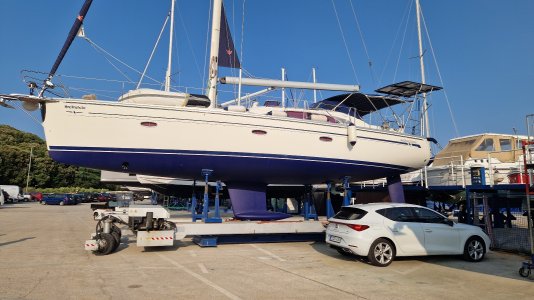
I know of a yacht which has a 440W bifacial panel mounted horizontally on an arch, mostly overhanging the stern. I wonder whether reflection from the water surface will produce any significant gain over a monofacial panel.
 
One of the primary applications is to mount them vertically in rows, oriented north/south. Not a boat thing.
  • Not damaged by hail.
  • Stay clean. No bird bombs.
  • More power morning and evening (good if mixed with standard tilted panels--more even power through the day).
  • More power on cloudy days, when the light is diffuse.
  • No snow cover. A big deal farther north.
  • Better with lower sun angles (farther north).
  • Cheaper racks.
  • Easier to mow the grass or even grow crops.
IMG_9487-1024x768.jpg
 
Bifacial solar panels are quite popular on sailing yachts. The bifacial nature can theoretically improve the output by as much as 30%, but with typical marine surfaces, around 5-10% seems more typical.

This is a nice bonus, but other factors such as the overall solar panel efficiency are often more important.
 
Bifacial solar panels are quite popular on sailing yachts. The bifacial nature can theoretically improve the output by as much as 30%, but with typical marine surfaces, around 5-10% seems more typical.

This is a nice bonus, but other factors such as the overall solar panel efficiency are often more important.

As he says, 5-10% is more common, and probably <5% based on measurements I've taken. To confirm this, look at a camera light meter reading a piece of wood held up under the shade (not lying on the deck) vs flat on the deck. Even very open shade is typically 20x less. Any effect is a rounding error, far less important that shade on the panel, which we already know is lethal, if only on a few cells.

The 30% figure probably uses a mirror, not gelcoat. That is the only way the math works. Geometry.

It is not uncommon for regular panels to produce very slightly more than their rated output. I've seen that.
  • Low latitudes and very clear skies.
  • Cooler temperatures than rated.
  • Conservative ratings.
 
Last edited:
I think @geem is using bifacial panels on his new panels, if I remember correctly.
I remember the same, he did not make a big thing about them - and no-one queried it.

Jonathan
I have 1,2 kW of Bifacial panels mounted on an arch, I've seen them produce more than their rated output ....


View attachment 202766
More could be 1% (though if you have noticed it it must be more.

Can you add any, even rough, figures?

Jonathan)
 
More could be 1% (though if you have noticed it it must be more.

Can you add any, even rough, figures?

Jonathan)
Conventional, non-bifacial panels are capable of delivering significantly more than their rated output in exceptional conditions.

Thus, it is difficult to quantify the benefit of bifacial panels without detailed controlled side by side controlled experiments.
 
I know of a yacht which has a 440W bifacial panel mounted horizontally on an arch, mostly overhanging the stern. I wonder whether reflection from the water surface will produce any significant gain over a monofacial panel.
Reflection off water in a horizontal position is only likely to provide about a 6% gain.
We have our bifacial panels mounted on the guardrails. We get a nice gain early morning when we can leave all panels vertical and get output from the front of the ones facing the sun and the back of the panels on the other guardrail that are facing the sun.
 
Conventional, non-bifacial panels are capable of delivering significantly more than their rated output in exceptional conditions.

Thus, it is difficult to quantify the benefit of bifacial panels without detailed controlled side by side controlled experiments.
Being able to tilt panels towards the sun is the single biggest benefit enhancement you can make. My 300w horizontal panels in an unshaded location this week have peaked at 279W. The 500W of bifacial panels mounted on the guardrails, tilted to face the sun have peaked at 573W and 566W in the last 3 days. I found the same exceeding of the rating occurred on my old non-bifacial panels that were previously installed on the guardrails.
I am sure the bifacial aspect add some performance but I suspect it's not significant compared the 25% gain I believe I achieve from the ability to tilt the panels. Research suggests the bifacial aspect provides an additional 6% output
 
Conventional, non-bifacial panels are capable of delivering significantly more than their rated output in exceptional conditions.

Thus, it is difficult to quantify the benefit of bifacial panels without detailed controlled side by side controlled experiments.

So basically we cannot do that and have to rely on gut feeling :) or the data and results outlined in the link forming the basis of the thread.

excepting Geem's practice,

Reflection off water in a horizontal position is only likely to provide about a 6% gain.
We have our bifacial panels mounted on the guardrails. We get a nice gain early morning when we can leave all panels vertical and get output from the front of the ones facing the sun and the back of the panels on the other guardrail that are facing the sun.

and thinwater's earlier post and picture

One of the primary applications is to mount them vertically in rows, oriented north/south. Not a boat thing.
  • Not damaged by hail.
  • Stay clean. No bird bombs.
  • More power morning and evening (good if mixed with standard tilted panels--more even power through the day).
  • More power on cloudy days, when the light is diffuse.
  • No snow cover. A big deal farther north.
  • Better with lower sun angles (farther north).
  • Cheaper racks.
  • Easier to mow the grass or even grow crops.
IMG_9487-1024x768.jpg

Though, if at anchor, vertical panels, on the life lines, does rely on dependable northerly or southerly wind and is a disaster if the prevailing winds are easterlies or westerlies

Jonathan
 
So basically we cannot do that and have to rely on gut feeling :) or the data and results outlined in the link forming the basis of the thread.

excepting Geem's practice,


and thinwater's earlier post and picture


Though, if at anchor, vertical panels, on the life lines, does rely on dependable northerly or southerly wind and is a disaster if the prevailing winds are easterlies or westerlies

Jonathan
If the wind is easterly, as it is in the Caribbean, your boat points east and you get sun from the south. Tilted panels towards the sun works perfectly. Ditto if the wind is from the west. If the boat swings around at anchor, just fix the panels horizontal and you are no worse off than panels on a solar arch
 
If the wind is easterly, as it is in the Caribbean, your boat points east and you get sun from the south. Tilted panels towards the sun works perfectly. Ditto if the wind is from the west. If the boat swings around at anchor, just fix the panels horizontal and you are no worse off than panels on a solar arch

As Zoidberg said

'Strewth! Weren't like that when ah were a lad...'

Jonathan
 
More could be 1% (though if you have noticed it it must be more.

Can you add any, even rough, figures?

Jonathan)
It wasn't much, my panels are rated at 315W and I have 4 of them , they run through 2 MPPTs and the sum from both MPPTs was around 1,3kW or just over. Sun splitting the sky, clear, sea flat calm at anchor and the kettle and toaster were running off the inverter. When the toast popped it dropped considerably. I was watching the Victron app at the time because the conditions seemed good for a good current draw from the panels.
 
One of the primary applications is to mount them vertically in rows, oriented north/south. Not a boat thing.
  • Not damaged by hail.
  • Stay clean. No bird bombs.
  • More power morning and evening (good if mixed with standard tilted panels--more even power through the day).
  • More power on cloudy days, when the light is diffuse.
  • No snow cover. A big deal farther north.
  • Better with lower sun angles (farther north).
  • Cheaper racks.
  • Easier to mow the grass or even grow crops.
IMG_9487-1024x768.jpg

Perhaps ok for a farm or such like but for any large scale deployment the necessary space between the rows due to shading makes them less efficient than regular frame / ground mounted panels.

Interestingly our insurance provider will only provide insurance on our new roof mounted schemes when we spec bifacial panels.
 
Being able to tilt panels towards the sun is the single biggest benefit enhancement you can make. My 300w horizontal panels in an unshaded location this week have peaked at 279W. The 500W of bifacial panels mounted on the guardrails, tilted to face the sun have peaked at 573W and 566W in the last 3 days. I found the same exceeding of the rating occurred on my old non-bifacial panels that were previously installed on the guardrails.
The biggest single enhancement that can be made is to mount the solar panels in as shade-free location as possible. This is not easy on a yacht, but avoiding mounting objects above the panels will make a significant difference even if the actual shadow is small, such as that from a GPS aerial.

Our first two cruising yachts had tilting solar panels, and this does help a bit, but mounting them in as shade-free a location is more significant. Flat, shade-free panels will still exceed their rating in good conditions.
 
The biggest single enhancement that can be made is to mount the solar panels in as shade-free location as possible. This is not easy on a yacht, but avoiding mounting objects above the panels will make a significant difference even if the actual shadow is small, such as that from a GPS aerial.

Our first two cruising yachts had tilting solar panels, and this does help a bit, but mounting them in as shade-free a location is more significant. Flat, shade-free panels will still exceed their rating in good conditions.
Of course shading is a an issue, but all things being equal, tilting the panels provides 25% more output in unshaded conditions. The figures i quoted are for now, as we approach mid winter. Low sun angles. In the height of summer, tilting panels will still be better than flat panels but by a lesser margin. I exceeded the rating of the panels this week. Not something you are going to achieve with flat panels in winter
 
Another factor is your style of cruising. If you spend days at anchor in locations where yawing is minimal and the boat will likely face east/west, tilting panels makes sense. But if you are underway a good bit of the time, and if generation underway is a priority, then flat panels that are always in position, sun up to sun down, make sense. I know, for example, that I'm not going to take the time to fiddle with panel angles. In my cruising area we usually swing north/south. About the most I'm going to do--and only sometimes--is swing the boom out for better light on the hard top panels.

On the other hand, cats have a lot of room for panels, so my view is influenced by that. I don't need perfect output. Big biminis can be claustrophobic and restrictive on monos in a way that they are not on cats. I have a trimaran that doesn't even have a dodger (but I do have solar on deck).
 
I exceeded the rating of the panels this week. Not something you are going to achieve with flat panels in winter
We are in the Caribbean at the moment, slightly closer to the equator than you are in Mindelo, but we have exceeded the rated output of the panels this week despite the flat orientation and pretty poor weather.
 
Top