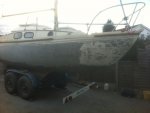
Best way to mark the top of a new boot top?

The last time I did this I used a very simple Dumpy level.

Set up just below ( 6 inches ) the the top of the line, estimate only. Then tilted the level using the adjustments on dumpy to get the stern and bow line.

So I could see the stern line then swing the lens to the bow and land on the mark. No need to level the boat.

Being just below the centre point of the line will give a natural bt very gradual rise in the line at both ends.

Having established the bow and stern points, I used a small timber off cut to offset the line for the boot top.

I use the plastic tape "Boot Top Tape" available from chandlers and some sign righter outlets.

Good luck and fair winds. :)
 
Check the athwartship angle of the boat on the hard with a spirit level. They are seldom exactly level. Then chock up a pole at the bow across the hull and level this the same as the hull. Tape a string-line to the required position of the top of the line at the stern and drop the other end over the pole with a weight on it. Move the line outwards so that it is just touching the hull at the stern and tape it to the hull with a bit of masking tape. Move the line in slightly so it again touches the hull about 6 inches forward of the first mark. Tape the line in place. Continue doing this until you have reached the bow. (The bits of tape stop the line sliding down the hull). Mark the position of the line along the hull and then mask the full length ready for painting. This ensures a perfectly straight line on the curved hull no matter how the boat is laying.

That doesn't seem to take into account the tumblehome of the hull. Where the topside are more vertical it will be lower and where they are angled the line will rise.

I found the best way to get a level line (you can adjust for a pleasing look after that) is the laser. As PCUK says the boat must be level across it's beam. fore to aft doesn't matter.
I put the cheap laser on a tripod with a revolving head. Get the plane of the tripod head so that it will hit a point at the bow and the stern that seem correct and then just turn the laser and mark along the hull as you go.Do the same at the other side and then measure down to the marks amiships to ensure they are equal. If not your boat wasn't levelled. Levelling across the beam should be pretty easy whether it's chocked or on a trailer.

Laserlining.jpg
 
Last edited:
PCUK's method is almost the traditional method. If the boat is chocked so that it sits vertically the difference in height fore and aft doesn't matter. Set a straight batten across the bow and stern at the desired height of the line, at right angles to the centre line of the boat, and trim level. Lay a line weighted at both ends over the battens. Move it so that it just touches the hull. Mark the contact point. Move the line so that it just touches the hull somewhere else. Mark the contact point. Keep doing it. Join the dots. For a small boat you can use a stiff batten instead of a weighted line.

If you get bored easily, use a laser level.
 
That doesn't seem to take into account the tumblehome of the hull. Where the topside are more vertical it will be lower and where they are angled the line will rise.
>>>>>>>>>>>
Not absolutely sure what you mean. But as Andy says, this traditional method puts a straight line on a curved hull no matter the shape of the topsides. Doesn't matter whether the hull is level or upright as long as the pole is in line with the tilt (or list) of the hull this is a foolproof method that works every time without fail and has done for very many years. Every other method requires the boat to be sitting exactly level in all planes as it would in the water. By the way LS I have always understood 'tumblehome' to be where the topsides are narrower at the top, but I'm open to correction!
 
I've re-read your post. I found it a bit ambiguous. I've done it that way but found that the string "crawled" on the sloping parts of the topside.

Tumblehome

crcsm1.gif


I found the laser method much easier.
 
I've re-read your post. I found it a bit ambiguous. I've done it that way but found that the string "crawled" on the sloping parts of the topside.

Tumblehome

crcsm1.gif


I found the laser method much easier.


Thanks LS. Glad to see my tumblehome thought was correct. Placing tape every six inches along the line as you go stops the string moving up or down. Hence the infallibility of the system. Lasers are OK if you can get the boat exactly plumb in all directions. Not always easy. But going back to the original query the OP now has a range of options to do his job.
 
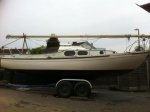
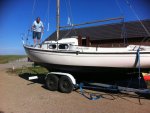
Eynhallow was treated with CopperCoat last winter and on haul out yesterday, she just had a light coating of a green slime which jet washed of easily.
However, the boat has no boot top and there was a growth of green slime on the gelcoat to about 50mm above the water line which was much more difficult to remove. So I'm going to extend the CopperCoat by about 50mm, to where a conventional boot top would be.
What's the best way of marking the top of the new boot top?
Obviously, I can simply measure 50mm near the bow where the topsides are almost vertical. But how do I get a fair line as I move towards the stern where the topsides are nearer horizontal?

Pre electronics, one method, was to use a clear hosepipe filled with water.
Have one end water level at the boot top you require & move the other end along the hull.
The water levels will always be the same & you can mark off as you progress.
Its basically a U-Tube.
 
. Lasers are OK if you can get the boat exactly plumb in all directions. Not always easy.
Fore/aft doesn't matter. You adjust the rotating head so that the laser hits a bow and stern mark. It is important that the boat is level across the beam. You can check that by measuring a midships mark down from the gunwhale on each side.
The laser is great for marking across chines or spray rails. The red stripe is the laser beam

chinemark.jpg


sprayrail.jpg


Yes. Looks odd, but that is the water-line

TaylorAFprimer.jpg


boatonmooring3.jpg
 
Last edited:
if your line is good at the moment pace a 100 mm or so tape above it using it as a guide then one more above it then pull out the first one simples
their is a ratio to curve the line up and it works as I done mine and I was told it was in case the boat was loaded stern or bow heavy so the line would still show


just found this and it is what I used

start your sweep about 1/3 of the waterline's length aft of the bow, , maybe 1/4 of the way back. Start the upward sweep

at the stern 1/6 to 1/7 forward of the transom, unless the boat is especially wide butted then decrease this amount.
Do this treatment on both the bottom paint and the boot, with the top of the boot having more sweep then the bottom paint.

WoodenBoat magazine had an article about this an issue or two ago. It serves two purposes, first it fixes an optical illusion created by the curves of the boat.
The pointy end if farther from your vantage point then midship and to an lesser extent the stern also.
This causes a dead straight line to visually droop toward the ends of a yacht. The upward sweep or sheering of the boot and bottom paint solves this issue.
Secondly, a dead straight boot or bottom job will show the slightest trim imbalance, but a swept boot and bottom, will mask this handily
 
Last edited:
Raised my antifoul line a crude but effective way. I assumed the old boot topping line followed the right line/tumblehome/sheer or whatever the term is. Took a 1" piece of wood about a foot along and slid it along the existng line marking with a pencil along the upper edge of the wood Then simply laid the masking tape along the lines which smoothed out any changes in direction (the short length of the wood minimised the angles where the pencil lines met). Looks exactly right and was dead easy to do.
 
That's a brilliant suggestion. I need to replace the boot topping which is paint over the top of tape I think, so using a temporary pencil line would be oh so simple.

Ta

Pete
 
First attempt

I had a go at marking the top of the boot top today, using the St Tom method of taking a proportion of the top side, or in may case the distance from the style line to the existing top of the antifouling (in my case read CopperCoat).

Starting at the bow I measure 0.5m intervals along the top of the antifouling, 28 down each side. I them measured the distance from the top of the antifouling to the style line. I did this down both sides of the boat. However, when I compare port and starboard measurements, i found a significant discrepancy (up to 45mm), i.e. the existing waterline isn't even, it's lower on the port side (less antifouling). This accounts for why there was much more green slime around the waterline on the port side, than on the starboard side, and my assumption that the boat was listing to port.

So I entered the measurements into a spreadsheet, two columns of 28 measurements, averaged each pair, and then took 95% of the result. This should give a symmetric and slightly curved boot top which is based on the shape of the style line, which in turn follow the shear line of the deck.

I got as far as cleaning up the scum and dirt off the first 100mm or so of topside above the waterline and marking the 28 new positions on the hull, when I ran out of daylight.

The "line" I see, connecting to dots by eye, looks OK.

As I was working away, two other questions came to mind:

1) Is it better to polish the topsides before I apply the CopperCoat boot top? The upside is that, I won't have to worry about polishing the CopperCoat, the down side is that the hull will no doubt be streaked buy the winter weather, so I may have to polish again in March.

2) I need to abrade the gelcoat before applying the CopperCoat, is it better to mask the line before abrading or after? if I abrade before masking, I stand a reasonable chance scratching the topside. If I mask first, I'll have a definite line to abrade to and some protection for the topside, but I may damage the masking tape, resulting in a ragged line or having to re-mask a second time.

Any thoughts and or experience out there which might help me decide which are the better options?
 
That doesn't seem to take into account the tumblehome of the hull. Where the topside are more vertical it will be lower and where they are angled the line will rise.
>>>>>>>>>>>
Not absolutely sure what you mean. But as Andy says, this traditional method puts a straight line on a curved hull no matter the shape of the topsides. Doesn't matter whether the hull is level or upright as long as the pole is in line with the tilt (or list) of the hull this is a foolproof method that works every time without fail and has done for very many years. Every other method requires the boat to be sitting exactly level in all planes as it would in the water. By the way LS I have always understood 'tumblehome' to be where the topsides are narrower at the top, but I'm open to correction!

A sweep to the top edge can be achieved with the "sliding string" method if the top edge of you trestle(s) (or jig) has an incline or a gradual wedge placed (apex pointing outward) on the top of the trestle. As you slide the string inboard it will lift, giving the flare you want. Adjustments to the degree of flare depend on gradient of the wedge.
 
Top