Best way to extend a wire

dunedin

Well-Known Member
Joined
3 Feb 2004
Messages
15,841
Location
Boat (over winters in) the Clyde
Visit site
OK, bear with me as I am a bit of a newbie to doing electrics properly.
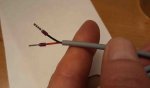
So what is the best way to extend a thin wire, needed for fitting a replacement bow navigation light (see picture). Wire join will need to be up in a fairly awkward to get at space underneath the toerail.

So options seem to include

1) Small chocolate bar connector - using bootlace ferrule on the other wire to match. (Quickest and simplest to do?)

2) Remove ferrule on wire, twist wires together and then solder plus a heat shrink wrap. (Tricky space to solder in but not entirely impossible)

3) Heat shrink connectors with copper insert (Also easy to do?)
https://www.amazon.co.uk/dp/B0725GL3ZJ/_encoding=UTF8?coliid=IQ91JCQM2DN1I&colid=1W9928G2DF3WS&psc=0

4) Something else !

Views?
 

Attachments

  • 20180119_153438.jpg
    20180119_153438.jpg
    75.1 KB · Views: 0
OK, bear with me as I am a bit of a newbie to doing electrics properly.
So what is the best way to extend a thin wire, needed for fitting a replacement bow navigation light (see picture). Wire join will need to be up in a fairly awkward to get at space underneath the toerail.

So options seem to include

1) Small chocolate bar connector - using bootlace ferrule on the other wire to match. (Quickest and simplest to do?)

2) Remove ferrule on wire, twist wires together and then solder plus a heat shrink wrap. (Tricky space to solder in but not entirely impossible)

3) Heat shrink connectors with copper insert (Also easy to do?)
https://www.amazon.co.uk/dp/B0725GL3ZJ/_encoding=UTF8?coliid=IQ91JCQM2DN1I&colid=1W9928G2DF3WS&psc=0

4) Something else !

Views?

I know I definitely do it the worst way by using chocolate box connector but my main tactic is to pay for long lengths of wire to avoid ever joining and just have one end at switchboard and one end at the device. I've got very good at threading wires through hidden spaces.

When I do a temporary job and join wires it has to be so somwhere hidden so it can't be knocked, protected, very accessible and so dry and high above the waterline that it could be twisted wires and still not fail or be knocked.
 
I would use crimp connectors which you can get already heat shrink lined. I would add another layer of glue lined heat shrink on top of that (has to be on the wire before you crimp it) and finally wrap in self amalgamating tape.
 
Wago 221 is the poodles privates.

Nooooooo.
They must be the worst connector in the world, even a Screw-it is better.
Only my professional opinion of course.

Best way if you MUST extend a cable is twist + solder with smear of Vaseline then glue-lined heatshrink over individual cores, then an outer glue-lined heatshrink with at least 1" overlap over all the cores.
 
Last edited:
Nooooooo.
They must be the worst connector in the world, even a Screw-it is better.
Only my professional opinion of course.

Best way if you MUST extend a cable is twist + solder with smear of Vaseline then glue-lined heatshrink over individual cores, then an outer glue-lined heatshrink with at least 1" overlap over all the cores.

Well they are not ‘maintenance free’ but as long as they are used in an accessible place AND placed in the WAGO junction box (https://www.screwfix.com/p/wagobox-junction-box/7355f) they are approved on 240 volt systems, so should be OK on 12 VDC - however I would share your concern if they were passing higher than say 5 amps. But otherwise....see this You Tube video - LINKY

 
Last edited:
Possible to replace the wire in the light fitting for a longer piece and therefore bring any 'join' to an easier place to work on it and protect it as per previous posts suggestions?
 
Is your nav light an led type? If conventional filament lamp, your existing wire size appears a tad marginal.

(blue touchpaper now lit and burning.....)
 
I came across a very tasty electronics connector bit if kit very handy for very rugged situations .. A jelly block in a small nylon casing..
The jelly block splits in two and you out the joint into the middle and close shut with a snap. The jelly then mounlds round the wires and is sufficiently waterproof to be used under water..

I used it to connect the control wires for my anchor winch .. so far very good.


Got if from CEF.. I will try and find more details when I am net on board.
 
For heavier 2 or 3 core cables these are excellent.

https://www.ebay.co.uk/itm/2-3-Pin-...hash=item283bec193c:m:mhl9A8YpZRW06miyMENkpEA

For smaller joints I prefer to slip two lengths of heat shrink over one about 2" longer than the joint the other 3", then wrap the bared conductors with about 1/2" overlap with the two conductors in line, wrapping half one of the conductors around the other then vice versa, then solder. Place the shorter heatshrink in place first, This produces a neat inline joint barely bigger than the original conductor.
 
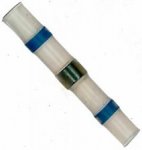
As others have said, a soldered joint covered with heat shrink insulation is probably best. I found these very useful during a recent project:

s-l225.jpg

Search for "heat shrink solder connector" on eBay or Amazon. They work well. The solder will melt with a conventional hot-air gun (set on high) or a gentle flame. Lots of videos on YouTube, e.g.: https://www.youtube.com/watch?v=24FjjIVpk9U
 
Last edited:
I had an intermittent bow light many years ago. Worked fine - except at night at sea.

I found a join in the cable under the headlining carpet in fore cabin. Hardly surprising on an old boat - the bowlight is very exposed after all. The join was a plug block inside a plastic junction box sealed with silicon. And the cable was still green! However the connection was fine.

The ACTUAL problem was only found when I replaced the entire cable. The builders had accidentally put a bronze pin through it. It had worked fine since 1990. Twenty years later it was a solid lump of verdigris. Moral is that on a boat virtually everything conducts! Except when you want it to.

I would only join the cable in cabin.

PS If you're using a multimeter on a boat to check 12v it's really handy to have a bulb on wires to connect across the input. Otherwise you'll measure 12v even with the supply switched off!
 
Thanks all for your suggestions. And starting with the easy bits
- yes it is an LED nav light, hence the thing wires it comes with
- no I can't just start with a longer piece of wire, wish I could, as the connections are embedded in the plastic that surrounds the LED
The AquaSignal light comes with about 1.3m of wire, only, and joining above deck on the pushpit would be a nightmare, so joining just below deck is least bad option.

So looks like the majority consensus is my option (2) to solder and heat shrink.

Arcady's solution sounds a bit like my option (3), using the heat shrink with solder inside it - which sounds slightly easier if it works reliably

Intrigued by Tomahawk's jelly blocks
 
PS If you're using a multimeter on a boat to check 12v it's really handy to have a bulb on wires to connect across the input. Otherwise you'll measure 12v even with the supply switched off!

OK now you have me really confused. Yes I will be using a multimeter, which when I cut through the old wire proved that a full 13-14V was reaching the old failed LED (like breaking an egg to check it, was slightly worrying that after cut wire would find it wasn't the LED after all).

But I can't see how I would get 12V even with the light switch / supply off ?
 
Alan, you could extend the wire before fitting and make the join to the loom in an easier place. I guess Ruffles was referring to no-load voltage vs voltage with current flow. A high resistance joint will allow full voltage open circuit measurement but drops it to near zero if a load is connected.
 
Top