Best waterproof covering for ply

Fantasie 19

Well-Known Member
Joined
23 Mar 2009
Messages
4,591
Location
Chichester, West Sussex
Visit site
I've had a lack of success with west systems epoxy (water is still getting underneath the covering) but I'm happy to accept that may be user error - looking for alternatives as I don't want to have to do it again...

Subject is cockpit locker lids - 9mm ply - what do I cover them with? The weak point seems to be the end grain, so something that soaks in well??

Recommendations, please...
 
Hi, I can only assume you did not seal the end grain well enough - this is important, as gas pressure from the inside of the ply, when it heats up in the sun etc., can cause the bond to fail.

Coat the ply well and give the edge grain multiple coats of straight epoxy without fillers. You have up to 72 hrs between coats to achieve a chemical bond without the need to sand. Do both sides of the ply to give it a complete seal. Make sure the wood is completely dry.

Finally, finish off with glass cloth and a float coat. Paint the lot with a two part system. Epoxy is not UV resistant.

Good luck.
 
Polyester resin, thinned with some acetone for the first coat, so it soaks in better.
Polyester resin has poor bond to wood in comparison to epoxy.

Fibreglassing ply decks and hulls was rather popular once. I have inspected several where you could pull off the sheathing very easily and in long strips.
 
Polyester resin has poor bond to wood in comparison to epoxy.

Fibreglassing ply decks and hulls was rather popular once. I have inspected several where you could pull off the sheathing very easily and in long strips.

Penetrating epoxy is the best resin for protection wood and in particularly plywood.

Polyester resin as said does not adhere to wood in the long term.

Thinner for polyester

acetone for thinning polyester resin?.

https://www.amazon.com/TotalBoat-Pe...rating Epoxy has an,, mildew, and salt damage.
 
Edge with solid timber. You can get 9mm teak wide teak strip from kjhowells.co.uk. You can then paint the face of the ply. IMHO epoxy coating is a waste as properly applied conventional paint (perhaps with Interdeck for the locker lids if seats) is adequate, and Danboline or similar underneath. The weak point is end grain and solid edging glued with epoxy solves the problem. BTW 9mm is rather thin for locker tops, or do they have a framing?
 
I did my samson post this week i used marine plywood and coated all over with west epoxy then a few days afterwards i painted with outdoor teak varnish , fingers crossed this works ok as the wood was rotten before.
 
Edge with solid timber.
This is what I did. I used a hockey stick moulding, flush on top and protruding on the bottom to act as a drip stop, which helps keep the inside of the locker dry.

Be generous with the glue (waterproof - I used Gorilla Glue Original) and sand off the excess and fill any imperfections. I finished it with several coats of le Tonkinois, which gives a high gloss but non-slip finish and has the advantage over ordinary varnish that it doesn't lift and have to be stripped if water gets under it.
 
I did my samson post this week i used marine plywood and coated all over with west epoxy then a few days afterwards i painted with outdoor teak varnish , fingers crossed this works ok as the wood was rotten before.
My pal spent a lot of time on his cockpit coamings for his Elizabethan 29 - West epoxy followed by marine grade varnish to protect from UV. Looked gorgeous when finished but 3 years later is a mess - water has got under the coating. Probably International Woodskin would be better in the long run.
 
Smiths Clear Penetrating Epoxy Sealer, Cold Weather Formula Smiths CPES - Clear Penetrating Epoxy Sealer, UK and Europe Good customer reviews from many in a marine, boat environment.

I used Smith's for exactly the same purpose. It soaks very fas into the ply, very low viscous formula, like water, designed exactly for this purpose, the renovation of wood. I then varnished with Ronseal Satin exterior grade varnish. Smiths claim it is also is good base for the first coat of varnish to stick too. and that was the case, but not sure how much better it is than other sealants or just varnish on wood.

I also edged the end grain with a hard wood moulding bought from B&Q, but finished flush with the top and proud by 3mm with the bottom. The lip on the bottom allows water to break off and drip away, not run under the locker lid sticking to the bottom face, smile flat button, sharp edged, no rounding.

So far holding up well but not a lot of foot traffic lats year, this year, but I do expect the varnish to be touched up and redone in a few years.
 
I agree with the sentiment that West perhaps isn’t the ideal product for this. It doesn’t penetrate as well as others, including solvented epoxy or even some (thinner formulations of) laminating resin.

It does a better job if applied as warm and thin as possible.

Don’t think you can blame West. It’s a fine laminating and repair resin and just tends to be what a lot of us have lying around...
 
We use Bonda G4 thinned down to 50% for any surface that is hidden and then for anything that we are going to varnish or paint.
 
Cheers guys - plenty of food for thought there..

@dankilb Agreed re. West's - I use it all the time and had some lying around, but it is quite a thick consistency and I think penetrative qualities were limited.. user error on my part

I was interested in the CPES but at 57 quid I could afford to buy solid plastic/acrylate... :) Two votes for the G4, so I think I'll go that route...
 
Hardwood edging with no end grain exposed would be a proper job.

But I'd use whatever WEST or SP or whatever epoxy I had.
If you warm up the wood with a hot air gun, the epoxy goes very runny, and as the wood cools, epoxy is drawn into the grain.
As the warmed epoxy sets quicker than the stuff in your pot, you can get several coats on quickly.
Depending on the job, I might heat the work, prime it with epoxy then thicken the remaining epoxy and fill the grain.
I might use tape to stop the epoxy running out of the work.

Another answer might be a layer of glass cloth or tape and epoxy.

Is it to be painted or varnished?

Locker lids can get condensation on the inside, so need to be well sealed all around, otherwise the epoxy is going to get bypassed and is likely a waster of time.
 
Penetrating epoxy is the best resin for protection wood and in particularly plywood.

Polyester resin as said does not adhere to wood in the long term.

Well, that's my 40 year old boat down to Davey Jones then, all of the internal bulkheads and joinery were stuck together with polyester. Anyone want a cheap old Westerly ?
 
  • Haha
Reactions: pvb
Well, that's my 40 year old boat down to Davey Jones then, all of the internal bulkheads and joinery were stuck together with polyester. Anyone want a cheap old Westerly ?


Having had a plywood boat in the UK sheathed in glass and polyester resin that delaminated from the ply inside a year is what I based my comment on.

Th fact he boat westerly is a GRP hull its the adhesion of the bulked and joinery is your concern unlike mine which was the outside hull

Also some others have made the same comment.

Glass Sheathing New wood - Methods?
 
STop and htink about why there are so many accounts of coating failure: they have one thing in common, seperation of the two materials. Water then gets in and finsihes off the ply as it rots out, delaminates etc. Towards the end of the plywood boat era, huge efforts were made to prevent this hapening and to slow or stop failure of the ply. Having been brought up in this era as an impecunious owner of many end of life plywood hulls, I learned a good deal! There was a good reason why polyesyter resin based grp was known as the boat killer. Polyester resin does not stick to wood long term.

Epoxy on new ply is highly succesful. The west system extended plywoods life substantially, but only if applied on new ply. West specified this themselves. On old ply it was very unlikely to succeed, and the key was found to be the moisture content of the ply: West specified a maximum of 15% moisture content, ideally a lot less. It is virtually impossible to dry a ply wood boat to that extent, but even penetrating epoxies will not adhere well if the moisture content is much higher.

So what goes wrong? Quite simply, wood expands and contracts as the moisture content varies. Resins dont. Doesnt matter what kind, it doesnt exapnd and contract with the timber. So quite simply the glue join is subject to huge stresses which cause it to fail. Water ingress compounds the problem, and rot sets in, and that that. Also fresh water encourages rot, so most plywood boats rotted from the top down, as the end grains became exposed, and water is literally sucked in by capillary action. Once in, it is very difficult to dry i out again.

West discovered that as long as they kept the ply wood below 15% moisture content, their system worked, and worked well. Until someone cut a hole and didnt seal the exposed end grains propeely allowing moisture back in.

Tranona's answer is the boat builders way of sealing end grains, particualrly on older ply. it works.

And before someone points out that plywood bulkheads are usually bonded in using polyester, remeber that interior ply is not exposed to weather and seawater, or to direct sunlight. Also it is new ply, with low moisture content, and is not generally exposed. Stresses tend to be compression rather than shearing or pulling, so it survives in a way external plywood structure does not. As long as the GRP is taken above any normal bilge water present it survives.
 
I've had a lack of success with west systems epoxy (water is still getting underneath the covering) but I'm happy to accept that may be user error - looking for alternatives as I don't want to have to do it again...

Subject is cockpit locker lids - 9mm ply - what do I cover them with? The weak point seems to be the end grain, so something that soaks in well??

Recommendations, please...

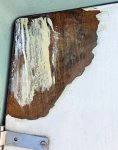
The photo on your blog suggests that you'll have quite a job sorting out your cockpit locker lids...

locker.jpg

... and you've said that you don't want to have to do it again. So I'd suggest a more radical approach - replace the ply lids with recycled plastic board. It's 100% waterproof, can be worked and shaped like ply, is strong, and will last for decades. You'd need to paint it to match, but I reckon it'd be a once-and-for-all solution. If you Google for recycled plastic board 9mm you'll find some suitable products.
 
Top