Best Value For Money New Generation Anchor

Interesting how everyone knocks the CQR but its still used today, 80/90 years after it was introduced, used by Kim Novak till recently (in places many here will never visit). Used on Sunstone on a Pacific Ocean circuit. Yes - there are better - but some people find it reliable and have other things on which to spend their money. Also interesting the times a Fortress is knocked - they have sold over 600,000 units - yet people here swear its unreliable. Brittany are common on bow rollers in the Med, and we have 3 or 4 on yachts near our mooring - and there is no distributor here (confess - I've never used a Britany - so cannot comment other than observing how common they are).

Its difficult to believe the trolling in the face of the shear volume of evidence.

If these anchors were the disaster implied they would have died like the XYZ or the Hydro Bubble.

I was always quite happy with our CQR I have a Bruce which came with the boat.

I haven’t read the 26 pages.
I would say the best value for money anchor a available is a used CQR
 
Last edited:
If you use an elastic, or more elastic, rode then some of the tension is stretching the rode, not setting the anchor. In the same way some people set their anchor with snubber attached - you are wasting engine power. By all means use a chain lock when you power set - don't use an elastic snubber.

That's true while the rode or snubber is in the process of stretching and absorbing energy, but for a static load (as in the case under reverse engine power held for a few seconds) once there is no more stretching going on, the force at the anchor will be the same as the force at the boat end of the line. The way that stretchy rodes reduce force at anchors by stretching only works when the force applied to the rode is released before the rode has reached its stretch level for that force, i.e. dynamic loads typical from a pitching boat in a sea. I expect anchor tests with load gauges are done with static loads, so the rode stretch has no effect on the outcome.
 
That's true while the rode or snubber is in the process of stretching and absorbing energy, but for a static load (as in the case under reverse engine power held for a few seconds) once there is no more stretching going on, the force at the anchor will be the same as the force at the boat end of the line. The way that stretchy rodes reduce force at anchors by stretching only works when the force applied to the rode is released before the rode has reached its stretch level for that force, i.e. dynamic loads typical from a pitching boat in a sea. I expect anchor tests with load gauges are done with static loads, so the rode stretch has no effect on the outcome.

Most people I see power setting, and they are a minority, do so 'momentarily' not a sustained set.

Anchor tests are commonly conducted with a short length of the appropriately sized chain and then wire or less commonly dyneema (and a load cell). Wire is common because its easier to handle, most work boats have a wire drum winch and handling chain frequently (if you are testing a few anchors) is hard work.

Jonathan
 
Most people I see power setting, and they are a minority, do so 'momentarily' not a sustained set.

Anchor tests are commonly conducted with a short length of the appropriately sized chain and then wire or less commonly dyneema (and a load cell). Wire is common because its easier to handle, most work boats have a wire drum winch and handling chain frequently (if you are testing a few anchors) is hard work.

Jonathan
What is the difference betwwen momemtarily and sustained?
We always power set our anchor once we have set the snubber. I give the engine low rpm to stretch out the chain. Once its pulled in a straight line, I increase the revs slowly until with a transit I can see we are not moving and the SOG is zero. I then increase the revs slowly to set the anchor. I would be close to full revs for a second or two and if we havent moved, we are set. The whole power setting probably only takes a minute or so but the anchor is properly set.
We use a spade by the way, we have found it to be an excellent anchor
 
Angus has described the physics behind the snubber correctly.

Using a snubber when setting the anchor is fine. The best way to think about the snubber is that it will average out the short term high and low peak loads. This is usually helpful when setting the anchor, especially in the early stages, but it makes little practical difference in most situations.

However, if you do not use a snubber when setting I would suggest at least using another means of removing the load from the anchor winch during the setting process, particularly if there is any waves/swell.
 
Last edited:
I give the engine low rpm to stretch out the chain. Once its pulled in a straight line, I increase the revs slowly until with a transit I can see we are not moving and the SOG is zero. I then increase the revs slowly to set the anchor. I would be close to full revs for a second or two and if we havent moved, we are set. The whole power setting probably only takes a minute or so but the anchor is properly set.

Do you go through the same routine every time the tide changes?

(I do the same, of course. But surely the most important thing is that the anchor is reliable at re-setting itself on turn of tide. You and I use a NG anchor that is good at this - although nothing's certain. But it always amazes me how some sailors go through a routine to set their anchor under power, thinking it can't be relied on unless they do, and then don't give it a second thought when the tide is pushing them the other way.)
 
Most people I see power setting, and they are a minority, do so 'momentarily' not a sustained set.

Anchor tests are commonly conducted with a short length of the appropriately sized chain and then wire or less commonly dyneema (and a load cell). Wire is common because its easier to handle, most work boats have a wire drum winch and handling chain frequently (if you are testing a few anchors) is hard work.

Jonathan

I hear you, but I can't understand that behavior.

First, when powersetting an anchor you would obviously back down just above idle first, to get the slack out of the system. Then you would trottle up, waiting a few more seconds for the catenary and the snubber stretch to stabilize. This will only be a few seconds. Then, if the person had EVER pushed something into mud or sand, it would be obvious that the push must continue for at least 10 seconds. Thus, the time to stretch the snubber is irrelevant.

But I've witnessed the same behavior and I've watched folks plow needless furrows in the harbor as well.
 
Do you go through the same routine every time the tide changes?

If you set an anchor and it is in a reasonable substrate, it will invariably respond to a change in direction by "shuffling". The ability to shuffle well is an important property and is dependent on the anchor type. Some models (for example the Danforth pattern, in my view) rotate poorly and are more likely to break out.

During this shuffling process the anchor should stay buried and gradually rotate around to the new orientation. It does not normally break out, or move, other than rotating, although most anchors develop a list so the holding is not quite as secure during the rotation process.

Thus, once set, there is no need to reset the anchor with a change in the direction of force. The anchor will stay in the same place and remain buried.

With a simple tidal change the force (without much wind) is often not enough to even do this, and typically the anchor will stay in the same orientation even though the boat and chain have moved to the other side of the swinging circle.
 
Last edited:
All this talk of "setting" anchors using engines - should this not be in the Motorboat forum. Some of us have sailing boats, and anchor under sail. :rolleyes:
 
There are 2 types of action causing a change in tension direction.

The first is simply veering or shearing of the wind in an anchorage causing the yacht to constantly alter its orientation. The average direction might not change. This veer is caused by both the yacht characteristics and the anchorage, some anchorages are more prone to bullets - its counterintuitive but 'sheltered' anchorage can be more prone to bullets. You do not want the anchor to move, at all - but if you dive on your anchor and touch any exposed part you will feel it twitching, if the chain is off the seabed - and a moving (twitching) anchor reduces shear strength and hold.

The more chain that is buried - the less twitching. Most good modern anchors bury chain and fluke simultaneously - so by design or chance their burial of chain reduces twitching and maintains hold. Anchors that do not bury chain do not have this advantage. Consider also the chain is moving both vertically, as the yacht horses, and side to side, as it yaws. Good snubbers will reduce/dampen any chain movement (the snubber will stretch rather than the chain moving).

But these movements are continuous, every second (I exaggerate), every minute the chain is moving.

The second movement is when the anchor shifts because the dominant wind directing shifts and in this case commonly the wind shift is over a finite period of time and most anchors will react - unless the anchor is very deepset.

This change will commonly take a long time, seldom minutes, maybe hours - plenty of time for the anchor to move one or 3 degrees at a time.

An anchor that shuffles to a change of dominant wind direction 'easily' is one that will also be constantly moving to veers (even though the dominant wind direction remains constant) and will thus have less than ideal hold - so a contradiction.

A well set, power set, anchor will commonly be set to a tension higher than being exposed to 30 knot gusts - and it should not move (until wind is in excess of 30 knots) - but if it is shallow set and constantly twitching its hold will have been diminished - and hold at an angle is but a shadow of direct line hold.

One reason Danforth and Fortress do not change direction easily is because they can be very deep set, in fact so deep set the wind can reverse and they will not move. One complaint of these anchors is that after strong wind events they can be very difficult to retrieve (also a complaint of good modern anchors - that time needed to wait patiently for the anchor to release with the scope at 1:1).

Really you cannot have your cake and eat it - your anchor sets and holds tenaciously (and then it might not turn with wind shifts) or your anchor turns with the wind (and worse every little yaw of your yacht) and will not have as high a hold as the tenacious anchor.

To me an anchor that shuffles easily is a poor anchor - I want my anchors to hold and only move when the winds are over 30 knots - but then I want them to move, stay set and dive more deeply and dive more deeply, steeply and in a short distance.

Work has been done on 'turning of anchors' (though sadly the work has not received much attention) the effects of long term wind shifts, and certainly shallow (flat) set flukes will turn easily. Spade, Kobra, Excel all of which have protruding ballast chambers and weight concentrated in the toe seem to turn most easily when deep set AND remain deep set (whether this is an effect of the protruding ballast chamber or the weight in the toe - don't know). Rocna and Supreme tend to list and Bruce are not very good, they roll onto their side too easily.

Any anchor that moves easily/frequently has every opportunity to catch something in the toe (even if the anchor stays buried) - and then you have the classic dragging situation.

Yawing of a yacht should be minimised, setting 2 anchors is an easy way, riding sails another, hammerlocks (?) - dropping an anchor so it it only drags on the surface - works well. Shoreline are obvious. Reliance on one anchor when your yacht is being beaten through 90 upto 180 degree bullets - is a recipe for a sleepless night. But this is a whole new thread.

Anchors are a compromise - do not forget it.

There is no perfect anchor.

Jonathan
 
An anchor that shuffles to a change of dominant wind direction 'easily' is one that will also be constantly moving to veers (even though the dominant wind direction remains constant) and will thus have less than ideal hold - so a contradiction.

You want an anchor that shuffles well, not easily.

The difference between anchors that shuffle well and ones that shuffle poorly is very obvious if you watch the anchors underwater. An anchor that shuffles well will remain buried with a minimum list and good grip on the substrate throughout the change.

Those that shuffle poorly develop a high list and lose a lot of grip during the rotation. Often the anchor will dig in again when the new direction of pull is established and the skipper is unaware of the underwater behaviour. However, this type of rotation is less secure. With a gust at the wrong time the anchor will break out completely and once moving an anchor has a hard time setting again.

In my opinion, anchors like the Danforth and Fortress rotate less well than most other designs and you should use some caution if a change in the direction of pull is expected. In my experience, the Rocna shuffles very well, better than the convex plow anchors, but I agree the steel Spade is also a good performer in this regard.

A yacht yawing back and forth at anchor will typically not produce any rotation of a reasonably set anchor. So even an anchor that shuffles poorly such as, in my view, the Danforth pattern anchors, will not have any chance to develop a high list.

It is only with a sustained direction change that the anchor will start to rotate and even then it takes some time for rotation to occur.

Anchors are a compromise - do not forget it.

But some are more of a compromise than others :).
 
All this talk of "setting" anchors using engines - should this not be in the Motorboat forum. Some of us have sailing boats, and anchor under sail. :rolleyes:

Its a dying art, and one (I confess) I do not practice. However I do like to see people coming into an anchorage and anchoring under sail. Those who are slick are impressive - getting it wrong means I simply drink more wine as I'm being entertained.

Jonathan
 
You want an anchor that shuffles well, not easily.


Those that shuffle poorly develop a high list and lose a lot of grip during the rotation. Often the anchor will dig in again when the new direction of pull is established and the skipper is unaware of the underwater behaviour. .

Very true - but as long as it consistently re-sets - it really does not matter. Obviously if its is full of mud and weed - it will not reset, until the fluke clears (which it might not do - hence Morgans Cloud assessments and the yachts on beaches, with their anchors still clogged.)

Ignorance is bliss - as those who use anchors with shallow setting angles are good examples. Interestingly the best example of this - the developers acknowledge the weakness in private, but do point out they had prioritised hard seabeds. The compromise is shallow set, long distance (relative) to gain hold, good ability to turn in a wind shift (because they are in the upper substrate) and the need for a bigger anchor (than other designs) to cope with (even overnight) or storm conditions. Some owners are so unsure they go even bigger - to twice the size, quite amazing. Sadly - it will still be the same hold as a smaller anchor - no magic with anchors, except in the imagination. But if you believe that a bigger anchor will develop more hold than a smaller one - maybe you sleep better and that bliss is arguably good - but its a false sense of security with not an iota of basis. The hold is the tension on the rode from windage of the yacht or engine power - no more, no less (big or small - as long as of a still sufficient size).

Jonathan
 
Last edited:
Here are 3 very popular anchorages with not a lot of swinging room, and where the wind can blow a hooligan. ( totally inverting a Dragonfly 8m. tri anchored in the second )

I'm interested in which, where and how the assembled panel would deploy anchor(s) in each.


39080705070_711497a840_z.jpg


27019836688_bbb0a1268b_z.jpg


39080705810_4ae218b47f.jpg
 
Last edited:
I find conversation about "this anchor is great at short scope" funny, since unless some one can suggest magic rules of soil mechanics... they all perform about the same when the angles are the same (I over simplified that just a bit, but only as relates to plows and claws).

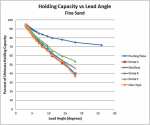
Without naming names, Scope A, B, and C are new gen anchors that we have been talking about, tested in sizes from 2-45 pounds. Notice the striking similarity. Mud was very similar, with a slightly different slope. The stockless data is 500-4000 pounds. Pivoting fluke is different because the angles are quite different.

The basic problem is this; soil can only resist so much up lift. To some point, the anchor can keep digging deeper, but depending on the angles, that trend stops at short scope. Then, they can only resist what soil cohesion and friction provide. That's it. Chain helps up to a certain windspeed, depending on scope and depth; whether heavy chain or 25% more anchor is better is an endless debate. Are we better off with a smaller anchor that is deeply set or a large anchor that is lightly set? That probably depends in part on the anchor design; is the anchor very large and allowed to just shuffle (Mantus?), or is it anchor anchor that goes deep (Fortress?)? We can play with optimizing an anchors ability to reset and deal with difficult bottoms. But there is a basic geometry that is seemingly impossible to fight; shallow angles set and re-set well, and steep angles hold better, particularly at reduced scope.

But we can't fool the math at short scope with cool curves or the next generation.

Interesting stuff. You would have thought this would have been perfected 150 years ago, but apparently not.

p1bt58cej11icc18bk11ve1dip1p35f.png
 
Last edited:
Thinwater

The first lesson is that anchoring is an art and trying to quantify performance is totally unnecessary and may further complicate an already difficult topic.

I think you already are well aware that you are better with a big anchor as it is a well known fact that they will develop more hold than a smaller one - it stands to reason. I assume the same magic applies at short scope but, you, as an agnostic the magic will not work for you. Again it is a well known fact that at short scope a large anchor, in fact its the self same magic, will have a better hold than a small anchor - and this is the very reason so many buy bigger anchors. As true believers the magic works for them.

Worse you are even so fanatical to suggest shallow set anchors might have a lower hold at short scope. Such fanaticism will not be tolerated - and you data must be suspect.

I think you worship to the wrong religion and attempts will be made to have you banished to the nether regions until you mend your ways and can learn and preach truth according to the various established muse. Fortunately YBW tolerates lack of true religion and you should be safe from banishment.

Sorry to be the bearer of such sad news.

Jonathan
 
Top