Best material for deck pad under electric windlass?

R.Ems

Well-Known Member
Joined
1 Apr 2022
Messages
354
Visit site
I'm fitting a Lofrans Tigres. It needs a pad under it, as apart from anything else, the deck is curved so water runs to the scuppers, but the winch bottom is flat.
The deck is traditional laid pitchpine planks, covered in plywood with a layer of glass fibre sheathing over the top.
The structure will be reinforced below, with the windlass bolts going through heavy timbers.
I was thinking of making something out of hardwood, which I could do myself. (That's what was previously used, under the old manual windlass.)
Bronze would be ideal, but out of the question.

But I have read about new materials, like the sort used in chopping boards etc, being used in this application. Apparently the stuff lasts for ever?
I presume the stuff can't be glued to laminate it. Can it be bought in 50mm thckness, a foot square, for example?
Cheers for your opinions, specially if you've done it yourself.
 
Sounds like you have a substantial deck already with planks+plywood&fiberglass. I would just laminate a few layers of CSM/Polyester below if you even need it?
 
Chopping boards are made from a thermoplastic, UHMWP or something similar. This means that they will deform over time under load, known as creep. So not really ideal for this sort of use, although cheap and convenient. I have several chopping boards in the kitchen and not one of them has remained flat.

My windlass is mounted on half of the anchor locker lid, with heavy plywood beneath 20 mm thick. It has been like this for many years, no deterioration. Windlass installation
 
Sounds like you have a substantial deck already with planks+plywood&fiberglass. I would just laminate a few layers of CSM/Polyester below if you even need it?

I agree with LoneHort. I'd lay up half a dozen layers of Polyester resin/CSM over a suitably curved sheet of metal.

Why don't you go to a Plastics Fabricator (maybe Signmaker) and go through their recycle bin?
 
My Lofrans Kobra on a sheathed ply deck is mounted on a teak block with sealant. The attraction of the plastic pad is as a replacement for the rubber pad used by Lofrans for mounting on GRP as a cushion. It holds water and causes corrosion so replacing it with plastic bedded in sealer is a common alternative. However in your situation (like mine) totally unnecessary and standard mounting on a flat wooden base with sealant (non setting such as polysulphide) is fine.
 
My Lofrans Kobra on a sheathed ply deck is mounted on a teak block with sealant. The attraction of the plastic pad is as a replacement for the rubber pad used by Lofrans for mounting on GRP as a cushion. It holds water and causes corrosion so replacing it with plastic bedded in sealer is a common alternative. However in your situation (like mine) totally unnecessary and standard mounting on a flat wooden base with sealant (non setting such as polysulphide) is fine.
Cheers, time for me find some nice hardwood!
 
Do as Coopec has suggested, go to a plastic fabricator, they make spatulas for the food industry, using Polypropylene and Nylon, you can get this 50mm thick, it will not distort and last a lifetime, see what offcuts they have, i replaced all the winches and cleats on a Vega, plus an outboard pad using this stuff (Polypropylene) fix and forget.
 
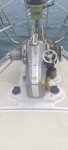
Our Lofrans Falkon sits on a teak pad on top of the deck. The teak was glassed over, filled and faired then sprayed with Awlgrip. The foot switches also sit on the pad. The raised pad helps to keep the underside of the windlass dry. Our old one rotted out due to being sat on wood for its whole lifereceived_2116652528498734.jpeg
 
Our Lofrans Falkon sits on a teak pad on top of the deck. The teak was glassed over, filled and faired then sprayed with Awlgrip. The foot switches also sit on the pad. The raised pad helps to keep the underside of the windlass dry. Our old one rotted out due to being sat on wood for its whole lifeView attachment 134290
That's a very neat installation. I was pondering where to put the foot switches...
 
Consider fitting a wireless remote rather than foot switches.
Yes it sounds a good idea, but also, like other little plastic gadgets, it could easily get smashed, lost, trodden on, flat battery etc etc. But avoids a couple of holes where you don't want them.
I am also looking at industrial hoist controls which are cheap and could plug in to a socket, but all the ones I have found through casual websearching seem to be rated for 5A @ 240v AC, while the Lofrans ones are rated 5A at 12v DC, a different kettle of fish.
I also have the little Lofrans up/down switch panel to mount in the cockpit area.
Cheers everybody this is all very helpful. Decisions decisions..
Pic added to show hoist control, with inadequate current rating though.F395113F-B705-4FB9-BE2E-4D0EEC0EAD61.jpeg
 
Last edited:
Don’t forget that you are switching the solenoid not the load, the current will be mA not Amps. We have switch at helm and cheap remote that is used at bow, has worked perfectly for last 5 years
 
Don’t forget that you are switching the solenoid not the load, the current will be mA not Amps. We have switch at helm and cheap remote that is used at bow, has worked perfectly for last 5 years
I have just checked, the Lofrans leaflet states their supplied foot buttons are rated at 4A at 12v DC.
I would be curious to see foot buttons for 150 amps...
 
I have never used foot switches simply because neither of my 2 previous boats had them fitted as they did not suit the layout of the foredeck and the anchor locker. The windlass on both was below the level of the deck on a platform in the anchor locker. This layout lends itself to a handheld control, either wired or wireless. once I had wireless I never used the wired one. My latest boat has foot switches and will see how I get on as the layout is different with the anchor on a roller on a short bowsprit.
 
I have never used foot switches simply because neither of my 2 previous boats had them fitted as they did not suit the layout of the foredeck and the anchor locker. The windlass on both was below the level of the deck on a platform in the anchor locker. This layout lends itself to a handheld control, either wired or wireless. once I had wireless I never used the wired one. My latest boat has foot switches and will see how I get on as the layout is different with the anchor on a roller on a short bowsprit.
Possibly dumb question: What happens if the person in the cockpit presses the up button, and the foredeck person pushes the down button at the same time?
 
Top