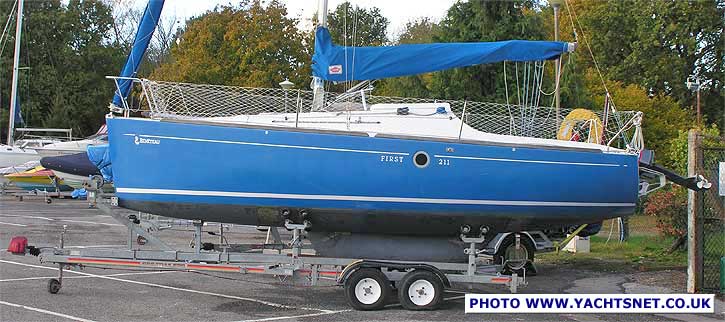
Beneteau First 211

Witchwood

Member
Joined
31 Jul 2009
Messages
37
Visit site
Does anyone know whether a 211 will sit happily on a sandbank on a drying mooring unaided, or would it need drying legs?

 
As the 211 has a swing keel, it should sit happily unaided.

This is taken from a Beneteau archive:-

"The hull of the Beneteau First 211 is solid GRP, with sandwich construction for the deck moulding. There is foam buoyancy at bow and stern, guaranteeing unsinkability. The ballasted drop keel is raised by by a manual jack, and allows easy transport of the boat as well as drying out if required, supported level by the twin rudders."
 
Last edited:
Definitely needs legs as it has a stub keel. Rudders are not suitable for supporting it.

first-211-trailer.jpg
 
Last edited:
As the 211 has a swing keel, it should sit happily unaided.

This is taken from a Beneteau archive:-

"The hull of the Beneteau First 211 is solid GRP, with sandwich construction for the deck moulding. There is foam buoyancy at bow and stern, guaranteeing unsinkability. The ballasted drop keel is raised by by a manual jack, and allows easy transport of the boat as well as drying out if required, supported level by the twin rudders."


Despite the above the rudders dont look very substantial in terms of supporting the boat and for the later versions such as the 21.7 drying legs are a factory option.
 
Definitely needs legs as it has a stub keel. Rudders are not suitable for supporting it.

first-211-trailer.jpg

Yes, it definitely needs legs. It doesn’t have a stub keel as such, but the raised keel lies along (and parallel to) the underside of the hull; it doesn’t retract into the hull as other lift-keelers do. The draft with keel raised is just under a metre, so if you don’t use legs (and I have seen this done in France), it will dry out at a steep angle.

The thing is that, because of the keel lying under the hull, the legs are relatively long, about 5 feet I would guess (I’ll measure them for you when I get home if you would like), and this means that there can be quite big leverage forces on them if the boat dries out (or lifts off) if there is any swell, or any cross-current or cross wind. Being inside the boat at such times is quite alarming, with an unholy medley of graunching, squeaking and banging noises.

That being said, however, the design must be stronger that I think it is, because you do see them left to dry out in relatively exposed locations, as Lakesailor says, without suffering any apparent damage.

So, using legs, would I leave mine on a drying mooring on a sandbank..? I guess that would depend on how sheltered the location is. If I could be confident that it wouldn’t suffer any swell or tide/current then I guess I might. But I’d rather not!!

Edit - here is a picture of a First 211 on legs: http://www.google.co.uk/imgres?q=be...page=5&tbnh=189&tbnw=257&ndsp=26&tx=110&ty=78
 
Last edited:
Thanks for all your thoughts. My feeling was that legs would be needed. I've been looking at 211's and Etap 21's (tandom keel) and they actually draw the same depth (with the 211's keel raised). I agree that relying on the rudders to balance the boat is asking a bit much of either boat, particularly on an exposed mooring such as mine (on the Exe). Perhaps the Jeanneau Sun 2000 would cope better, but it's not completely to my liking. Time to look for a deeper water mooring, I think.
 
Top